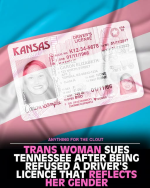
A transgender woman has a birth certificate identifying her as female.
Her passport identifies her as female, too.
But when she asked Tennessee to update her driver's license to match, officials refused.
Now she's taking the state to court.
The woman, identified only as Jane Doe to protect her privacy, lives in Knox County, Tennessee.
In June 2026, she legally amended her birth certificate in Illinois, the state where she was born, to reflect her sex as female.
She then visited a Tennessee driver's license office, expecting to update the document she uses in everyday life.
Instead, she was told that state law prohibited the change.
The refusal has become the center of a new lawsuit against Tennessee Governor Bill Lee and Department of Safety and Homeland Security Commissioner Jeff Long.
And the case raises a question about what happens when two states recognize someone's identity differently.
In 2023, Tennessee adopted a law defining sex in state statutes according to anatomy and genetics at birth.
The state subsequently implemented a policy preventing transgender residents from changing the sex designation on their driver's licenses to match their gender identity.
But Doe argues that Tennessee's refusal to recognize her amended Illinois birth certificate violates her constitutional rights.
Her lawsuit cites the Fourteenth Amendment, which addresses due process and equal protection.
It also invokes the Constitution's Full Faith and Credit Clause, concerning recognition of official acts and records between states.
The state has not been found to have violated those provisions in this case.
That is what the court will have to determine.
For Doe, however, the dispute isn't simply about a letter printed on a plastic card.
According to her complaint, carrying identification that doesn't match her other documents can reveal her transgender status to strangers.
She says that unwanted disclosure exposes her to potential discrimination, harassment, and violence.
And driver's licenses are used for far more than driving.
People show them when applying for jobs, checking into hotels, making purchases, and completing everyday transactions.
Doe says she uses her passport as identification whenever possible.
But she cannot always avoid situations where her Tennessee license is requested.
Her case also joins an existing legal dispute over the state's identification rules, which transgender residents have challenged since 2024.
For now, the outcome remains uncertain.
The lawsuit asks the court to consider whether Tennessee can refuse a change already reflected in an official document issued by another state.
And for the woman bringing the case, the stakes are personal.
She wants her everyday identification to reflect the woman she is, without having to explain her private history each time someone asks to see her license.
SOURCE with comments