What to call this thread?

The average cost of breast augmentation with implants is $4,875 and the average cost of breast augmentation with fat grafting is $5,719, according to the latest statistics from the American Society of Plastic Surgeons. This average cost is only part of the total price – it does not include anesthesia, operating room facilities or other related expenses.

 
breast implants $4,875 #2,062
- fine -
BUT !
Bionic boobies may require back support.

This guy charges $12.50 / hr.

proxy-image


“Happy people don't have the best of everything. They make the best of everything. Be happy first." Neil Pasricha / quotefancy.com

Ladies: if your man doesn't like your boobs, you have 3 boobs.
 
1792420305392.png

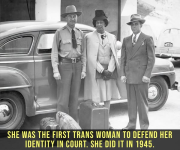
One night during Prohibition, the sheriff arrested Oxnard, California's favorite hostess for selling liquor. The town's leading banker bailed her out almost immediately. He had a big dinner party coming up, and she was cooking it.

That was Lucy Hicks Anderson's Oxnard. She ran a brothel, poured illegal booze, and still got invited into the best homes in town, usually through the kitchen door with a tray in her hands.

Anderson was born in Waddy, Kentucky, in 1886. From the time she could talk, she insisted she was a girl. Her worried mother took her to a doctor, and his advice was remarkable for the 1890s: let the child live as a girl. Her mother listened. Lucy wore dresses to school and went by the name she'd picked for herself.

She left school at 15 to work as a domestic. Around 20, she headed west to a hotel job in Pecos, Texas. In 1920, she married Clarence Hicks in Silver City, New Mexico, and the couple settled in Oxnard.

Oxnard was segregated. Anderson made friends across the color line anyway. She worked as a cook and a nanny, won awards for her cooking, and catered parties for the town's wealthy families. Church newcomers got welcome dinners. Soldiers shipping out got send-offs. Meanwhile, she saved her money, bought a ....

CONTINUED with comments
 
1792436266384.png

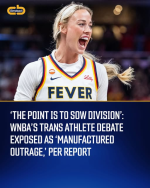
The debate over transgender athletes took over much of the conversation around the WNBA this summer, after Indiana Fever guard Sophie Cunningham took a high-profile stance on the issue, even though the league has never had a transgender woman in the league.

Now, a new report has found that much of that discourse was driven by a small number of viral posts from accounts with a financial incentive to stir up anger, and plenty of people say they saw it coming from a mile away.

The controversy kicked off in July, when Indiana Fever guard Sophie Cunningham told ESPN that she wanted “to protect young girls in a locker room, or young girls in sport who shouldn’t have to go against biological men.”

From there, groups opposed to transgender women in women’s sports rallied around Cunningham at Fever games. Former NBA player Enes Kanter even declared for the 2027 WNBA Draft in what was widely seen as a publicity stunt.

But according to an exclusive report from CT Jones of Rolling Stone, the online conversation was nowhere near as widespread as it seemed.

The data analytics company GUDEA analyzed 188,631 posts about the topic from July 20 to Aug. 12, and nearly 99% of them were on X. The firm found that only a handful of posts ever got more than 3,000 retweets.

“If you take out the eight top posts, this [narrative] didn’t happen. Nobody would be talking about this,” GUDEA founder Keith Presley told Rolling Stone.

GUDEA’s director of client experience Georgia Paul argued that the conversation was dominated by influencers and pundits looking to profit off of engagement.

“You’re going to make money in these divisive ways because you’re tugging at real-world conversations. Anger has turned into dollars for other people. The point is to sow division,” Paul said.

Needless to say, most people were not surprised by these findings.
 
1792928091513.png

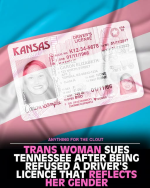
A transgender woman has a birth certificate identifying her as female.

Her passport identifies her as female, too.

But when she asked Tennessee to update her driver's license to match, officials refused.

Now she's taking the state to court.

The woman, identified only as Jane Doe to protect her privacy, lives in Knox County, Tennessee.

In June 2026, she legally amended her birth certificate in Illinois, the state where she was born, to reflect her sex as female.

She then visited a Tennessee driver's license office, expecting to update the document she uses in everyday life.

Instead, she was told that state law prohibited the change.

The refusal has become the center of a new lawsuit against Tennessee Governor Bill Lee and Department of Safety and Homeland Security Commissioner Jeff Long.

And the case raises a question about what happens when two states recognize someone's identity differently.

In 2023, Tennessee adopted a law defining sex in state statutes according to anatomy and genetics at birth.

The state subsequently implemented a policy preventing transgender residents from changing the sex designation on their driver's licenses to match their gender identity.

But Doe argues that Tennessee's refusal to recognize her amended Illinois birth certificate violates her constitutional rights.

Her lawsuit cites the Fourteenth Amendment, which addresses due process and equal protection.

It also invokes the Constitution's Full Faith and Credit Clause, concerning recognition of official acts and records between states.

The state has not been found to have violated those provisions in this case.

That is what the court will have to determine.

For Doe, however, the dispute isn't simply about a letter printed on a plastic card.

According to her complaint, carrying identification that doesn't match her other documents can reveal her transgender status to strangers.

She says that unwanted disclosure exposes her to potential discrimination, harassment, and violence.

And driver's licenses are used for far more than driving.

People show them when applying for jobs, checking into hotels, making purchases, and completing everyday transactions.

Doe says she uses her passport as identification whenever possible.

But she cannot always avoid situations where her Tennessee license is requested.

Her case also joins an existing legal dispute over the state's identification rules, which transgender residents have challenged since 2024.

For now, the outcome remains uncertain.

The lawsuit asks the court to consider whether Tennessee can refuse a change already reflected in an official document issued by another state.

And for the woman bringing the case, the stakes are personal.

She wants her everyday identification to reflect the woman she is, without having to explain her private history each time someone asks to see her license.

SOURCE with comments

1792928261342.png
 
1792956394688.png

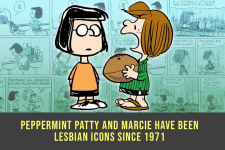
Charles Schulz based Peppermint Patty on his favorite cousin, Patricia Swanson. He based Marcie, the bookish best friend who calls her "sir," on Swanson's roommate, Elise Gallaway.

Lesbians noticed long before anyone told them.

Peppermint Patty first barreled into "Peanuts" on August 22, 1966. Schulz later said he created her in response to the women's movement. He wanted a girl who broke the rules about what girls were supposed to be, and he delivered.

In a strip where nearly every girl wore a dress, Patty wore a T-shirt, shorts, and sandals. She played every sport and beat the boys at all of them. She called Charlie Brown "Chuck," bossed around her baseball team, and was raised by a single dad who gave her the sandals she refused to give up.

She also got a D-minus on just about everything, and Schulz played that for laughs. She wasn't polished, and she wasn't trying to be.

Then, on July 20, 1971, Marcie showed up. She was quiet, nearsighted, and brilliant, and from her first line in the strip, she called Patty "sir." Patty told her to knock it off. Marcie kept doing it, and eventually Patty stopped complaining. The two became inseparable for the rest of the strip's run.

For a generation of tomboys and baby dykes reading the Sunday funnies, Peppermint Patty was the first character who looked like them. She was the girl who'd rather be on the field than in a dress, who didn't fit in, and who didn't seem to care. Marcie, quietly devoted and always by her side, completed the picture.

As lesbian groups began claiming Patty as one of their own, Schulz got cagey. He downplayed the fact that the character was based on his cousin, a move his biographer described as protecting Swanson's privacy. When fans asked about the pair directly, Schulz generally brushed it off. In his view, they were kids.

The jokes never stopped anyway. For decades, Patty and Marcie have been a running gag on sketch comedy and animated shows, usually with a wink about what "sir" really meant. The joke landed because everybody already got it.

Schulz died in 2000, and the strip ended with him. The characters didn't. In 2022, Apple TV+ released a Peanuts Mother's Day special built around Peppermint Patty, who doesn't have a mom. Marcie comforts her by reminding her that families come in all kinds. "Some kids even have two moms," Marcie says.

It was the first time the franchise had acknowledged same-sex parents. Conservative outlets were outraged. Lesbians who'd been reading between the panels since the Nixon administration were not surprised.

Schulz never said Patty and Marcie were in love, and nobody can say it for him. Not every icon needs her creator's permission, though. Peppermint Patty was a tough, tomboyish girl in sandals with a devoted best friend, and queer readers recognized her immediately.

They've been calling her "sir" ever since.

SOURCE with comments

 
Back
Top