Food

sear

Administrator
Staff member

In Texas cattle country, ranchers brace for flesh-eating screwworms​

By Heather Schlitz, Cassandra Garrison and Elida Moreno / August 15, 20255:00 AM GMT-5
LIVE OAK COUNTY, TEXAS; TAPACHULA, MEXICO; PANAMA CITY -

Ranchers in central Mexico are discovering the dreaded fly’s maggots burrowed in their cattle for the first time in a generation, and a factory in Panama is losing a race against time to breed sterile flies, the most powerful tool to quell an outbreak.
Today, the parasitic flies are pushing northward from Central America again after being officially eradicated from the U.S. in 1966, threatening $1.8 billion in damage to Texas’ economy alone, according to a U.S. Department of Agriculture estimate. An outbreak could further elevate record-high beef prices by keeping more calves out of the U.S. cattle supply. ...
Despite stepped-up efforts, there are not enough sterile flies to stop them. ...

He was only eight years old in 1973, but fifth-generation Texas rancher Kip Dove remembers spending countless days trotting up to sick and dying cattle on horseback that year during the last major outbreak of flesh-eating screwworm. He carried a bottle of foul-smelling, tar-like medicine in his saddlebag and a holstered revolver to shoot any animals too far gone to treat.

The attempt to suppress this outbreak by releasing sterile flies to crash their population has failed.

It's "supply & demand". As the ratio of available food diminishes in proportion to the consuming public, the price of food increases proportionally.


🧁
 

The Vitamin Verdict​

The researchers concluded that multivitamins don’t reduce the risk for heart disease, cancer, cognitive decline (such as memory loss and slowed-down thinking) or an early death.
They also noted that in prior studies, vitamin E and beta-carotene supplements appear to be harmful, especially at high doses.

“Pills are not a shortcut to better health and the prevention of chronic diseases,” says Larry Appel, M.D., director of the Johns Hopkins Welch Center for Prevention, Epidemiology and Clinical Research.

Alright.
So it's better to obtain all the required nutrients from a naturally, nutritionally complete diet.
And for those of us that have more to do each day than shop for fresh fruits and vegetables?

Reference Guide: Daily Values for Nutrients

If a patient catches cold, and takes a few grams of Vitamin C by tablet, the benefit is placebo ? But if by citrus fruit, genuine nutritional benefit?

hmmm
 
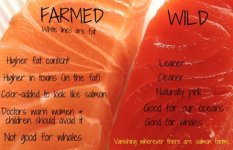
Salmon01s.JPG

There's multiple reasons for vegetarianism.
Among them, the ethics of killing a wild animal.
Is it less unethical to kill / eat an animal that is artificially cultivated, farmed specifically as food?

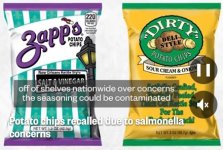
PC01.JPG

Oh!
I recall potato chips.
 
2.5 billion meals worth of unspoiled food is thrown away each year
California's Assembly Bill 660 completely bans consumer-facing "sell-by" dates on packaged foods to stop households from prematurely throwing away good grocery items.
Food manufacturers must adopt a uniform system, using "BEST if Used by" strictly for peak product quality and "USE by" for public food safety. https://www.foxla.com/news/california-ab-660-food-date-labeling-law

California Food Date Labeling​

Starting July 1, 2026, this bill prohibits the sale of any food item (except eggs and infant formula) for human consumption in California that is not labeled for quality using the terms "best if used by" or "best if frozen by" or labeled for food safety using the terms "use by" or "use or freeze by." Also starting July 1, 2026, this bill prohibits the use of consumer-facing "sell by" dates, alternatively allowing coded "sell by" dates that retain stock rotation information for retailers while eliminating the source of consumer confusion that results in the disposal of wholesome, nutritious food.

Why Is Food Date Labeling Important?​

AB 660 co-sponsor Californians Against Waste reports that more than 50 differently phrased date labels have been used in the U.S., resulting in confusion and food waste. The California Department of Resources Recycling and Recovery (CalRecycle) reports that 2.5 billion meals worth of unspoiled food is thrown away each year, contributing to the organic waste that is 48% of what Californians send to landfills. As organic waste decomposes in landfills, it accounts for 41% of the state’s methane emissions, a greenhouse gas with 84 times the power to heat the climate as carbon dioxide. Wasted food also reduces what can be saved for food banks and impacts Californians’ wallets by throwing good food away too soon.
The California Department of Food and Agriculture (CDFA) in consultation with the California Department of Public Health (CDPH) acknowledges that bringing clarity to food date labels would greatly aid in curbing food waste that often is discarded prematurely. The U.S. Department of Agriculture (USDA) and U.S. Food and Drug Administration (FDA) are partners in this effort.

https://www.cdfa.ca.gov/is/foodrecovery/fooddatelabeling/
 
One advantage of living in New Mexico is stores like El Super and Mesquite Grocery Store that sell local or Mexican products with little or no artificial treatment.
Much better tasting, fresher, and cheaper all at the same time.
The ingredient list is usually very short, and no chemicals.
 
R5 gloating a little ?
"One advantage of living in New Mexico is stores like El Super and Mesquite Grocery Store that sell local or Mexican products with little or no artificial treatment.
Much better tasting, fresher, and cheaper all at the same time.
The ingredient list is usually very short, and no chemicals." R5 #5
It's counterintuitive to us living in a consumerist society. We expect the brand new Rolls Royce to cost more than a dilapidated Yugo.
BUT !
Counterintuitive though it may be, sometimes when you're not willing to settle for anything less than the absolute best,
you have to be willing to pay $less for it.

Bioaccumulation

end part I of II
 
R5 gloating a little ?

It's counterintuitive to us living in a consumerist society. We expect the brand new Rolls Royce to cost more than a dilapidated Yugo.
BUT !
Counterintuitive though it may be, sometimes when you're not willing to settle for anything less than the absolute best,
you have to be willing to pay $less for it.

Bioaccumulation

end part I of II

One possible explanation for these local stores to be both cheaper and better, is that they buy locally, so there is not the extra cost added on by all the additional corporate levels of ownership.
 
"part I of II" s #6
R5,
There's a controversy about irradiated food.
The purpose of irradiating food before human consumption is to kill pathogens.

Advocates say killing potentially lethal pathogens in food such as E. coli is good. BUT
opponents observe if farmers and other food handlers know the food will be irradiated,
proper hygiene standards will not be maintained (unofficially deemed extraneous).

end part II of II
 
R5,
There's a controversy about irradiated food.
The purpose of irradiating food before human consumption is to kill pathogens.

Advocates say killing potentially lethal pathogens in food such as E. coli is good. BUT
opponents observe if farmers and other food handlers know the food will be irradiated,
proper hygiene standards will not be maintained (unofficially deemed extraneous).

end part II of II

Two major problems with irradiating food.
One is that it will kill beneficial micro organisms that are necessary.
Two is that irradiating food will break up normally safe molecules and cause deadly volatile ions.
 
Japan obtained useful industrial profit & productivity gains with "just in time" supply chains.
Instead of Mazda buying sub-assemblies like automobile instrument panels in bulk, warehousing them, and supplying the final assembly plants from the Mazda warehouse as needed,
they instead had the sub-assembly makers supply the final automobile assembly plant directly.
"One possible explanation for these local stores to be both cheaper and better, is that they buy locally, so there is not the extra cost added on by all the additional corporate levels of ownership." R5 #7
That reduces transportation distances, and therefore probably also reduces transportation costs.
Whether it's farm to store, thereby eliminating an intermediate storage step ... don't know.

I don't know the ratios, but read an account of truckers transporting farm produce to market getting paid more for their truck-load than the farmer earned producing it.
Transportation was expensive before Trump's second term began. Now?
 
Besides being cheaper, these Hispanic grocery store foods are fresher, riper, tastier, and less bruised.
So it could be they have to charge less because the large chains would not buy them?
 
"Besides being cheaper, these Hispanic grocery store foods are fresher, riper, tastier, and less bruised.
So it could be they have to charge less because the large chains would not buy them?" R5 #11
Because the price too low, and the quality too high?
That would explain it. BUT !
It's not the Ockham's Razor explanation.

Perhaps the bigger stores lack smaller market agility,
their business model may not mesh with smaller suppliers.

Economy of scale certainly has its advantages.
You may have found one of its vulnerabilities, not suited to contracting with a diversity of smaller scale local producers.
"Every Presidential campaign is an epidemic of economic illiteracy, but this year is a particularly egregious case when talking about the manufacturing [jobs] crisis. What that means is manufacturing employment as a percentage of total employment is declining. True. [It] Has been for 60 years.
We make steel today, we made steel 20 years ago. We just make 1/3 more steel today with 2/3 fewer steel works who have gone on to other points of employment.
If we have a crisis in manufacturing ... we have a calamity in agriculture, because in 1940 19% of our employers were in agriculture, 4% by 1970, 2% today. That's a triumph of American productivity, not a problem." George Will
The family farm is fading, agribidness is taking over.
 
Back
Top