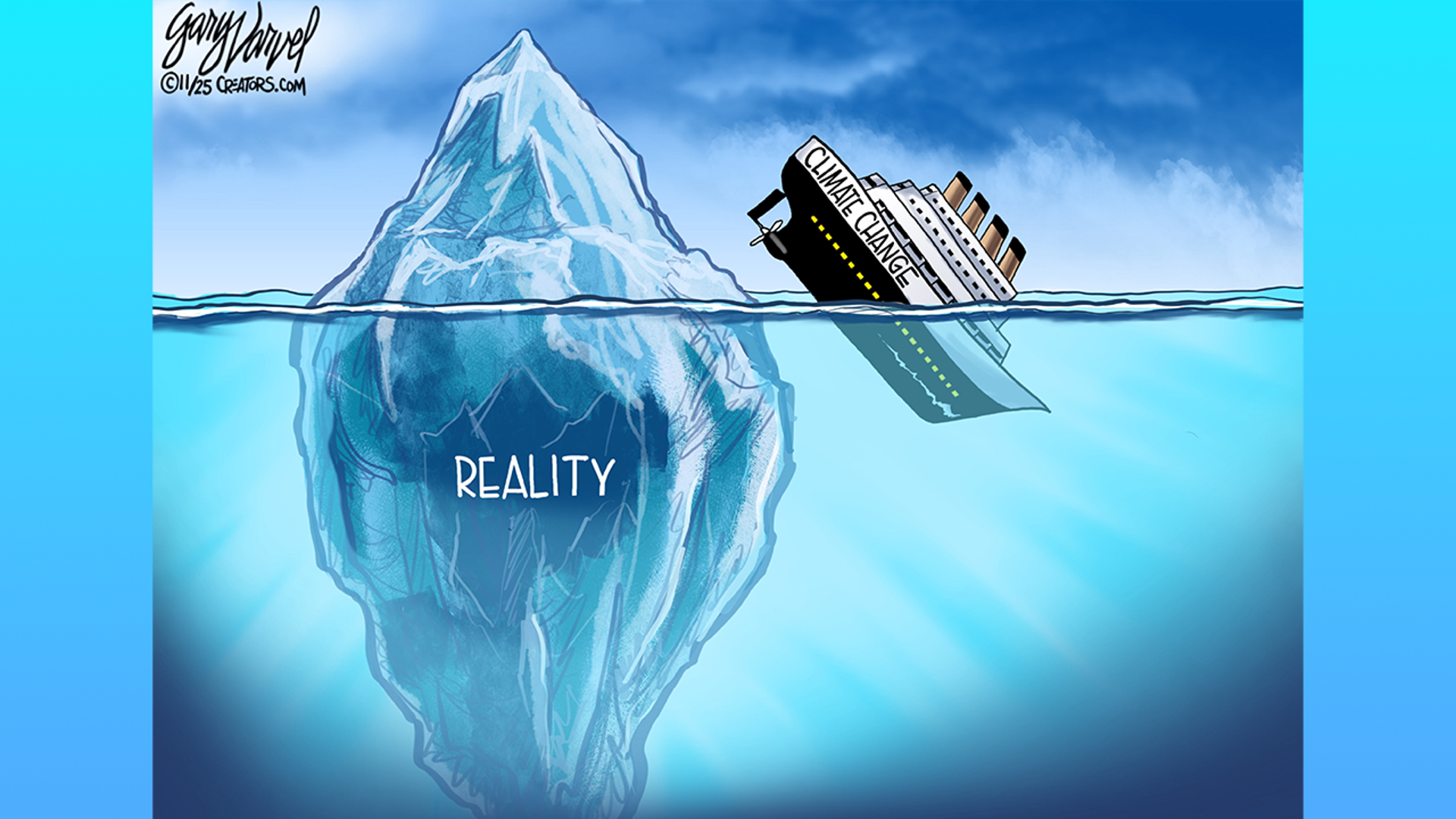
Anthropogenic Global Warming ... how hot is it ?

572030925_122260570916203766_9152194218804645209_n.jpg


In May 2025, atmospheric carbon dioxide (CO2) levels reached a record-breaking 430.5 parts per million (ppm), the highest in human history and likely in over 2 million years, according to measurements from the Mauna Loa Observatory in Hawaii, a global benchmark for atmospheric monitoring since 1958.

This milestone, reported by the National Oceanic and Atmospheric Administration (NOAA) and the Scripps Institution of Oceanography, reflects a 3.6 ppm increase from May 2024, driven by unprecedented fossil fuel emissions, deforestation, and reduced carbon absorption by natural sinks like forests due to wildfires and land-use changes.

CO2, the primary human-caused greenhouse gas, traps heat, intensifying global warming and fueling extreme weather events like heatwaves, droughts, and floods. It also contributes to ocean acidification, harming marine ecosystems.

SOURCE
 
The Glacier That Vanished Overnight

- The #Hektoria #Glacier #collapsed faster than any in history — eight kilometers of #ice #vanished almost #overnight, #warning of a #dangerously #unstable future for #Antarctica.


Lebanon's historic pines are dying, one cone at a time​

By Raghed Waked / November 11, 20255:55 AM GMT-5
BKASSINE FOREST, Lebanon, Nov 11 (Reuters) -

In the heart of southern Lebanon, where pine trees once stood tall and abundant, a quiet crisis is unfolding. The cones are barren, the trees are drying and a forest that was a lifeline for entire communities is under siege.
Farmers in Bkassine forest have watched their pine yields dwindle for years. At first, they blamed seasonal weather changes. Then, in 2015, scientists confirmed what many feared: an invasive insect had taken hold, one that feeds on the cones that produce Lebanon's prized pine nuts.
The insect, Leptoglossus occidentalis, is originally from North America and likely arrived in Lebanon via untreated wooden shipping pallets.

Most of Lebanon's pine forests were planted hundreds of years ago. These older trees are still within their productive lifespans, but droughts, erratic rainfall and rising temperatures triggered by climate change have made them more vulnerable to the pests.
"A healthy tree can fight back," Nemer said. "But when it's thirsty and starved, it has no defence."


- nuts -
 
For the past eight years, one of the primary objectives of the annual negotiations has been to limit global warming to 1.5 degrees Celsius, compared to the temperatures in the late 1800s. That temperature goal was established after a landmark international scientific report laid out the catastrophic effects of exceeding that amount of warming.
But that goal is no longer plausible, scientists say. Humanity has not cut planet-warming pollution quickly enough, and the planet will exceed 1.5 degrees Celsius of warming, likely in the next decade, according to a recent United Nations report.
 

Washington residents evacuate amid catastrophic flooding, National Guard going door-to-door in Burlington

The flood threat is far from over.

Atmospheric rivers have dumped more than 15 inches of rain on parts of Washington state in the last few days, sparking historic river flooding and submerging neighborhoods -- and the threat is far from over.

Washington Gov. Bob Ferguson, who has declared a state of emergency, stressed that .....

 
Since we don't have a thread about women scientists we've never heard of simply because they weren't men I'm posting this one herre

1765976965866.png

In the 1850s, a woman named Eunice Foote made an important discovery while raising her children. In her home, she used simple glass tubes and thermometers to test different gases in sunlight. She found that carbon dioxide trapped much more heat than normal air. She wrote that if more of this gas filled the atmosphere, Earth would become much warmer. Eunice Foote had discovered the greenhouse effect.

In 1856, her research was shared at a major science meeting, but Eunice was not allowed to speak because she was a woman. A man read her work instead, and her discovery was soon forgotten. A few years later, another scientist, John Tyndall, made similar experiments and became famous. For more than 150 years, his name was remembered while hers disappeared.

Eunice Foote also fought for women’s rights and signed the Declaration of Sentiments at Seneca Falls. She believed women deserved equal voices, even as her own was ignored. Today, as the world faces climate change, her work is finally being recognized. Her story reminds us that when we ignore voices because of who they are, we may lose ideas that could change the future.

SOURCE
 
Too many people wrongly think that greenhouse gases just get warm like any gas, and that is not the problem.
The problem is that CO2 is transparent to the high frequency solar light coming into our atmosphere, but opaque to the low frequency infrared given off by things the sunlight heats up.
So it essentially is a one way valve that causes the whole planet to get hotter and hotter.
We already put enough CO2 in the atmosphere to cause heat to be retained and increase the temperature, for hundreds of years.
 
Too many people wrongly think that greenhouse gases just get warm like any gas, and that is not the problem.
The problem is that CO2 is transparent to the high frequency solar light coming into our atmosphere, but opaque to the low frequency infrared given off by things the sunlight heats up.
So it essentially is a one way valve that causes the whole planet to get hotter and hotter.
We already put enough CO2 in the atmosphere to cause heat to be retained and increase the temperature, for hundreds of years.
Fine.
I'm not sure they need to know that.

What matters is not their understanding of radiational dynamics, but their socio-economic commitment to breaking the runaway. We're already over target for mitigating disaster.

Whether a Netherlands style dike will be required around major coastal cities like New York may be secondary.
Will we be able to continue to produce enough food to feed the human population explosion? Trump policy makes matters worse.

Addressing the U.N. general assembly Trump declared anthropogenic global warming "the greatest con job perpetrated by the world."
 
While the potential of the oceans rising 200' is likely to now happen, it won't likely happed for at least 100 years or so, which makes people complacent and cynical.
Some climate experts say that the warming will increase water vapor to the point it will reflect solar light and prevent the worst of the warming.
But I kind of like seeing the stars, and perpetual cloud cover does not seem very desirable to me.
 
"While the potential of the oceans rising 200' is likely to now happen, it won't likely happed for at least 100 years or so ..." R5 #412
200' not good. BUT !
Before sea level rises 200' it'll rise one foot.
That would mean major issues for coastal cities around the world.

The U.S. home insurance industry is in turmoil.

Dozens of insurance companies have collapsed or have been declared insolvent in Florida, Louisiana, Texas, and California. In the period 2018-2023, insurers canceled nearly 2 million homeowner’s policies in response to rising climate risks. Premiums have skyrocketed in many places, making them unaffordable for many homeowners.
 
200' not good. BUT !
Before sea level rises 200' it'll rise one foot.
That would mean major issues for coastal cities around the world.

The U.S. home insurance industry is in turmoil.

Dozens of insurance companies have collapsed or have been declared insolvent in Florida, Louisiana, Texas, and California. In the period 2018-2023, insurers canceled nearly 2 million homeowner’s policies in response to rising climate risks. Premiums have skyrocketed in many places, making them unaffordable for many homeowners.

While risk pooling makes sense, nothing is gained by having it run by a private company that skims off profits.
 
"While risk pooling makes sense, nothing is gained by having it run by a private company that skims off profits." R5 #414
Whether $20% is skimmed privately or publicly wouldn't matter much to those making the insurance policy payments.

Cutting the skimmers out of the loop may seem a viable option. Problem is that may mean attending to the administration of the policies without them.

I suspect this is why most Americans with insurance policies have insurance agents.

We could dismiss the insurance element itself.
It's imprudent to overlook the broader issue. Our actuarial system has for centuries been static modeled.
The sky is not falling, Chickens Little.
But acting like we have to allow Insurance industry catastrophe to sabotage itself to non-existence is silly.

Stop granting building permits for homes located in the forest, built of flammable materials. It's not rocket surgery. Stop acting stupid.
 
Whether $20% is skimmed privately or publicly wouldn't matter much to those making the insurance policy payments.

Cutting the skimmers out of the loop may seem a viable option. Problem is that may mean attending to the administration of the policies without them.

I suspect this is why most Americans with insurance policies have insurance agents.

We could dismiss the insurance element itself.
It's imprudent to overlook the broader issue. Our actuarial system has for centuries been static modeled.
The sky is not falling, Chickens Little.
But acting like we have to allow Insurance industry catastrophe to sabotage itself to non-existence is silly.

Stop granting building permits for homes located in the forest, built of flammable materials. It's not rocket surgery. Stop acting stupid.

Insurance companies are incredibly profitable. They have brought up almost all the hospitals and clinics.
Public agencies that do the same functions, like Medicaid and VA, have less than 10% of the overhead that private insurance companies charge.

Since public agencies are the ones issuing the building permits, then only public agencies have the ability to reign in the risks.

We had a bad forest fire that wiped out a small village, and the result was all the rural policies got cancelled.
That made no sense because I put on a metal roof and did Hardiplank siding in order to fireproof my house, and they did not care and still canceled.
 
Insurance companies are incredibly profitable. They have brought up almost all the hospitals and clinics.
Nonsense - home insurers' profit margins are, in general, between five and ten percent of premiums. And don't forget that they have to accumulate capital in order to be able to pay for catastrophes (hurricanes, tornadoes, earthquakes, and the like).

As for health insurers - profit margins there are even slimmer - pre-tax they're between three and five percent of premiums (and that's including all investment income including that earned on their own funds).

Public agencies that do the same functions, like Medicaid and VA, have less than 10% of the overhead that private insurance companies charge.
That's because, among other things they're in government owned buildings so little things like rent, property taxes, and the like don't enter into their income statements.

Since public agencies are the ones issuing the building permits, then only public agencies have the ability to reign in the risks.
No idea how you come to that conclusion - that is unless you want them to retroactively cancel building permits for buildings in an already build up area.

We had a bad forest fire that wiped out a small village, and the result was all the rural policies got cancelled.
That made no sense because I put on a metal roof and did Hardiplank siding in order to fireproof my house, and they did not care and still canceled.
Without speaking to the insurance company involved I don't know what their logic was. While I understand them cancelling all rural policies I can't comment on your particular circumstances. Would you have been the only policy they had remaining after cancelling.

BTW, Hardiplank siding will not fireproof your house - it's fire resistant and won't contribute flammable material to a fire. And it also means that stray sparks won't ignite it - that doesn't mean your house is fireproof - put a hot enough fire next to it for long enough and the wood below it will ignite so it just takes longer to start.

From Hardie's own website

While JamesHardie® products will not ignite when exposed to direct flame or contribute fuel to a fire, heat will transfer through them. Because of this, the product itself is not 1-hour fire rated. However, they do qualify for use in certain 1-hour fire rated Warnock Hersey and UL assemblies. Think of JH products as a pan used for cooking. The pan can be directly exposed to a stove's flame and not burn, yet the food in the pan will cook in time. Having an interior wallboard that resists burning for 1-hour buys time for the homeowner and fire professionals.
 
Nonsense - home insurers' profit margins are, in general, between five and ten percent of premiums. And don't forget that they have to accumulate capital in order to be able to pay for catastrophes (hurricanes, tornadoes, earthquakes, and the like).

As for health insurers - profit margins there are even slimmer - pre-tax they're between three and five percent of premiums (and that's including all investment income including that earned on their own funds).


That's because, among other things they're in government owned buildings so little things like rent, property taxes, and the like don't enter into their income statements.


No idea how you come to that conclusion - that is unless you want them to retroactively cancel building permits for buildings in an already build up area.


Without speaking to the insurance company involved I don't know what their logic was. While I understand them cancelling all rural policies I can't comment on your particular circumstances. Would you have been the only policy they had remaining after cancelling.

BTW, Hardiplank siding will not fireproof your house - it's fire resistant and won't contribute flammable material to a fire. And it also means that stray sparks won't ignite it - that doesn't mean your house is fireproof - put a hot enough fire next to it for long enough and the wood below it will ignite so it just takes longer to start.

From Hardie's own website

But 10% profit margins are extremely high.
Most companies, like food stores, run around 3% profits.
Medicaid and VA only add 2% overhead.

Catastrophes like "acts of god" are exempt from insurance payments, and FEMA covers it instead.

Health insurers have incredibly higher profit margins because they created a horizontal health care monopoly, where they end up paying themselves, so deliberately inflate their own prices.

Insurance companies have a wealth of funds, so all own their own buildings as well, and they don't have to pay insurance premiums like most home owners do.

If insurance was public, then the permits, fire prevention, and fire fighting resources would all be under one roof and made in harmony.
Just canceling policies in risky areas like the private companies did, makes no sense.
The reality is that on average, rural claims are lower than urban ones, not higher.
To cancel all rural policies after a hundred year event should be illegal.

Rural threat to homes is entirely from flying embers, not slow cooking.
It is a flash, not a slow cook, as long as the area around the structure is reasonably clear.
 
But 10% profit margins are extremely high.
What part of health insurers have pretax margins of between three and five percent including investment income on their own funds did you miss?

As for homeowners insurance those profits are highly variable - look at the number of companies in places like Florida that have gone out of business.

And what part of government entities like Medicaid and the VA are in government buildings so they don't have to pay rent did you miss? And of course they don't have to pay agents or brokers for obtaining the business.

Catastrophes like "acts of god" are exempt from insurance payments, and FEMA covers it instead.
You really have to learn something about insurance - if insurance companies didn't cover catastrophes there wouldn't be a multi-trillion dollar reinsurance market that covers that type of claims.

Insurance companies have a wealth of funds, so all own their own buildings as well, and they don't have to pay insurance premiums like most home owners do.
Actually many (most?) do purchase insurance to keep that risk off of their balance sheet. And if they don't any such losses flow thru their income statement.

===========================================

However, if you want to continue commenting on insurance related matters I suggest you learn something about the subject.


Shouldn't take you more than eight to ten years (depending on your mathematics background.
 
What part of health insurers have pretax margins of between three and five percent including investment income on their own funds did you miss?

As for homeowners insurance those profits are highly variable - look at the number of companies in places like Florida that have gone out of business.

And what part of government entities like Medicaid and the VA are in government buildings so they don't have to pay rent did you miss? And of course they don't have to pay agents or brokers for obtaining the business.


You really have to learn something about insurance - if insurance companies didn't cover catastrophes there wouldn't be a multi-trillion dollar reinsurance market that covers that type of claims.


Actually many (most?) do purchase insurance to keep that risk off of their balance sheet. And if they don't any such losses flow thru their income statement.

===========================================

However, if you want to continue commenting on insurance related matters I suggest you learn something about the subject.


Shouldn't take you more than eight to ten years (depending on your mathematics background.

The profitability of insurance is obvious since they purchased almost all the hospitals and clinics.

Bankruptcies do not indicate lack of profits, but instead just a scam to avoid payouts.
 
Back
Top