Anthropogenic Global Warming ... how hot is it ?

And this only refers to insured losses.

Cat 5 Florida hurricanes could drive $300bn plus insurance market loss: Swiss Re​


Under certain scenarios, a category 5 hurricane ploughing into Miami or Tampa Bay has the potential to drive more than US $300 billion of losses across the global insurance and reinsurance market, Swiss Re’s Institute said today, while also explaining the importance of reinsurance and ILS capital in protecting the state.

florida-hurricane-question
In addition, the research found that a repeat of the 1926 Great Miami Hurricane event, a category 4 storm, has the potential to drive over US $200 billion of industry losses to the re/insurance sector today.

These scenarios illustrate “how population growth and the accumulation of assets in exposed areas are driving higher insured natural catastrophe losses globally,” Swiss Re explained.

Balz Grollimund, Head Catastrophe Perils at Swiss Re, commented, “The Atlantic hurricane season has been relatively quiet so far this year, but it only takes .....

CONTINUED
 
And this only refers to insured losses.

Cat 5 Florida hurricanes could drive $300bn plus insurance market loss: Swiss Re​


Under certain scenarios, a category 5 hurricane ploughing into Miami or Tampa Bay has the potential to drive more than US $300 billion of losses across the global insurance and reinsurance market, Swiss Re’s Institute said today, while also explaining the importance of reinsurance and ILS capital in protecting the state.

florida-hurricane-question
In addition, the research found that a repeat of the 1926 Great Miami Hurricane event, a category 4 storm, has the potential to drive over US $200 billion of industry losses to the re/insurance sector today.

These scenarios illustrate “how population growth and the accumulation of assets in exposed areas are driving higher insured natural catastrophe losses globally,” Swiss Re explained.

Balz Grollimund, Head Catastrophe Perils at Swiss Re, commented, “The Atlantic hurricane season has been relatively quiet so far this year, but it only takes .....

CONTINUED

Which is why I never liked private insurance.
The whole point of society is to collectively rely on each other instead of a private profit motivated monopoly.
Insurance not only is wasteful due to profits, but also makes you prepay.
The way it should be done is by sharing the cost of natural disasters after the fact.

The private insurance companies tend to be worthless.
Like after there were a lot of claims from a rural forest fire, the insurance companies dropped everyone who lived in the country in the entire state.
So all those decades of paying in was essentially stolen.
Only after they dropped me did I then realize that if there was a forest fire there that destroyed the house, I would not even want to rebuild there anyway.
So rural fire insurance I had been paying for decades was useless.
 
1790077485695.png

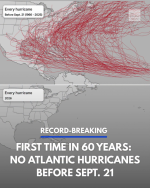
The 2026 Atlantic hurricane season has broken a 60-year record for the latest start to hurricane formation since satellite tracking began in 1966. This unprecedented quiet period is primarily driven by a very strong El Niño producing high wind shear that prevents Atlantic storms from organizing.
 
View attachment 6525

The 2026 Atlantic hurricane season has broken a 60-year record for the latest start to hurricane formation since satellite tracking began in 1966. This unprecedented quiet period is primarily driven by a very strong El Niño producing high wind shear that prevents Atlantic storms from organizing.

I can't say I totally understand El Nino or La Nina, but I reduce it in my mind to easterly or westerly prevailing ocean winds.
{...
El Niño is associated with higher than normal sea level air pressure over Indonesia and Australia, and across the Indian Ocean to the Atlantic Ocean. La Niña has roughly the reverse pattern: high pressure over the central and eastern Pacific and lower pressure through much of the rest of the tropics and subtropics.[2][3] The two phenomena typically last approximately one year each and typically occur every two to seven years with varying intensity, with neutral periods of lower intensity interspersed.[4] El Niño events can be more intense, but La Niña events may repeat and last longer.

A key mechanism of ENSO is the Bjerknes feedback (named after Jacob Bjerknes in 1969) in which the atmospheric changes alter the sea temperatures that, in turn, alter the atmospheric winds in a positive feedback. Weaker easterly trade winds result in a surge of warm surface waters to the east and reduced ocean upwelling on the equator. In turn, this leads to warmer sea surface temperatures (called El Niño), a weaker Walker circulation (an east—west overturning circulation in the atmosphere) and even weaker trade winds. Ultimately, the warm waters in the western tropical Pacific are depleted enough so that conditions return to normal. The exact mechanisms that cause the oscillation are unclear and are being studied.
...}
https://en.wikipedia.org/wiki/El_Niño–Southern_Oscillation

The upper atmosphere connection that would involve the Atlantic, I had no idea existed at all.
 
"This unprecedented quiet period is primarily driven by a very strong El Niño producing high wind shear that prevents Atlantic storms from organizing." S2 #723
To the layman that might seem a benefit of global warming. BUT !

Huge El Niño projected to cause 450,000 deaths in next six months​

New report predicts a heavy toll from Nigeria to the US – and comes on top of existing impacts of the climate crisis
Damian Carrington Environment editor / Wed 23 Sep 2026 00.00 EDT
More than 450,000 people are projected to die from the additional heat brought by the super El Niño in the next six months, according to estimates by climate scientists.
The toll is on top of the early deaths resulting from temperatures already driven up by the climate crisis. It will strike across the globe, from Indonesia to India, and Nigeria to the US. Many further deaths are expected from the droughts, wildfires and flooding that El Niños bring.

:oops:

More than 480,000 deaths annually (including deaths from secondhand smoke)

So El Niño is predicted to kill as many in the next 6 months as tobacco kills in 12.
 

Nepal PM Says Floods 'A Warning To The World' About Climate Change​

By AFP - Agence France Presse

Nepal's catastrophic flooding last month "was a warning to the world" about the rising dangers of climate change, Prime Minister Balendra Shah told the United Nations on Thursday, urging countries to step up to help his country adapt.

Addressing the General Assembly in sunglasses during its high-level week, Shah said a warming climate was "destabilizing the fragile Himalayan ecology," melting .....

CONTINUED
 

Nepal PM Says Floods 'A Warning To The World' About Climate Change​

By AFP - Agence France Presse

Nepal's catastrophic flooding last month "was a warning to the world" about the rising dangers of climate change, Prime Minister Balendra Shah told the United Nations on Thursday, urging countries to step up to help his country adapt.

Addressing the General Assembly in sunglasses during its high-level week, Shah said a warming climate was "destabilizing the fragile Himalayan ecology," melting .....

CONTINUED

While melting glaciers can be a problem, unless there is a sudden collapse of an ice dam, most of that should be slow enough to not be much of a problem.
And melting glacier water is sort of a one-time problem in that once it has run off, it is gone.
But the bigger and constant problem will be the rising oceans, that will constantly put the coastline at greater risk.
They project that Florida will be under water in just 100 years.
The heat will keep accumulating even if we add no more CO2 at all.
And eventually that will be a 200' ocean level rise.
 

"Nepal PM Says Floods 'A Warning To The World' About Climate Change" AFP #727​

:(
"Preaching to the choir", a somewhat metaphorical allusion to notifying the already informed.
Those that understand the catastrophic implications of anthropogenic global warming don't need the Nepalese anecdote.

Facts do not cease to exist because they are ignored ~ Aldous Huxley

Perhaps they're dim enough to believe it doesn't matter when it's an issue in Nepal.
It's not worth fussing about until it's a catastrophe in Kalamazoo.

The irony of this delusion is we have already crossed the alarm line, the dire consequence threshold.

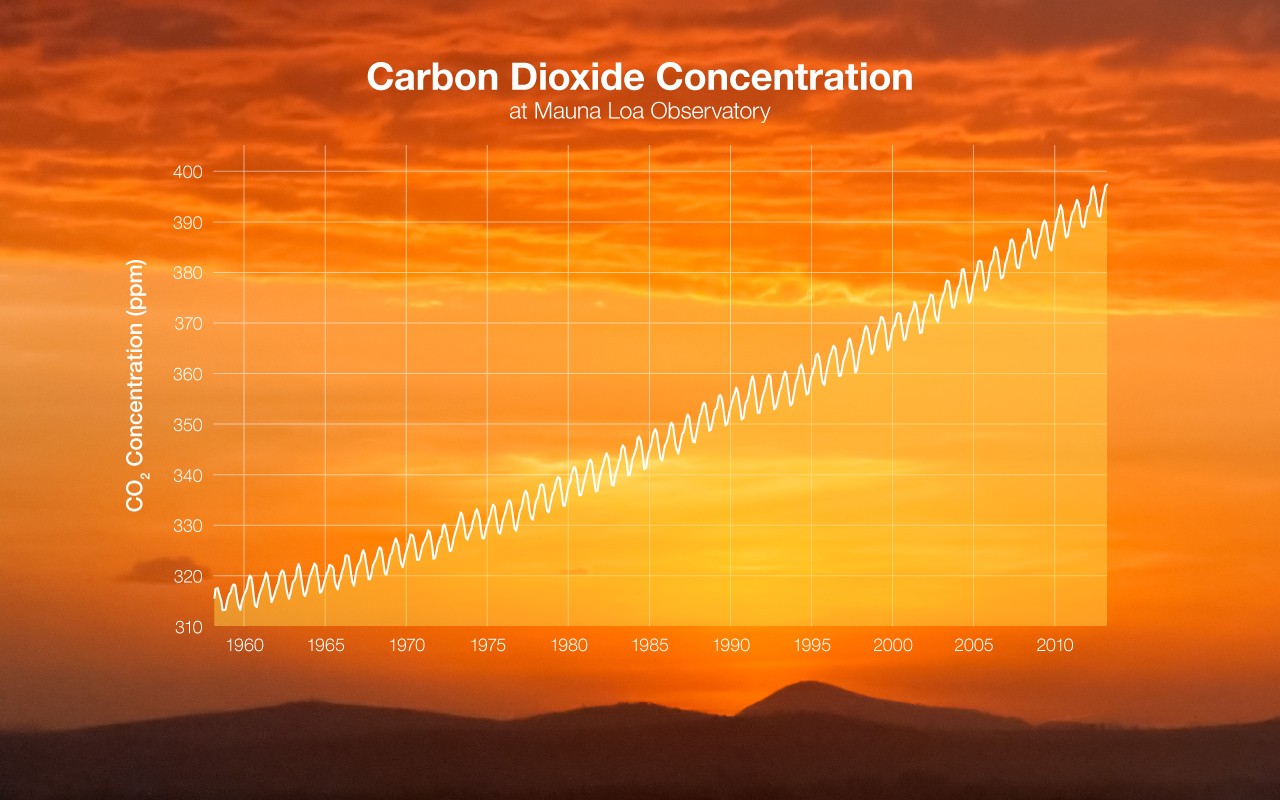
With a more than 50% increase in CO2 since the start of industrial times in the 18th century, scientific measurements have linked this increase primarily to the burning of coal, oil, and gas. This means that CO2 levels are now 150% the value they were at in 1750 — this is at least 1.5 times greater than the natural increase observed at the end of the last ice age 20,000 years ago, which happened over thousands of years ... the amount of CO2 rises from 365 parts per million (ppm) in 2002 to over 420 ppm in 2022.
 
:(
"Preaching to the choir", a somewhat metaphorical allusion to notifying the already informed.
Those that understand the catastrophic implications of anthropogenic global warming don't need the Nepalese anecdote.

Facts do not cease to exist because they are ignored ~ Aldous Huxley

Perhaps they're dim enough to believe it doesn't matter when it's an issue in Nepal.
It's not worth fussing about until it's a catastrophe in Kalamazoo.

The irony of this delusion is we have already crossed the alarm line, the dire consequence threshold.

With a more than 50% increase in CO2 since the start of industrial times in the 18th century, scientific measurements have linked this increase primarily to the burning of coal, oil, and gas. This means that CO2 levels are now 150% the value they were at in 1750 — this is at least 1.5 times greater than the natural increase observed at the end of the last ice age 20,000 years ago, which happened over thousands of years ... the amount of CO2 rises from 365 parts per million (ppm) in 2002 to over 420 ppm in 2022.

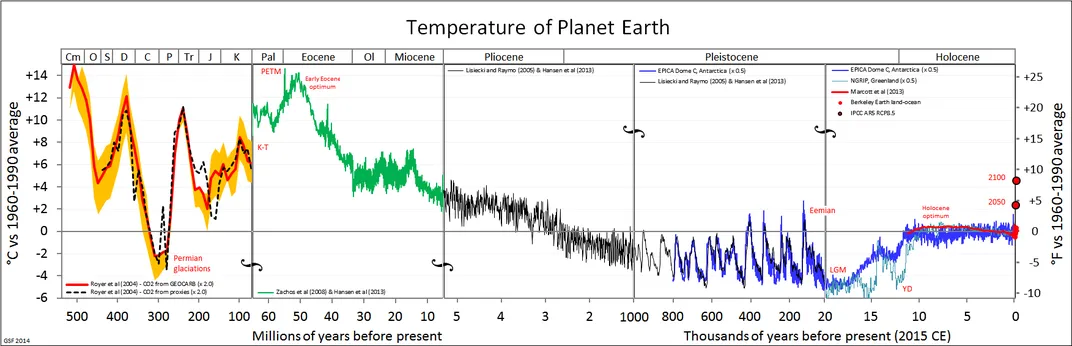
From casual observation, we also can tell that with the normal ice age and warming cycle being about 110k years long, and the last ice age glaciers melting just 20k years ago, that we must be only slightly past the warmest part of the natural temperature cycle.
So the natural CO2 level and temperature were already at their highest.
Which means that by adding all this additional CO2 from sequestered fossil fuels, we are unnaturally adding a new warming cycle on tops of the already existing warmest part of the natural cycle.
That means the next 100k years are going to be unlike any the planet has ever seen for over 5 million years.
It means going back to the constant cloud cover of the Pliocene era.
All_palaeotemps.png
 
"It means going back to the constant cloud cover of the Pliocene era." R5 #730
Oh no! Not that again!

R5,
Not sure you had this in mind, but you raise the issue:
if the natural trend (without humans) would be global cooling in 2026,
but because of humans it's warming,
our greenhouse impact may be rendered a little less severe.

Even if by unanticipated means, if we disrupt this natural cycle, at worst reverse it
instead of partially canceling opposite trends, we may risk synergistic warming trends, both natural and anthropogenic.

- uh oh -
 
Back
Top