Shiftless2
Well-known member
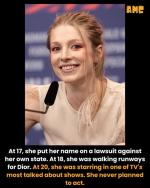
Her name is Hunter Schafer. She was born on December 31, 1998, in Trenton, New Jersey.
Her father is a pastor. The family moves from church to church, from New Jersey to Arizona, and finally to Raleigh, North Carolina. She is the oldest of 4 children.
Even as a toddler, she expresses herself in feminine ways. In 7th grade, she tells her parents she is a gay boy. By 9th grade, she understands something deeper. She comes out as a transgender girl and begins her transition.
She is still a teenager when, in 2016, North Carolina passes a law that controls which public bathrooms transgender people can use. It is based on the sex listed at birth, not on who they are.
Here's what makes it harder: this law lands right in the middle of her high school years.
She does not stay quiet. She becomes the youngest person named as a plaintiff in a lawsuit challenging the law. In July 2016, she writes an essay about it for Teen Vogue that spreads far and wide. The law is later repealed.
In 2017, Teen Vogue names her one of its 21 Under 21. That same year, she is named a semifinalist for the U.S. Presidential Scholars Program.
Art is her other world. She paints with watercolors, draws comics, and designs clothes. In 2017, a modeling agent finds her through Instagram, and she moves to Brooklyn.
Within months, she is working with Dior and Marc Jacobs. In early 2018, she walks for 9 fashion houses and travels overseas for the very first time.
Her real plan is college. She is accepted to Central Saint Martins in London, where she wants to design clothes for non-binary people.
Then she sees a casting call looking for transgender girls.
She has never acted before. She auditions anyway. A month after her final audition, she is filming the pilot of HBO's Euphoria.
She plays Jules Vaughn, a trans high school girl. It is a rare thing: a leading trans character, played by a trans actress. In 2017 and 2018, there were only 17 trans characters on all of American TV.
She works with the show's creator to make Jules feel real. In 2021, she co-writes her own episode, and critics praise it.
That same year, Time names her one of 100 rising leaders shaping the future.
In 2023, she plays Tigris in a Hunger Games prequel. In 2024, she lands her first lead film role in the horror movie Cuckoo, which earns her an Independent Spirit Award nomination.
The girl who planned to study fashion in London ended up rewriting her own path instead.
Sometimes the life you plan is only the door. The life you're meant for is waiting on the other side.
SOURCE with comments