You are using an out of date browser. It may not display this or other websites correctly.
You should upgrade or use an alternative browser.
You should upgrade or use an alternative browser.
What to call this thread?
- Thread starter Shiftless2
- Start date
Shiftless2
Well-known member
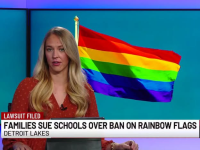
BREAKING


But the ban went much further. In a surprise 4–2 vote that wasn’t on the public agenda, they banned rainbow stickers, Pride flags, posters, buttons and more throughout the district.
Since the vote, one of the students suing says classmates told them even their rainbow clothing is banned.
The motion was introduced only after the meeting had already started. The two board members who voted against it and even the superintendent said they were blindsided.
The board chair confirmed the ban could reach Pride patches on students’ backpacks. But when asked whether cross necklaces would be treated the same way, he said: “I’m a Christian so that doesn’t bother me.”
And it turns out there were private messages before the vote. One week earlier, a board member sent another a link to a group whose mission includes: “Reject inclusion. Embrace exclusion.” The lawsuit alleges the four members who voted for the ban privately coordinated beforehand.
When the public finally got a chance to speak the next month, nearly 100 people packed the room. Nineteen people spoke. All but three opposed the ban.
One Detroit Lakes graduate explained what those tiny stickers had meant to him: “It meant that at least one person would stick up for me.”
Now two students are taking the district to court. One is president of the high school’s Queer Community, formerly its Gay-Straight Alliance. They say the district singled out LGBTQ expression and violated students’ free speech and equal protection rights.
Supporters of the ban argue the stickers are not “politically neutral” and that every teacher should be a safe person for every student. Wouldn’t that be nice…
The students are asking a judge to stop the ban immediately.
SOURCE with comments
Shiftless2
Well-known member

Logic - it's like that
Shiftless2
Well-known member
I'll take things that never happened for $500
Shiftless2
Well-known member
Shiftless2
Well-known member
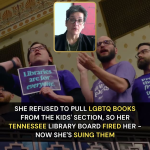
Luanne James ran the library system in Rutherford County, Tennessee, until the board told her to move 132 children's books with LGBTQ content into the adult section. She said no, they fired her, and this week she sued them.
James filed a federal civil rights lawsuit in Nashville on September 23 against the library system and the board members who voted her out. She says they broke discrimination law and violated her First Amendment rights.
She also says the board's then-chair, Cody York, had directed her to compile a list of everyone who checked out books with LGBTQ themes, with their names, addresses and household information. She refused that too, and York has denied any wrongdoing.
The suit says the board majority decided that "being gay or transgender was harmful to children." It argues that a message like that, coming from a public institution, tells gay and trans residents they aren't welcome to use it.
Hundreds packed the county courthouse this spring while the board decided her fate, and dozens chanted her name. The vote to fire her went 8-3.
"No one board member has the right to make a decision for a parent what a child can and cannot read," James told The Daily News Journal. "It's not fair."
SOURCE with comments
Shiftless2
Well-known member
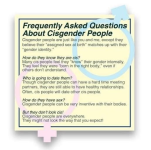
Yes you can have cisgender friends! Their "lifestyle" is not a choice. They were BORN THAT WAY! Be tolerant and accepting.
Shiftless2
Well-known member
Shiftless2
Well-known member
"If you think it's just kids who do the bullying it isn't. Not long ago in Kelowna a child was misgendered by the grandparent of another participant at a school sports event. They thought the child was transgender and demanded to see proof of their gender assigned at birth. The child was not transgender."
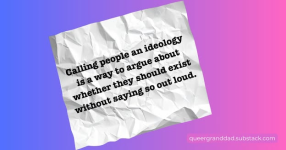
This election season, you will see candidates or commenters claim that SOGI 123 is "pushing an ideology" in BC schools. Here's what it actually is.
SOGI stands for sexual orientation and gender identity. Everyone has both, including every student, teacher, and person reading this post.
Since 2016, BC's Human Rights Code has protected gender identity and expression, and every school district in the province has been required to include sexual orientation and gender identity in its codes of conduct and anti-bullying policies. SOGI 123 is a free set of resources that helps educators meet those existing obligations. The "1, 2, 3" refers to policies and procedures, inclusive environments, and curriculum resources.
In a classroom, this might look like a picture book showing different kinds of families, a lesson about respecting differences, or a clear expectation that slurs and name-calling are not okay. The lesson plans connect to the existing BC curriculum. There is no separate SOGI course, and nothing in it asks a child to become anything other than who they are.
These policies protect more kids than people realize. Think of a straight girl with short hair who plays hockey and gets called a lesbian in the hallway, or a boy who gets mocked for ....
CONTINUED with comments
This election season, you will see candidates or commenters claim that SOGI 123 is "pushing an ideology" in BC schools. Here's what it actually is.
SOGI stands for sexual orientation and gender identity. Everyone has both, including every student, teacher, and person reading this post.
Since 2016, BC's Human Rights Code has protected gender identity and expression, and every school district in the province has been required to include sexual orientation and gender identity in its codes of conduct and anti-bullying policies. SOGI 123 is a free set of resources that helps educators meet those existing obligations. The "1, 2, 3" refers to policies and procedures, inclusive environments, and curriculum resources.
In a classroom, this might look like a picture book showing different kinds of families, a lesson about respecting differences, or a clear expectation that slurs and name-calling are not okay. The lesson plans connect to the existing BC curriculum. There is no separate SOGI course, and nothing in it asks a child to become anything other than who they are.
These policies protect more kids than people realize. Think of a straight girl with short hair who plays hockey and gets called a lesbian in the hallway, or a boy who gets mocked for ....
CONTINUED with comments
Shiftless2
Well-known member
Shiftless2
Well-known member
The Bible and Same-Sex Relationships: Fictions and Facts
Fiction #1
Homosexuality is a major topic of concern in the Bible.
Fact:
The Bible contains only three or four clear references to male same-sex love and only one possible reference to female same-sex love. Moreover, “homosexuality” itself is a modern term, coined in the late 19th century, and represents forms of same-sex love not present in the cultural context of the ancient Mediterranean world from which the Bible comes.
Fiction #2
The Bible’s allusions to same-sex relationships are all negative.
Fact:
The Bible depicts several very positive same-sex relationships, including the probably erotic relationship of Jonathan and David and that of the Centurion and his “boy-lover” in the Gospel of Matthew (see below). In addition, the words of Ruth to her mother-in-law Naomi, two women, are so representative of modern understandings of intimate relationships that they are most often found in marriage ceremonies (Ruth 1: 16-17).
Fiction #3
The Bible views homosexuality as a sin and indeed as a greater sin than all others.
Fact:
The Bible rarely mentions same-sex love. It is not prohibited in the Ten Commandments, as adultery is, and it is not prohibited by Jesus, as divorce is. There are simply no biblical grounds for arguing that homosexuality is a greater sin than adultery or divorce; indeed,
just the opposite is the case.
Fiction #4
Jesus preached against homosexuality.
Fact:
In the New Testament gospels, Jesus says absolutely nothing about homosexuality or same-sex relationships. In fact, it is possible that Jesus actually commends a man who is in a same-sex relationship in Matthew 8:5-13 (the Roman centurion and his “boy,” a common pederastic relationship in Roman antiquity).
Fiction #5
The story of Sodom is about homosexuality.
Fact:
In the story of Sodom in Genesis 19, all the men of Sodom attempt to gang rape the foreign visitors staying at the house of that other foreigner, Lot. As in rape cases today, this act is not about sexuality but about violence, power, and the hatred of strangers. All the references to this story in the rest of the Hebrew Bible (Old Testament) confirm that the “sin” of Sodom was hatred of foreigners, pride, and abuse of the poor. No sexual “sin” is mentioned in any of these later references to the story of Sodom’s destruction.
Fiction #6
The Bible supports monogamous heterosexual marriage.
Truth:
The primary form of marriage in the Hebrew Bible (Old Testament) is polygamy, with the prize going to King Solomon, who was said to have 700 wives and 300 concubines. In the New Testament, the sexual path of life most strongly recommended by Jesus and Paul was chastity. This is not surprising since Jesus and Paul themselves were both unmarried adult men. In the Bible, marriage between one man and only one woman is explicitly required only for bishops (1 Timothy 3:2)!
Fiction #7
The creation stories in Genesis 1-3 condemn any form of same-sex relationships.
Truth:
The creation stories in Genesis 1-3 never mention same-sex relationships of any kind. The purpose of these stories is to show that God is the creator of everything that exists, and in the modern period this would certainly include those people who have a sexual orientation towards others of the same sex. Moreover, in the creation story in Genesis 2, the explicit purpose of creating sexual partners in the man and woman is not procreation but instead the relief of loneliness. Same-sex relationships fulfill that purpose of creation just as well as opposite-sex relationships do.

Shiftless2
Well-known member

Shiftless2
Well-known member
From Canada
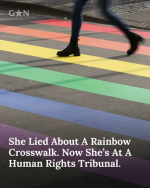
In 2023, Westlock, Alberta resident Benita Pedersen distributed flyers opposing a proposed rainbow crosswalk featuring the colours of the Trans Pride flag.
The flyer claimed gender-affirming care could leave children “rendered infertile and unable to reproduce”, describing it as “chemical castration and genital mutilation”.
Laurie Hodge, a Westlock resident who is now a city councillor, filed a human rights complaint, alleging the flyer discriminated on the grounds of gender, gender expression and gender identity.
The Alberta Human Rights Tribunal hearing opened this week. Pedersen’s lawyer argued the flyer was protected political speech and “did not incite hatred”.
Jennifer Garvie, a Trans woman from Edmonton, testified that the flyer made her reconsider visiting her father in Westlock because she feared what she might encounter there.
The tribunal is now considering whether Pedersen’s flyer crossed the line from protected expression into discrimination under Alberta’s Human Rights Act.
SOURCE with comments
In 2023, Westlock, Alberta resident Benita Pedersen distributed flyers opposing a proposed rainbow crosswalk featuring the colours of the Trans Pride flag.
The flyer claimed gender-affirming care could leave children “rendered infertile and unable to reproduce”, describing it as “chemical castration and genital mutilation”.
Laurie Hodge, a Westlock resident who is now a city councillor, filed a human rights complaint, alleging the flyer discriminated on the grounds of gender, gender expression and gender identity.
The Alberta Human Rights Tribunal hearing opened this week. Pedersen’s lawyer argued the flyer was protected political speech and “did not incite hatred”.
Jennifer Garvie, a Trans woman from Edmonton, testified that the flyer made her reconsider visiting her father in Westlock because she feared what she might encounter there.
The tribunal is now considering whether Pedersen’s flyer crossed the line from protected expression into discrimination under Alberta’s Human Rights Act.
SOURCE with comments

North of Panama it's the U.S., not Canada that gets the civil rights press coverage."From Canada" S2 #2,033
"If it bleeds it leads"? BUT !
Alarming, sensational headlines are not the same as human rights progress.
My confidence in U.S. justice has never been lower.
That may not reciprocally elevate Canada.
But at least on superficial level it may seem to.
This tribunal could easily be interpreted as malevolent, the formal manifestation of finalizing injustice."The tribunal is now considering whether Pedersen’s flyer crossed the line from protected expression into discrimination under Alberta’s Human Rights Act." S2 #2,033
Not necessarily.
If instead this were a specific step in formalizing / clarifying an important if subtle legal (and therefore social) distinction.
In the U.S., discrimination was combated with "affirmative action", a euphemism for discrimination.
"Hope for the best. Plan for the worst." psychologist Joy Browne

Shiftless2
Well-known member
The issue is unfair discrimination as opposed to discrimination in general. After all, people discriminate every day.In the U.S., discrimination was combated with "affirmative action", a euphemism for discrimination.
We discriminate by age when we don't let children obtain drivers licenses. Or we set minimum drinking ages. Or have laws that set an age of consent.
We discriminate by sex when we have single sex public washrooms.
The Catholic Church discriminates by sex when the won't have female priests.
The list goes on.
Indeed."The issue is unfair discrimination as opposed to discrimination in general. After all, people discriminate every day.
We discriminate by age when we don't let children obtain drivers licenses. Or we set minimum drinking ages. Or have laws that set an age of consent.
We discriminate by sex when we have single sex public washrooms.
The Catholic Church discriminates by sex when the won't have female priests.
The list goes on." S2 #2,035
The outcome of this tribunal may contribute to defining Canadian culture.
Humanity risks a bad ruling.
We may benefit from a good one.
All best Canada.
Shiftless2
Well-known member
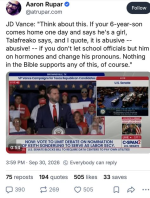
Does anyone believe that Vance even believes this
Shiftless2
Well-known member
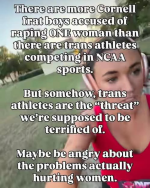
The situation isn't anywhere near as simple as initial reports said.
Shiftless2
Well-known member

A trans Georgia high school senior is fighting for student dignity after school officials blocked her from running for homecoming queen.
As reported by Faefyx Collington for LGBTQ Nation, Charles R. Drew High School student Riley Williams had already paid her registration fee, sat for her official campaign headshot, and prepared her candidate materials when school administrators called her into the principal's office to cancel her bid.
School officials told Williams she could only compete for homecoming king while wearing a suit and using male honorifics, claiming federal athletic guidance under Title IX mandated their decision.
Clayton County Public Schools later conceded in an official statement that the district possesses no written policy regarding gender identity on homecoming court, yet claimed adherence to birth gender was necessary to safeguard federal funding. (Since when have high schools received federal funding - that's always from the city)
Williams took the fight public and immediately exposed the flaw in applying sports equity rules to a student popularity vote, pointing out that a homecoming court carries no physical competition or athletic advantage. She then launched a statewide campaign to establish clear, inclusive guidelines for high school activities.
Her petition swiftly got press attention and gathered over one thousand signatures, drawing broad community backing from classmates and local residents.
The district tried using artificial regulations to quietly strip a student from a celebratory ballot. Her community responded.
SOURCE with comments
Shift's comment added in red
Shiftless2
Well-known member
And people are dumb enough to vote for someone who could actually say this with a straight face