Shiftless2
Well-known member
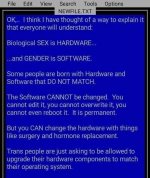
One way to think about it
Last edited:

Actually it's more like factory installed firmware - something that can't be changed.
And, conversion therapy doesn't work - fact is it's actually harmful.

Metaphor and analogy may serve as shorthand to clarify in some cases.#1,123 & #1,125
Metaphor and analogy may serve as shorthand to clarify in some cases.
It seems out of place here.
We're not computers.
Our software is chromosomes in our nuclei.
Any young person entering the portion of life where any of this matters,
should have access to relevant information.
Ultimately the decision is theirs. BUT !
They should not only know they have the Liberty to choose their own path,
and be empowered to review the facts. That includes:
- stats on population percentages
- stats on % that physically transition
- stats on suicide rates
- stats on happiness of those that transition, compared to those that don't.
It would be simple to bias such education. To minimize that risk neutral objectivity should be the guide.
Yes, but we're back to metaphor again."Most of that I agree with, but instead of saying, "Our software is chromosomes in our nuclei.", its a little less direct than that.
The chromosomes are more like architectural blueprints." R5 #1,127
Yes, but we're back to metaphor again.
soft·ware (sôftwâr′, sŏft-)
n.
Computers
The programs, routines, and symbolic languages that control the functioning of the hardware and direct its operation. *
chro·mo·some (krōmə-sōm′)
n.
1. A linear strand of DNA and associated proteins in the nucleus of eukaryotic cells that carries the genes and functions in the transmission of hereditary information. *
* The American Heritage® Dictionary of the English Language, Fifth Edition copyright ©2022 by HarperCollins Publishers. All rights reserved.
"Software" & "blueprint" are both metaphors. In this case is one superior to the other? A blueprint isn't software?
My view of this is that offered by Wilson.
When as a teen, during the tape-recorder era I learned of Watson & Crick's Nobel prize, I imagined our chromosomes to be where we record our traits.
We use modified playback for cellular succession.
Wilson persuaded me that's about exactly backward.
Our DNA field us to compete, much as nations field Olympic competitors, to contest others for supremacy, for dominance.
DNA that competes successfully proliferates. Proliferation seems to be the prime directive of DNA, not only for humans, but gazelles, cheetahs, and venereal diseases.
Merry Christmas

View attachment 3543
The Trump Administration is once again beating its chest in its latest attempt to get providers of legal, evidence-based, gender-affirming care to bend the knee at his whim.
As Erin in the Morning previously reported, the Department of Health & Human Services (HHS) hosted a press conference last week to unveil another wave of attacks targeting gender-affirming care and even clothing for transgender people. Much of the reporting focused on the long-awaited proposal from the Centers for Medicare and Medicaid Services (CMS). That effort conjured up a new right-wing buzzword, “sex-rejecting procedures,” and inserted it into proposed federal regulations.
The rules, which are currently undergoing a ....
MORE>
 www.cdc.gov
As for mercury in vaccines
Thimerosal and Vaccines
Answers to common questions about vaccine safety and thimerosal.

Did you even read that link? At all?
So just buy yourself a new hat - they're on sale at your local grocery store.
View attachment 3547
Why?"Trump administration HHS Secretary "Robert F. Kennedy Jr. is pushing to reclassify gender dysphoria to remove its status as a protected disability under federal ADA law." #1,130
In other words you know more about the subject than the doctors and scientists who actually work in the field. Nice to know.The link is 100% wrong.
I have read dozens of real articles on thimerosal and autism.
The point is 98% of the population won't get autism no matter what you inject them with.
So if you want to so a study over whether or not thimerosal causes autism or not, you have to eliminate all those without a mercury allergy, before conducting the test on half of them with mercury.
The link posted the single most invalid testing that has ever been don
In other words you know more about the subject than the doctors and scientists who actually work in the field. Nice to know.
But before you reply please start by telling us where you obtained your multiple PhD's in the relevant subject areas.
And once you've done that please provide links to peer reviewed studies in legitimate medical and/or scientific journals. Absent that we're forced to conclude that you have no idea what you're talking about. (Maybe RFK Jr isn't the only one with a brain worm?)