If history demonstrates that about healthcare, so be it.
More broadly, privatization seems to have benefited NASA.
I'm surely no Elon Musk fan. BUT !!
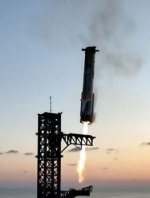
NASA used to litter the ocean floor with disposable rocket casings.
This is a stupendous achievement, landing a spent rocket casing in a cradle.
View attachment 4796
Not only a $cost savings, perhaps enhanced safety as well, as sooner or later
dropping rocket casings into the ocean risks dropping one on a boat, with humans aboard.
Would NASA now have this technology, or its lunar & Mars prospects, if it hadn't privatized?
That's only part of the story.
IF privatization benefited NASA, why not also healthcare?
This may have been perfectly true last week, but may begin drifting progressively further from the truth next week & thereafter.
Automation is a labor multiplier.
A.I. presents the likely prospect of radical changes to many job categories.
It's not merely that these markets are changing. The world is changing.
What has changed about change is the rate of change is increasing exponentially.
Who knows what the human job market will look like in the 2036?
Imagine a thought-projecting robot working the window @McD's. ... you want fries with that ! ...
Your real point is that the profit motive can induce faster innovation than the collective process of decision making by the public.
But I believe the reality is the risk of that innovation is not worth it.
For example, is it a good idea to land rockets tail first?
I don't think so.
The need to shift trust to balance it has got to be always on the verge of failing.
And in fact, it requires liquid fuel be used and carry about twice as much fuel than you would need just for take off.
Which add a vastly greater health hazard to any human around, if it does fail and explode.
Solid fuel is vastly safer and cheaper.
But even better would be to put wings on it and landing gear, so it could land safely like any glider.
I sort of like Musk, but I think the Tesla also has obvious fatal flaws.
I would never make an electric car.
It is not just all the inefficiencies of generating, transmitting, storing, retrieving and converting electricity back into kinetic energy, but the simple weight increase of all those heavy batteries. Since the batteries double the weight of the vehicle, then you more than double the energy needed to accelerate it up a hill.
With health care we don't really need or want innovation.
We just want people who are responsible, and when you privatize, you tie the hands of the honest and responsible care givers and make them follow cost guidelines.
My personal example is that after years of computer deadlines, I had some acid reflux or GERD problems.
I tried to have it looked at through my insurance, and its been over a year and they still have not gotten me to see a gastrologist specialist yet.
They keep canceling and rescheduling.
One place sent me to have cardiac stress test done, and they said I needed stints immediately.
Which makes no sense.
They said the EKG showed inverted signals, which is impossible.
What really must have happened is that the pain from the acid reflux was sending strong pain signals up the Vegas nerve bundle, while the EKG as sending weak heart rhythm signals down the Vegas nerve bundle.
What I have read is that you can't do a reliable EKG when a person has acid reflux.
They also said I have hypertension when my blood pressure is only 130/70, which is good at age 74, and they wanted me on statins, which I have read are highly dangerous and no one should take, because they cause your arteries to harden by removing all the lipids from their cells. Without lipids, cell walls become totally stiff.