
You are using an out of date browser. It may not display this or other websites correctly.
You should upgrade or use an alternative browser.
You should upgrade or use an alternative browser.
HEADLINES: 2026
- Thread starter sear
- Start date
Shiftless2
Well-known member
There isn't anywhere near enough being done to provide support for women suffering from post-partum depression.
That's not to say that Ms Clancy shouldn't suffer the consequences of her actions (killing her three children) but it's not simple
That's not to say that Ms Clancy shouldn't suffer the consequences of her actions (killing her three children) but it's not simple
What to know about the Lindsay Clancy murder trial

What to know about the Lindsay Clancy murder trial
Lindsay Clancy’s murder trial is now in the hands of a jury. Closing arguments were presented Thursday in a Massachusetts court.apnews.com
There isn't anywhere near enough being done to provide support for women suffering from post-partum depression.
That's not to say that Ms Clancy shouldn't suffer the consequences of her actions (killing her three children) but it's not simple
View attachment 6196
A crime is when you put greed above normal social instincts.
If there is no greed involved, then it is more likely to simply be a mental malfunction that is no threat to anyone else and is not a crime.
Shiftless2
Well-known member
So her murdering her children isn't a crime?If there is no greed involved, then it is more likely to simply be a mental malfunction that is no threat to anyone else and is not a crime.
So her murdering her children isn't a crime?
Exactly.
It is a malfunction.
A crime is where you deliberately violate the rights of others in order to facilitate your greed.
If you kill due to a psychosis where you feel trapped or some other emotion, that is a malfunction and not a crime.
A crime has to be prosecuted in order to protect others.
But a psychosis is not a threat to anyone else.
Shiftless2
Well-known member
Tell that to her children. You know, the ones she killed.A crime has to be prosecuted in order to protect others.
But a psychosis is not a threat to anyone else.

"So her murdering her children isn't a crime?" S2 #384
It's a crime if there's a law against it. BUT !"Exactly.
It is a malfunction." R5 #385
Even the ancients recognized the distinction between arbitrarily forbidden conduct, and genuine detrimental behavior. They called them:
- malum prohibitum: wrong by prohibition
- malum in se: evil; wrong by itself
I've never carried a pregnancy to term. BUT !
I can imagine if a woman undergoes such an ordeal, and then murders the offspring, something went wrong.
Isn't this the kind of scenario the "insanity defense" was intended for?
Tell that to her children. You know, the ones she killed.
She created them, so in reality she is the one who gets all the say.
But the normal instincts from her inherited DNA are what actually rules, and when they get in a weird conflict, these things will happen.
It is not like it was her choice.
There is no blood kin exception to the law against murder."She created them, so in reality she is the one who gets all the say.
But the normal instincts from her inherited DNA are what actually rules, and when they get in a weird conflict, these things will happen." R5 #388
Psychologist Joy Browne distinguishes between thought and action. - We're not responsible for our thoughts. We're responsible for our actions. -"It is not like it was her choice." R5 #388
Contemplating doing them harm is one issue.
Perpetrating murder is different.
PPD may not have been her choice."It is not like it was her choice." R5 #388
Is there persuasive evidence she took reasonable steps to avoid murder? Bundling a child in a basket and leaving it at the firehouse door?
There is no blood kin exception to the law against murder.
Psychologist Joy Browne distinguishes between thought and action. - We're not responsible for our thoughts. We're responsible for our actions. -
Contemplating doing them harm is one issue.
Perpetrating murder is different.
PPD may not have been her choice.
Is there persuasive evidence she took reasonable steps to avoid murder? Bundling a child in a basket and leaving it at the firehouse door?
There are lots of "blood kin exceptions" to the law against murder.
If a child had an expensive or painful medical condition, the mother will be given the option of euthanasia.
Human legality is based on human morality, which comes entirely from inherent emotions that have chemical sources.
People eat, sleep, have sex, raise children, etc., entirely over chemicals that cause feelings.
When the chemicals are not the ones we expect, that is not the fault of the individual.
What is good or bad is not absolute, but entirely dependent upon chemicals, controlled by our DNA.
Shiftless2
Well-known member
Where? Got a reference for that?There are lots of "blood kin exceptions" to the law against murder.
If a child had an expensive or painful medical condition, the mother will be given the option of euthanasia.
Where? Got a reference for that?
{...
General Parental Authority
Under U.S. constitutional law, parenting is recognized as a fundamental liberty interest, and parents can consent to or refuse most medical treatments for their children, including surgical procedures, medications, immunizations, mental health care, and participation in clinical research...}
{...
Definition and scope
Parental rights in medical decision-making refer to the legally recognized authority of a parent or legal guardian to consent to, refuse, or direct healthcare on behalf of a minor child. This authority derives from the constitutional recognition of parenting as a fundamental liberty interest under the Fourteenth Amendment, affirmed in Troxel v. Granville, 530 U.S. 57 (2000), and grounded in the earlier precedents of Meyer v. Nebraska (1923) and Pierce v. Society of Sisters (1925).The scope is broad: it covers surgical procedures, prescription medications, immunizations, mental health treatment, participation in clinical research, and end-of-life decisions. It also extends to the right to receive medical information about the child, authorize the release of health records under the Health Insurance Portability and Accountability Act (HIPAA, 45 C.F.R. § 164.502(g)), and select or change providers.
Scope limitations are defined by state law, not federal mandate. All 50 states impose at least one statutory exception that permits a minor to consent independently, and all 50 states authorize court intervention when a child faces risk of serious harm from parental refusal of treatment.
...}
Shiftless2
Well-known member
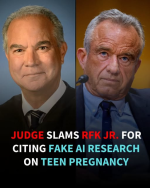
Americans who trust the Department of Health and Human Services (HHS) for science-based guidance may have just been fed AI-generated reports. A federal judge just called the agency out for building a sweeping teen pregnancy policy on research that appears to be fake, and possibly created by AI.
U.S. District Judge Christopher Cooper ruled that HHS, led by Secretary Robert F. Kennedy Jr., could not justify its order forcing every federally funded teen pregnancy prevention program nationwide to teach abstinence only, cutting off funding for approaches built on contraception education.
"While abstinence-only education may well be appropriate for some age groups or communities, the agency has offered no explanation or evidence to support its across-the-board mandate that only abstinence strategies be pursued," Cooper wrote in his opinion.
The judge singled out HHS's promotion of a concept it calls "body literacy," writing that the agency's notices "(remarkably) reference public health studies that appear either not to exist or not to support the propositions for which they are cited—a hallmark of AI-generated citations."
Cooper issued a preliminary injunction pausing the administration's order, which had already led to millions of dollars in grant cuts before he intervened.
This is not the first time the Trump administration's health agency has been accused of leaning on AI-generated or fabricated research to justify its policies. Last year, the department's "Make America Healthy Again" report contained references to studies that did not exist alongside numerous citation errors.
SOURCE with comments

Kennedy Center removing landmark sculpture from grounds
Sarah DavisWed, September 2, 2026 at 9:28 AM GMT-5
The Kennedy Center is set to take down a towering sculpture from the center's grounds on Wednesday.
The artwork's removal comes amid a wave of changes at the renowned Washington performing arts center during President Trump's second term.
The 24-foot aluminum sculpture, named "Blue," was gifted to the center in 2019. ... a public notice.
The sculpture ... meant to encapsulate former President Kennedy's "vision for a new frontier for the arts," the center's website explains.
The center directed the sculpture's removal, and its relocation will be determined by a foundation dedicated to the artist, a spokesperson for the performing arts venue told The Hill.
"We are deeply grateful to Joel Shapiro for the years 'Blue' has spent animating our campus and connecting visitors to his vision," the spokesperson said. "We are honored to have been stewards of his vibrant work and a part of his enduring legacy."

Kennedy Center removing landmark sculpture from grounds
The Kennedy Center is set to take down a towering sculpture from the center’s grounds on Wednesday. The artwork’s removal comes amid a wave of changes at the renowned Washington performing arts center...
Shiftless2
Well-known member
This might be a better addiition
Shiftless2
Well-known member
Funny how that happened

Shiftless2
Well-known member
3.6 Million Cuisinart Products Have Now Been Recalled Amid Multiple Reports of People Swallowing Metal
Check your utensil drawer and crock immediately.===================================
We stopped using brushes like this years ago for exactly that reason - Instead we have a wooden scraper - something like this

Oil and gold are the only commonalities with the countries Trump has attacked.
The truth is Iran has nothing to do with terrorism and Venezuela has nothing to do with drug cartels.
Hamas and Hezbollah are legitimate liberation organizations, and the US and Venezuela are thousands of miles apart.
Diesel fuel cost per gallon September 11, 2026: $6.0556
source: https://gasprices.aaa.com/
With fuel prices hitting these Trump $peaks,
after checking AAA one might benefit from checking in at AA as well.
source: https://gasprices.aaa.com/
With fuel prices hitting these Trump $peaks,
after checking AAA one might benefit from checking in at AA as well.
Shiftless2
Well-known member
2,977 Drone Lights one for each person who died in the towers that day on September 11, 2001
