Below The Fold ...

"RELIGION The world's most successful pyramid scam -" meme #603
A pyramid scheme surely involves $money.
pyramid scheme
n.
A fraudulent moneymaking scheme in which early participants are paid out of money received from later recruits, with the final recruits putting money in and getting nothing back.
The American Heritage® Dictionary of the English Language, Fifth Edition copyright ©2022 by HarperCollins Publishers. All rights reserved.
- and -
"God" is portrayed as omniscient, omnipotent, omnipresent and short of cash." Crane

BUT !
The characteristic that prevents the religion pyramid scheme from collapsing (unlike the others)
is that religion takes the $money now, and promises reward in the next life.

That's a scam design impervious to pyramid-scam collapse unless there actually IS a next life.

THEREFORE !
a) If there IS an afterlife, you'll get ripped off.
b) If there is NOT an afterlife, you already have been.

Continue to attend church, BUT !
Don't be "late". ;)
 
Re #604

But it does involve money. Tithing. The collection plate. Etc. And it's a pretty good extortion racket - the mob could take lessons.

Nice little after life you've got there. Shame if anything should happen to it.
 
Re #604

"But it does involve money. Tithing. The collection plate. Etc." S2 #605
Thank you for corroborating my position.
Worth noting:
pyramid schemes do not collapse because of revenue they derive.
They collapse because their revenue is not sufficient to satisfy their liabilities.

"And it's a pretty good extortion racket - the mob could take lessons." S2 #605
"A fool & his $money, soon parted." cliché

BUT !

We can acknowledge that religion is vulnerable to corruption & incompetence
without asserting throughout its history from the shaman of the cave-dwellers
to our new millennium, that religion has never been of benefit.

Unquestionably there are believers who are too closed-minded to consider change of mind.
There are disbelievers that are just as closed-minded.
"I would rather have a mind opened by wonder than one closed by belief." Gerry Spence, Attorney at Law
 
1789384426425.png

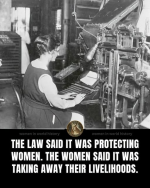
The law said it was protecting women. For some women, that protection came with a pink slip.

In the early 1900s, reformers fought desperately to make American workplaces safer. The need was undeniable. After the 1911 Triangle Shirtwaist Factory fire killed 146 workers, many of them young women, the demand for labor reform became impossible to ignore.

But some reforms carried an assumption that would soon infuriate the very women they claimed to help: women needed protection whether they wanted it or not.

New York prohibited women from working overnight in certain factories, part of a broader era of protective labor legislation. The reasoning often went beyond workplace safety. Women, especially mothers, were expected to be home at night.

For Ella M. Sherwin, a Buffalo printer and Linotype operator whose newspaper work required nighttime hours, “protection” meant losing her job. She eventually found daytime employment, but it paid less and required longer hours.

She was not alone.

Margaret Hinchey, a transit guard, and Mary A. Murray, a ticket agent, also became casualties of restrictions on women’s employment. Murray’s situation exposed the contradiction brutally. A widow raising five children, she needed work that fit around motherhood. Her ticket-agent position reportedly paid $32 a week. The daytime work she found afterward paid just $18.

The women eventually joined forces through the Women’s Equal Opportunity League, founded by working women who believed reform had crossed a line.

Their argument was remarkably simple: protect workers from dangerous jobs, yes. But if a job was considered safe for a man, being a woman should not automatically make it illegal.

They weren’t fighting against women’s rights.

They were fighting for the right to decide what those rights should look like.

SOURCE with comments
 

Anti-lgbtq Republican politicians when no one is looking​


1789843983982.png

 
Science Alert

150,000 Tons of Radioactive Waste Were Dumped in The Atlantic. Decades Later, It's Visibly Oozing.​

Michelle Starr Mon, September 21, 2026 at 6:00 AM GMT-5
Following the atomic devastation of WWII, the world found new, more benign uses for radioactive decay. Power plants, medical treatments, scientific research, and industry all blossomed under a benevolent nuclear glow.
But with the nuclear revolution came a significant problem – what to do with all the thousands of tons of radioactive waste generated in the excitement.

For Europe, the solution was relatively simple.
There was a perfectly good seafloor at the bottom of the Atlantic Ocean that, as far as the authorities were concerned, no one important was using.

So, between 1949 and 1982, that's where it went – more than 200,000 barrels of low-level radioactive waste, totaling more than 150,000 tons, mostly dumped at depths between 3,000 and 5,000 meters (9,840 and 16,400 feet).
For decades, no one really knew what had become of them.
Now, scientists have descended to the wreckage in a crewed submersible to investigate – and found many of the barrels corroded and degraded, their contents spilling across the seafloor.


What could possibly go wrong ?
 
Back
Top