View attachment 5776
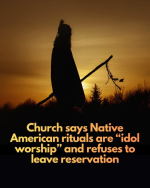
A Christian church is refusing tribal orders to leave a Wyoming reservation — and scientific data reveals that the Native American rituals the Church is attacking literally save lives.
A major clash on Wyoming’s Wind River Reservation has put a spotlight on the life-saving role of Indigenous cultural traditions. After Sarah Lucas, a pastor at the Foundations For Nations Church, publicly condemned traditional Native American rituals as 'demonic' and 'idol worship,' tribal leaders demanded the church leave the reservation.
While the church remains defiant and refuses to leave or retract its claims, scientific data highlights that these very ceremonies are vital to public health.
Decades of research show a direct link between cultural continuity and community survival, proving that the preservation of Indigenous traditions is not just about heritage—it is a critical matter of life and death.
The physical and psychological benefits of traditional practices are well-documented. A landmark 1998 study of First Nations communities by psychologists Michael Chandler and Christopher Lalonde revealed that Indigenous youth suicide rates dropped to zero in communities that maintained high levels of cultural continuity. Furthermore, clinical reviews confirm that traditional practices like sweat lodges, drumming, and talking circles are highly effective substance-use interventions, and are now standard complementary care in most Indian Health Service facilities.
By grounding individuals in a shared lineage, these sacred ceremonies provide the psychological continuity needed to foster hope, combat addiction, and save lives.
Want more evidence that Native American rituals help while Western influence and control of other culture harms? Fine.
Chandler, M. J., & Lalonde, C. (1998). Cultural continuity as a hedge against suicide in Canada's First Nations. Transcultural Psychiatry, 35(2), 191–219.
Chandler, M. J., & Lalonde, C. E. (2008). Cultural continuity as a protective factor against suicide in First Nations youth. Horizons, 10(1), 68–72.
Chase-Begay, D. M., Peterson, J. C., Liddell, J., & Belcourt, A. (2023). Traditional ceremonial practices as a strategy to reduce problem substance use in American Indian communities: A systematic review. Journal of Integrative and Complementary Medicine, 29(6–7), 408–419.
Dickerson, D. L., et al. (2021). Mental health, physical health, and cultural characteristics among American Indians/Alaska Natives seeking substance use treatment in an urban setting: A descriptive study. Community Mental Health Journal, 57(5), 937–947.
SOURCE with comments