Anthropogenic Global Warming ... how hot is it ?

The profitability of insurance is obvious since they purchased almost all the hospitals and clinics.

Bankruptcies do not indicate lack of profits, but instead just a scam to avoid payouts.
Now I know you're trolling - nobody can be dumb enough to actually believe either statement.

Financial statements for insurance companies are all available on line.
 
"The profitability of insurance is obvious since they purchased almost all the hospitals and clinics." R5 #420
Do you have stats to quantify the trend? Over the past decade? In the new millennium?

"Bankruptcies do not indicate lack of profits, but instead just a scam to avoid payouts." R5 #420
Clarification:
Bankruptcies may or may not indicate lack of profits, may instead be a scam to avoid payouts.

Right?

"Now I know you're trolling - nobody can be dumb enough to actually believe either statement." S2 #421
S2, I'd hoped CitizenVoice.us to be a reader-friendly / poster-friendly cyber-oasis on the infotainment superhighway, a refuge from acrimony.
Do we need the ad hom for that? I'm not sure potty-mouth helps either.

Besides, we can accord a little extra leeway with any post numbered #420. Right? mj03.JPG
 
Bankruptcies may or may not indicate lack of profits, may instead be a scam to avoid payouts.
Bankruptcy of an insurance company means that their debts exceed their assets. That means that their shareholders lose everything (i.e., get nothing back).

There are basically two ways this can happen: (i) losses (claims) exceed premiums (and that has to be often enough and by a sufficiently large margin to exceed the insurer's capital and surplus) or (ii) their investment portfolio goes bust - that happened to a number of companies that were heavily invested in asset backed securities when the market tanked.

Of course there are insurance companies that guarantee the performance of investments - i.e., issue guarantee bonds of one sort or another and they got nailed when the market tanked - and others that guarantee that companies will complete projects on time (Surety bonds).

Speaking of the market tanking - it only took a Gaussian copula formula to do it


BTW, the formula wasn't wrong - the problem is the people using it didn't really understand what it meant or how it worked.
 
"Bankruptcy of an insurance company means ..." S2 #423
Yes.
But the term R5 used is "bankruptcies", not "Bankruptcy of an insurance company". However,
S2 expertise on matters actuarial, second to none @CV, and second to few if any any cyber-elsewhere.

"- it only took a Gaussian copula formula to do it
BTW, the formula wasn't wrong - the problem is the people using it didn't really understand what it meant or how it worked." S2 #423
This formula includes anthropogenic global warming? Interesting.
I'd like to see that formula, and particularly, which factor/s quantify the rate of change.
 
Now I know you're trolling - nobody can be dumb enough to actually believe either statement.

Financial statements for insurance companies are all available on line.

Hospitals are expensive, so used to originally all be owned by the government of large charities like religions.
Now insurance companies are buying them all up, which takes a great deal of money.
 
Do you have stats to quantify the trend? Over the past decade? In the new millennium?


Clarification:
Bankruptcies may or may not indicate lack of profits, may instead be a scam to avoid payouts.

Right?


S2, I'd hoped CitizenVoice.us to be a reader-friendly / poster-friendly cyber-oasis on the infotainment superhighway, a refuge from acrimony.
Do we need the ad hom for that? I'm not sure potty-mouth helps either.

Besides, we can accord a little extra leeway with any post numbered #420. Right? View attachment 3662

Insurance used to almost not exist.
In the 1950s, almost no one had health insurance or car insurance.
In 1957, the IRS allowed companies to deduct health insurance for employees from their profits.
Which I consider illegal because it raised health care costs enough to force poor to also buy insurance, even though they had to pay higher rates as individuals.
Only then did insurance companies start to take off.
Then in the 1970s, car insurance started to be become mandated by law, which I consider illegal because there was no fairness regulations.
 
Bankruptcy of an insurance company means that their debts exceed their assets. That means that their shareholders lose everything (i.e., get nothing back).

There are basically two ways this can happen: (i) losses (claims) exceed premiums (and that has to be often enough and by a sufficiently large margin to exceed the insurer's capital and surplus) or (ii) their investment portfolio goes bust - that happened to a number of companies that were heavily invested in asset backed securities when the market tanked.

Of course there are insurance companies that guarantee the performance of investments - i.e., issue guarantee bonds of one sort or another and they got nailed when the market tanked - and others that guarantee that companies will complete projects on time (Surety bonds).

Speaking of the market tanking - it only took a Gaussian copula formula to do it


BTW, the formula wasn't wrong - the problem is the people using it didn't really understand what it meant or how it worked.

Bankruptcy is not when their "debts exceed their assets".
Trump bought companies all the time, with the intent of declaring bankruptcy for a profit.
The point is that bankruptcy is when your liquid cash is less than your current debt minimum payment.
It has nothing to do with assets, since they usually are not liquid.
People like Trump look for companies with high assets but low cash on hand.
Then he can declare bankruptcy, void all the debts, and keep the cash from liquidating the assets.
 
Bankruptcy is not when their "debts exceed their assets".
Trump bought companies all the time, with the intent of declaring bankruptcy for a profit.
The point is that bankruptcy is when your liquid cash is less than your current debt minimum payment.
It has nothing to do with assets, since they usually are not liquid.
People like Trump look for companies with high assets but low cash on hand.
Then he can declare bankruptcy, void all the debts, and keep the cash from liquidating the assets.

Insurance companies don't work like that. If you want to talk about insurance and bankruptcy you start with the material covered in these exams.


And insurance company becomes insolvent when its liabilities exceed its assets - that simple. Has nothing to do with "liquid cash". The company will end up being taken over by the relevant state regulator and, once they've finalized all the numbers they'll start paying claims - typically on a pro-rata basis so each claimant will (hopefully) get a percentage of their claim - unfortunately that process may take years.
 
Insurance companies don't work like that. If you want to talk about insurance and bankruptcy you start with the material covered in these exams.


And insurance company becomes insolvent when its liabilities exceed its assets - that simple. Has nothing to do with "liquid cash". The company will end up being taken over by the relevant state regulator and, once they've finalized all the numbers they'll start paying claims - typically on a pro-rata basis so each claimant will (hopefully) get a percentage of their claim - unfortunately that process may take years.

What I have read is that insurance companies deliberately declare bankruptcy because they have been pre-paid by customer premiums, and they want to "take the money and run" before they have to actually pay off the future claims that have not happened yet.

Insurance companies invest those premium assets, and that prevents them from being "liquid cash" if something comes up that requires payment.
So whether or not assets are liquid is extremely important.
If the company has liquid cash, then they can't declare bankruptcy and don't need to.
If they have no assets, then people like Trump would not be interested in buying them.
They only become a target for acquisition if they are short of liquid cash, have a debt load greater than their liquid cash, but have large value assets that can not be liquidated in time.
 
What I have read is that insurance companies deliberately declare bankruptcy because they have been pre-paid by customer premiums, and they want to "take the money and run" before they have to actually pay off the future claims that have not happened yet.
Doesn't work that way - if the company hasn't collected enough premium to pay those claims where is the money supposed to come from? Looking back to my consulting days more than once I had the unfortunate duty of telling a small start up specialty insurer that the premiums they had collected didn't come close to being enough to pay the claims under the insurance policies they'd issued. [To quote the CEO of one of those companies "we just sold $50 million in insurance for $30 million" - how can they pay those claims.

And that's hardly the worst I've seen - I've seen blocks of business where the loss ration was over 600% (a company's "loss ratio" is the ratio of losses to premiums so a 600% loss ratio means that losses were 6 times premium).

Insurance companies invest those premium assets, and that prevents them from being "liquid cash" if something comes up that requires payment.
So whether or not assets are liquid is extremely important.
In which case the company has to liquidate some assets to pay claims. Happens all the time.

If they have no assets, then people like Trump would not be interested in buying them.
They only become a target for acquisition if they are short of liquid cash, have a debt load greater than their liquid cash, but have large value assets that can not be liquidated in time.
Again - Insurance companies don't work that way - in the US they're regulated by the relevant state's insurance department and can't be simply sold off for parts until everything is settled.

That said, there are companies that specialize in buying "distressed" companies and make a profit in the process but that's because they manage to cut deals and convince insureds to take a percentage of their claim value now rather than wait around till the dust settles and maybe receive nothing.
 
Doesn't work that way - if the company hasn't collected enough premium to pay those claims where is the money supposed to come from? Looking back to my consulting days more than once I had the unfortunate duty of telling a small start up specialty insurer that the premiums they had collected didn't come close to being enough to pay the claims under the insurance policies they'd issued. [To quote the CEO of one of those companies "we just sold $50 million in insurance for $30 million" - how can they pay those claims.

And that's hardly the worst I've seen - I've seen blocks of business where the loss ration was over 600% (a company's "loss ratio" is the ratio of losses to premiums so a 600% loss ratio means that losses were 6 times premium).


In which case the company has to liquidate some assets to pay claims. Happens all the time.


Again - Insurance companies don't work that way - in the US they're regulated by the relevant state's insurance department and can't be simply sold off for parts until everything is settled.

That said, there are companies that specialize in buying "distressed" companies and make a profit in the process but that's because they manage to cut deals and convince insureds to take a percentage of their claim value now rather than wait around till the dust settles and maybe receive nothing.

We are not talking about selling $50 million in insurance for $30 million, because until the claims actually filed, there is no payout at all.
So there is nothing to "settle" if no claims have been filed yet.
Its a gamble.
They might feel lucky, and believe there won't be a lot of claims.
 
"I had the unfortunate duty of telling a small start up specialty insurer that the premiums they had collected didn't come close to being enough to pay the claims under the insurance policies they'd issued. [To quote the CEO of one of those companies "we just sold $50 million in insurance for $30 million" - how can they pay those claims." S2 #430
UUHHHGGGG !
I'm guessing (wildly?) that's because their formula for calculating premiums did not adequately account for the actual manifest liabilities.
The example that comes to mind is Florida, hurricane Andrew.

related?
Insurance supports attorneys
Some US$15 billion has been paid by insurers due to homeowners litigation since 2013 in Florida, driven by assignment of benefits cases (AOB) representing a third of new cases and litigation capitalizing on the “25 percent roof replacement” rule, where the insurer can have to pay for a roof to be replaced if just 25 percent was damaged.
The worst part is that homeowners have received less than a tenth of the US$15 billion, 91 percent is absorbed by attorney fees on both sides.
https://www.moodys.com/web/en/us/in...-managing-a-storm-of-floridas-own-making.html

"That said, there are companies that specialize in buying "distressed" companies and make a profit in the process but that's because they manage to cut deals and convince insureds to take a percentage of their claim value now rather than wait around till the dust settles and maybe receive nothing." S2 #430
Reminds me of Romney / LBO.
 
I'm guessing (wildly?) that's because their formula for calculating premiums did not adequately account for the actual manifest liabilities.
They were a medical malpractice insurer and they didn't take into account how long it takes for claims to be reported let alone paid.
 
"They were a medical malpractice insurer and they didn't take into account how long it takes for claims to be reported let alone paid." S2 #433
Thanks S2 #433.

Anthropogenic Global Warming ... how hot is it ?

The Thwaites Glacier has the world’s widest glacial interface with the ocean, extending roughly 75 miles (120 km). Alone, the Thwaites Glacier is responsible for about 4 percent of current global sea level rise. ... Such factors underscore an expectation by scientists that the glacier will collapse sometime during the 2040s and hasten the flow of ice off the WAIS into the ocean. Studies suggest that this process will eventually result in an increase in sea levels of up to 25.6 inches (65 cm) worldwide—a prospect that has caused some researchers to label the Thwaites Glacier the “Doomsday Glacier.” https://www.britannica.com/place/Thwaites-Glacier
 
And you've got a legitimate reference for that? Or did you just pull that claim out of your nether reagion.

https://pnhp.org/news/big-corporati...ctors-and-experts-say-its-ruining-healthcare/
{...

Big corporations are quietly taking over your medical practice. Some doctors and experts say it’s ruining healthcare.​

Share on FacebookShare on Twitter
By Shelby Livingston
Business Insider, April 11, 2024


  • Big businesses such as hospital systems, insurers, and PE firms are gobbling up medical clinics.
  • Some doctors and industry experts fear corporate owners could prioritize profits ahead of patients.
  • The federal government is dialing up scrutiny of PE firms and other corporate owners in healthcare.

Independent doctors are almost a thing of the past.

UnitedHealth Group struck a deal in March to buy the nine-state doctor group of the struggling hospital system Steward Health Care. The same month, the powerful healthcare conglomerate, which owns the nation’s largest health insurer, got the green light to take over a decades-old independent Oregon medical practice, adding another 100 healthcare providers to its roster. It picked up a 400-doctor group in New York about a year before.
...}
 
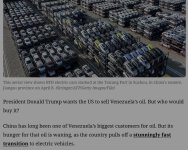
260112a.JPG

The photograph is eye-opening enough. Read between the lines.
China is an industrial titan. And while China has not terminated operation of either coal-fired commercial power generation,
or mining coal, this caption indicates China is also working to lower CO2 emissions at industrial scale.

Perhaps also worth noting:
Al Gore, the bloke that won the Y2K presidential vote and lost the s/election also authored:

An Inconvenient Truth: The Crisis of Global Warming by Al Gore

Therein Senator / Vice President / Author Gore cited a global danger, a major factor in
anthropogenic global warming. That danger? The internal combustion engine, or ICE for short.

- savor the irony
 
View attachment 3729

The photograph is eye-opening enough. Read between the lines.
China is an industrial titan. And while China has not terminated operation of either coal-fired commercial power generation,
or mining coal, this caption indicates China is also working to lower CO2 emissions at industrial scale.

Perhaps also worth noting:
Al Gore, the bloke that won the Y2K presidential vote and lost the s/election also authored:

An Inconvenient Truth: The Crisis of Global Warming by Al Gore

Therein Senator / Vice President / Author Gore cited a global danger, a major factor in
anthropogenic global warming. That danger? The internal combustion engine, or ICE for short.

- savor the irony


It is just my opinion, and I don't have proof, but it seems to me that electric vehicles increase CO2 output.
That is because electricity is inherently inefficient.
Both in generating electricity and converting electricity back into mechanical force, there is huge electrical waste, both from heat and from the imperfect alignment of magnetic fields.
It is even worse when you add the inefficiency of batteries, from resistance, heat, and weight.

Much better would be bio fuels like palm oil, ethanol, hydrogen, etc.
That is because the bio fuels remove far more CO2 while growing than are released later when burned.
They also weigh less, quicker to refuel, no resistance, etc.
 
"It is just my opinion, and I don't have proof, but it seems to me that electric vehicles increase CO2 output." R5 #438
They can
A Toyota Prius can, IF it or any plug-in hybrid is charged with commercial electric power from a coal-fired power plant.

"That is because electricity is inherently inefficient." R5 #438
I quantify this in CO2 per mile.
If per mile it burns a 20th of a gallon of gasoline not only will it add CO2 to the atmosphere but the amount in weight it adds can be more than the weight of the fuel.

If per mile it expends energy collected from solar or wind, fuel pollution is nearer zero.

"Both in generating electricity and converting electricity back into mechanical force, there is huge electrical waste, both from heat and from the imperfect alignment of magnetic fields.
It is even worse when you add the inefficiency of batteries, from resistance, heat, and weight." R5 #438
Fine. BUT !
All that inefficiency that you cite is Carbon free.

"Much better would be bio fuels like palm oil, ethanol, hydrogen, etc." R5 #438
Hydrogen seems like an absolutely dandy fuel. BUT !
Recent reports indicate storing Hydrogen adequately is easier said than done.
Jeremy Rifkin in The Hydrogen Economy says fuelizing Hydrogen is often accomplished by electrolysis of water, H2O.
Problem is, for the amount of energy input into the process, only 70% is retained.
So we need a more efficient means to supply the amount of Hydrogen needed. AND !!
Let's not forget Hindenburg.
 
They can
A Toyota Prius can, IF it or any plug-in hybrid is charged with commercial electric power from a coal-fired power plant.


I quantify this in CO2 per mile.
If per mile it burns a 20th of a gallon of gasoline not only will it add CO2 to the atmosphere but the amount in weight it adds can be more than the weight of the fuel.

If per mile it expends energy collected from solar or wind, fuel pollution is nearer zero.


Fine. BUT !
All that inefficiency that you cite is Carbon free.


Hydrogen seems like an absolutely dandy fuel. BUT !
Recent reports indicate storing Hydrogen adequately is easier said than done.
Jeremy Rifkin in The Hydrogen Economy says fuelizing Hydrogen is often accomplished by electrolysis of water, H2O.
Problem is, for the amount of energy input into the process, only 70% is retained.
So we need a more efficient means to supply the amount of Hydrogen needed. AND !!
Let's not forget Hindenburg.

While it is true that wind/solar can be totally clean, but not only is the US only 15% wind/solar, also bio fuels like palm oil actually reduce CO2 by absorbing more when grown than is released when burned.
So bio fuels are much better than wind/solar.
By better I mean much cleaner, cheaper, lighter, less flammable, etc.

We know hydrogen is not that hard to do because Iceland has been doing it for decades.
It is true hydrogen is hard to contain, but what Iceland does is generate it on the fly.
While a filled up car will lose its hydrogen in a month or two, that is not that big of a problem.
And it turns out hydrogen is not a fire risk.
The reason is it dissipates and rises too quickly to ever be a fire problem.
They say the Hindenburg was actually due to the flammable aluminum and varnish paint that was used.
While generating hydrogen has its inefficiencies, it is much more efficient than batteries.
Batteries are the worst possible, since they are expensive, heavy, slow, limited capacity, a fire hazard, and rare earth elements like lithium.
We could also use solar/wind to generate something else, like methanol.
Lots of options.
But the way we are headed is batteries, which is the worst possible.

 
Back
Top