... topic drift overflow ...

I suspect it's an isosceles triangle, two Hydrogen for every Oxygen.
We have to be a little bit careful. Many a layman might assume Hydrogen occupies a smaller sphere than Helium.
What little reading I've done about it suggests it's the opposite, counterintuitive though that may be. ... thus

Newton was brilliant, but not a quantum mechanic.


Water demonstrates cohesive force. It's why droplets falling from the drip-edge of a roof are the size they are.
Seems to me that would have to be connected to its quantum characteristics.


I'm guessing no.
One way to test it would be to measure light transmissibility through equally thick samples of amorphous vs crystalline forms of the same material.
My suspicion is there's little if any difference.

Whether amorphous is less dense, lighter per cubic centimeter than the crystalline form of the same molecule? I could guess, but am not sure.

My education ended in 1985, before all this string theory and newer ideas.
But I never totally understood quantum mechanics, which generally seems to be saying that there is no real mass, only the effects of vibrational energy.
 
"My education ended in 1985" R5 #21
I don't think so.
Formal education is a valuable gift, all too rare in our culture.
But stepping out of the schoolhouse into the sunshine does not terminate ones education.
Instead it merely puts the student in charge of his own life syllabus.

"... before all this string theory and newer ideas." R5 #21
I'm not sure string theory is substantially more than a bar room mind boink.
When Earth's leading chemists devise our latest innovations, I suspect they deal with electrons, protons, and neutrons, not strings.
Leave string to the Mudweisers. Anyone tries to pull a string on you, tell 'em to go fly a gemutlich kite.

"But I never totally understood quantum mechanics, which generally seems to be saying that there is no real mass, only the effects of vibrational energy." R5
Some may think Einstein proved Newton wrong.
I don't think so.
Long after Einstein assumed room temperature I attended college, and was taught Newton, not Einstein.

My layman's physics mantra is hardly poetic. But you're welcome to it.

Many laymen may know they don't know the laws of physics, but that there is a set of laws of physics, the scientists know them, and apply them when doing science.

That's wrong.

There isn't "a set of laws of physics".
There are three separate sets that we know of.

Newton's understanding, including his 3 laws of motion are most familiar, they're corroborated by our daily experience.
Quantum physics is different. Electrons, protons, and neutrons are not billiard balls. Quantum, a different set of laws.

Relativity, different still.
“Gravity slows down time … speed slows down time ...” Bob Berman

PS
Personal suspicion.
I don't think the speed of light (SOL) and or photons imposes a maximum speed on the universe.

Exactly the opposite, I suspect the universe imposes a maximum speed, and photons (& everything else) are subject to that cosmic speed limit.
Photons are not the enforcer. They're the victims.

Therefore to understand SOL, probably best to study 4 dimensional space / time.
 
I don't think so.
Formal education is a valuable gift, all too rare in our culture.
But stepping out of the schoolhouse into the sunshine does not terminate ones education.
Instead it merely puts the student in charge of his own life syllabus.


I'm not sure string theory is substantially more than a bar room mind boink.
When Earth's leading chemists devise our latest innovations, I suspect they deal with electrons, protons, and neutrons, not strings.
Leave string to the Mudweisers. Anyone tries to pull a string on you, tell 'em to go fly a gemutlich kite.


Some may think Einstein proved Newton wrong.
I don't think so.
Long after Einstein assumed room temperature I attended college, and was taught Newton, not Einstein.

My layman's physics mantra is hardly poetic. But you're welcome to it.

Many laymen may know they don't know the laws of physics, but that there is a set of laws of physics, the scientists know them, and apply them when doing science.

That's wrong.

There isn't "a set of laws of physics".
There are three separate sets that we know of.

Newton's understanding, including his 3 laws of motion are most familiar, they're corroborated by our daily experience.
Quantum physics is different. Electrons, protons, and neutrons are not billiard balls. Quantum, a different set of laws.

Relativity, different still.
“Gravity slows down time … speed slows down time ...” Bob Berman

PS
Personal suspicion.
I don't think the speed of light (SOL) and or photons imposes a maximum speed on the universe.

Exactly the opposite, I suspect the universe imposes a maximum speed, and photons (& everything else) are subject to that cosmic speed limit.
Photons are not the enforcer. They're the victims.

Therefore to understand SOL, probably best to study 4 dimensional space / time.

Interesting to consider if different manifestations, such as mass, wave, gravity, etc., come from which aspects are manifesting in our plane of existence, and which have shifted into other dimensions?
 
Humanity stumbles about, seemingly haphazardly. If a bloke ten times smarter than Einstein was born just a few millennia earlier,
and he told the truth, they'd have thought him a madman. Bear in mind, at that time, it was the sun that orbited the Earth. You could tell just by looking.

None the less guys like Russian chemist Dmitri Mendeleev helped forge order out of chaos. Mendeleev figured out the periodicity of the elements (despite those upstart Lanthanides).

"there is nothing covered, that shall not be revealed; neither hid, that shall not be known." St. Luke 12:2

"in time, all will be reviled." Wolf 2uk

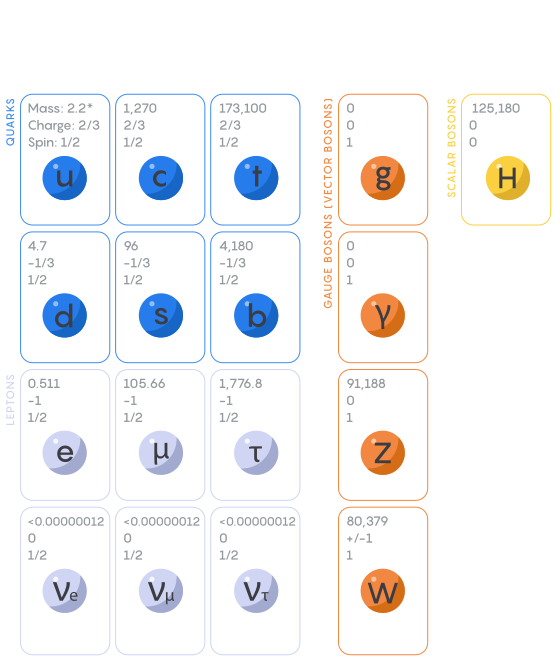
The following lists current understanding of quarks.
SM_graphic-FINAL_T01.svg


We're getting there.
Won't arrive anytime soon.
What's the rush?
 
Humanity stumbles about, seemingly haphazardly. If a bloke ten times smarter than Einstein was born just a few millennia earlier,
and he told the truth, they'd have thought him a madman. Bear in mind, at that time, it was the sun that orbited the Earth. You could tell just by looking.

None the less guys like Russian chemist Dmitri Mendeleev helped forge order out of chaos. Mendeleev figured out the periodicity of the elements (despite those upstart Lanthanides).

"there is nothing covered, that shall not be revealed; neither hid, that shall not be known." St. Luke 12:2

"in time, all will be reviled." Wolf 2uk

The following lists current understanding of quarks.
SM_graphic-FINAL_T01.svg


We're getting there.
Won't arrive anytime soon.
What's the rush?

I did know about quarks at one time, but forgot and had to look them up again.
{...
A quark (/ˈkwɔːrk, ˈkwɑːrk/ is a type of elementary particle and a fundamental constituent of matter. Quarks combine to form composite particles called hadrons, the most stable of which are protons and neutrons, the components of atomic nuclei.<a href="https://en.wikipedia.org/wiki/Quark#cite_note-1"><span>[</span>1<span>]</span></a> All commonly observable matter is composed of up quarks, down quarks and electrons. Owing to a phenomenon known as color confinement, quarks are never found in isolation; they can be found only within hadrons, which include baryons (such as protons and neutrons) and mesons, or in quark–gluon plasmas.
For this reason, much of what is known about quarks has been drawn from observations of hadrons.

Quarks have various intrinsic properties, including electric charge, mass, color charge, and spin. They are the only elementary particles in the Standard Model of particle physics to experience all four fundamental interactions, also known as fundamental forces (electromagnetism, gravitation, strong interaction, and weak interaction), as well as the only known particles whose electric charges are not integer multiples of the elementary charge.

There are six types, known as flavors, of quarks: up, down, charm, strange, top, and bottom.
Up and down quarks have the lowest masses of all quarks.
...}
 
Back
Top