I suspect it's an isosceles triangle, two Hydrogen for every Oxygen.
We have to be a little bit careful. Many a layman might assume Hydrogen occupies a smaller sphere than Helium.
What little reading I've done about it suggests it's the opposite, counterintuitive though that may be. ... thus
Newton was brilliant, but not a quantum mechanic.
Water demonstrates cohesive force. It's why droplets falling from the drip-edge of a roof are the size they are.
Seems to me that would have to be connected to its quantum characteristics.
I'm guessing no.
One way to test it would be to measure light transmissibility through equally thick samples of amorphous vs crystalline forms of the same material.
My suspicion is there's little if any difference.
Whether amorphous is less dense, lighter per cubic centimeter than the crystalline form of the same molecule? I could guess, but am not sure.
My education ended in 1985, before all this string theory and newer ideas.
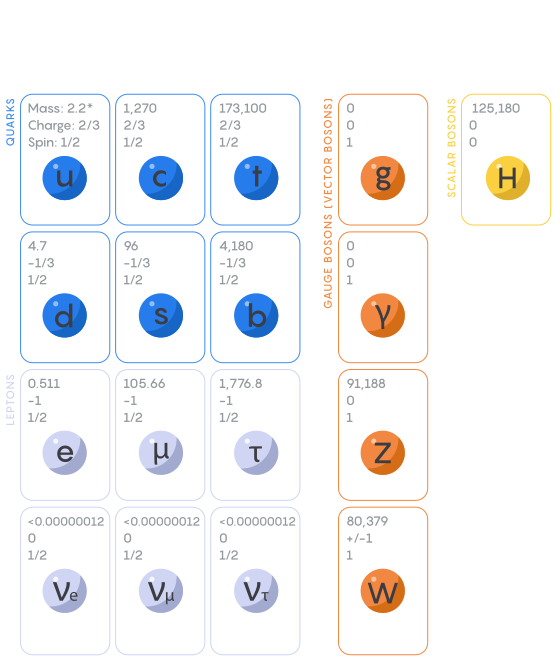
But I never totally understood quantum mechanics, which generally seems to be saying that there is no real mass, only the effects of vibrational energy.