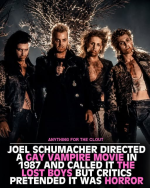
In 1987, The Lost Boys arrived as a vampire movie. Decades later, many viewers saw it as something much more: a stylish, rebellious story filled with unmistakable queer subtext.
Directed by Joel Schumacher, a filmmaker who was openly gay in Hollywood at a time when very few people in the industry were public about their sexuality, The Lost Boys became one of the most visually distinctive films of its era.
On the surface, Warner Bros. marketed it as a teenage horror film.
But beneath the leather jackets, neon lighting, and vampire mythology was a story about temptation, identity, belonging, and being drawn toward a world outside the one you were expected to follow.
Kiefer Sutherland’s character David leads the vampire group with confidence and charisma. He challenges Michael, played by Jason Patric, constantly inviting him into their world.
He teases him.
He tests him.
He tells him he is already becoming one of them.
Schumacher later described the vampires as a kind of gay biker gang, intentionally creating a group defined by beauty, danger, style, and outsider energy.
The director famously focused on casting actors with striking looks and undeniable presence, creating a group that felt almost mythological.
Released in (1987), The Lost Boys became a commercial success, earning more than three times its production budget and developing a devoted following.
For many LGBTQ+ viewers, especially those who discovered it while growing up, the film became memorable not just because of the vampires.
It was because of the feeling underneath it:
The idea that being different could be powerful.
That the outsiders could have their own world.
And that sometimes the stories people called “horror” were really stories about finding where you belong.
SOURCE with comments