
You are using an out of date browser. It may not display this or other websites correctly.
You should upgrade or use an alternative browser.
You should upgrade or use an alternative browser.
What to call this thread?
- Thread starter Shiftless2
- Start date

Shiftless2
Well-known member
GOP lawmaker revives bid to overturn same-sex marriage
Written by Amelia Hansford-

GOP lawmakers have called for the US Supreme Court to overturn Obergefell v Hodges. (Getty)
North Idaho GOP legislator Tony Wisniewski introduce a joint memorandum on Monday (23 February) that would call on the US Supreme Court to reverse its landmark decision on Obergefell v Hodges.
The 2015 ruling held that same-sex couples have a constitutional right to marriage, overruling any .....
MORE>
View attachment 4329
hi there. My name is Dakota Christine, and I am one of the many that received the letter following SB 244.
I am intersex; I was born with Androgen Insensitivity Syndrome, and have always… always… been a girl.
I was forced by the State of Kansas to hand in my drivers license, as if I was a criminal.
My drivers license was invalidated and void overnight, without warning, and it was a crime for me to drive to the DMV, to get my new license.
I do not feel equally protected, and it saddens me the lack of empathy within our Kansas State Legislature.
I am one of many that just want to exist. Live in peace, be free.
0.43% of the Kansas population is Transgender.
Percentage of Intersex people in Kansas? 0.018%
I am one of the many affected by this horrendous bill. I sobbed the entirety of yesterday, and I am so ashamed of the state that I grew up in.
I tried so hard to smile for my ‘new’ license picture, but how could I, when the state I live in, targets such a small minority.
Please vote. Please protest. This affects me, your neighbor. Your friend. Someone you actually know.
The power is and has always been with the people
SOURCE
Legible version of the letter can be found here

Log into Facebook | Facebook
Log into Facebook to start sharing and connecting with your friends, family, and people you know.www.facebook.com
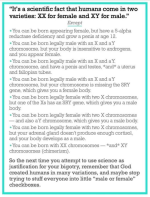
I had to look it up since I am not well informed on the subject.
{...
The different types of AIS are:
- Complete androgen insensitivity syndrome (CAIS): Your body doesn’t respond to androgens at all. Your external genitals appear female, but you don’t have female sex organs (no ovaries, fallopian tubes or uterus). People with CAIS are often raised as girls with a female gender identity. Approximately 1 in 20,000 genetically male infants are born with complete androgen insensitivity syndrome.
So it seems to me that regardless of being XY instead of XX, the person essentially is still female.
How they develop, feel, and appear will be female.
Shiftless2
Well-known member
Re #1,423
Shiftless2
Well-known member
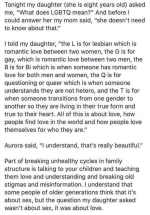
Interesting point about the difference between sex and love.
For me, what starts an attraction is about sex, but what lasts is about love.
Shiftless2
Well-known member
I agree with the second part but the first isn't always the case. I'm sure we all know someone whose significant other is ugly as sin. And they ended up talking etc because they had some mutual interest or worked together on a committee, or whatever. And somewhere along the line they suddenly realized that their partner was gorgeous on the inside where it counts.For me, what starts an attraction is about sex, but what lasts is about love.
On that topic, when I was in university campus security had a book that contained the official photos of every student on campus (basically just the photos found on our student cards). In any case, it was tradition that all the freshman students in residence had to attend a mixer (typically sometime in October) and your partner for the evening was simply assigned randomly. Didn't matter if someone already had a boyfriend/girlfriend - the assigned date was yours for that evening. Whether you ever saw them again was totally up to you. And the guys managed to get access to a copy of the book of pictures.
Then came the judging - it was called the "ghoul pool" and the guy who ended up with the ugliest date of all wouldn't hear the end of it for weeks afterwards. But one year we never told the winner that he had won cause he married her.

Reminds me a little of "Pig Night"."Then came the judging - it was called the "ghoul pool" and the guy who ended up with the ugliest date of all wouldn't hear the end of it for weeks afterwards. " S2 #1,427
Each dude brings the least attractive female he can find / invite.
The worst one wins?
Sea turtles don't suckle."... the difference between sex and love." R5 #1,426
Mom drops them into a hole in the sand, & then goes for a long swim.
Humans need over a decade to prepare offspring to live independently, & reproduce.
"Love" seems to be the remedy for that problem. Kind of fluky though.
The biology has not caught up to the sociology.
Shiftless2
Well-known member
Exactly the same except in the case of the "ghoul pool" the guys didn't make the choice - someone just arbitrarily assigned freshman students to each other. If you think about it, it actually makes sense - many (most?) first year students coming into residence don't know anyone at all - it's their first time away from home and they're living with hundreds of people in the same boat. This forces even the shyest students to meet other people.Reminds me a little of "Pig Night".
Each dude brings the least attractive female he can find / invite.
The worst one wins?
Shiftless2
Well-known member
Shame we have to keep repeating this

 www.facebook.com
What you’re really afraid of | Chris Mosier | Facebook
What you’re really afraid of
www.facebook.com
Shiftless2
Well-known member

Shiftless2
Well-known member
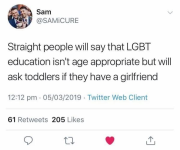
It's not practical for governments of an 8 billion planetary human population to tailor that governance to individual citizens. So we generalize, for example criminalizing beverage ethanol consumption for those below age 18, allowing it for those above age 18. BUT !
Due to individual variations, age 18 may be suitable to some, too young for others.
The cycle showroom displayed a rear-view mirror retail packaging touted as "universal".
My salesman explained, "universal" means it doesn't fit anything.
It's a valuable life lesson. Thank you Bob.
Is it not possible to present such subjects age appropriately as well?
We teach math to young children. We don't start them out with differential calculus. Single digit arithmetic is a constructive introduction.
Those that advocate against age appropriate familiarization with such sociological background are champions of ignorance.
Due to individual variations, age 18 may be suitable to some, too young for others.
The cycle showroom displayed a rear-view mirror retail packaging touted as "universal".
My salesman explained, "universal" means it doesn't fit anything.
It's a valuable life lesson. Thank you Bob.
It is a potential (deliberate?) mistake to teach delicate subjects age inappropriately to vulnerable public school children. BUT !"age appropriate" S #1,433
Is it not possible to present such subjects age appropriately as well?
We teach math to young children. We don't start them out with differential calculus. Single digit arithmetic is a constructive introduction.
Those that advocate against age appropriate familiarization with such sociological background are champions of ignorance.
Shiftless2
Well-known member
It is a potential (deliberate?) mistake to teach delicate subjects age inappropriately to vulnerable public school children. BUT !
Is it not possible to present such subjects age appropriately as well?
Define "age appropriate". And do it is such a manner that everyone will agree with you (a hint - that's not possible)
Those that advocate against age appropriate familiarization with such sociological background are champions of ignorance.
No question.
It's not practical for governments of an 8 billion planetary human population to tailor that governance to individual citizens. So we generalize, for example criminalizing beverage ethanol consumption for those below age 18, allowing it for those above age 18. BUT !
Due to individual variations, age 18 may be suitable to some, too young for others.
The cycle showroom displayed a rear-view mirror retail packaging touted as "universal".
My salesman explained, "universal" means it doesn't fit anything.
It's a valuable life lesson. Thank you Bob.
It is a potential (deliberate?) mistake to teach delicate subjects age inappropriately to vulnerable public school children. BUT !
Is it not possible to present such subjects age appropriately as well?
We teach math to young children. We don't start them out with differential calculus. Single digit arithmetic is a constructive introduction.
Those that advocate against age appropriate familiarization with such sociological background are champions of ignorance.
The question is whether or not sexuality does or should naturally develop, vs being accelerated by external suggestion?
Unlike math, where the sooner they understand it the better, it could be that sex awareness is better delayed as long as possible?
But I have no idea really.
Just remembering back to how I became aware of sexuality.
Shiftless2
Well-known member

She was a little girl in Mobile, Alabama who just wanted to dance.
Laverne Cox grew up with her mother and her twin brother, raised by a single parent who worked as a teacher and poured everything she had into her two children. From the time she was small, Cox was, by her own description, "very creative" — drawn to performance, movement, and expression in a way that felt as natural as breathing.
She began taking tap and jazz classes in third grade, performing in recitals and talent shows, alive onstage in a way she was never quite allowed to be anywhere else. But the world outside those dance studios was less welcoming. Harsh words from adults. Bullying from classmates. Messages from her church that left her feeling that the way she moved through the world — the very core of who she was — was something to be ashamed of.
At eleven years old, Laverne Cox attempted to take her own life.
She survived. And she kept going.
A scholarship brought her to the Alabama School of Fine Arts in Birmingham, where she began — slowly, carefully — to find herself. Another scholarship took her to Indiana University. She eventually transferred to Marymount Manhattan College in New York City, where she graduated with a degree in Fine Arts in Dance, caught the acting bug in the theater department, and for the first time saw transgender women living full, successful, unapologetic lives.
It changed everything she thought was possible.
She began her transition. She began auditioning. She spent years being told — by industry gatekeepers who should have known better — that she could never have a mainstream acting career. That being Black, being trans, being openly herself was simply too much for Hollywood to accept.
She made a postcard with her photograph and a simple statement: "Laverne Cox is the answer to all your acting needs."
She mailed it to 500 agents and casting directors. It got her four meetings. She kept going.
In 2012, she booked a role on a new Netflix drama called Orange Is the New Black. Her character — Sophia Burset — was layered, dignified, fully human, and unlike nearly anything television had seen before. TIME Magazine called her character "the most dynamic transgender character in history."
In 2014, two things happened that no one had ever seen before.
First, Laverne Cox became the first openly transgender person ever nominated for a Primetime Emmy Award.
Then, in June of that same year, she became the first openly transgender person ever to appear on the cover of TIME Magazine.
Standing at the intersection of both milestones, she said what many people watching needed to hear: "I was told many times that I wouldn't be able to have a mainstream career as an actor because I'm trans, because I'm black — and here I am."
She didn't stop there. She went back to Indiana University — the campus where she had once arrived as an uncertain, gender-nonconforming freshman — and delivered a speech called "Ain't I a Woman," echoing the historic words of abolitionist Sojourner Truth. She told her audience to have difficult conversations. To educate instead of dismiss. To understand that when someone needs to be who they truly are, that is not a problem to be solved. That is simply a person, being a person.
A little girl in Alabama who was told she couldn't exist.
A woman who stood on the cover of TIME and proved the world wrong.
Her name is Laverne Cox. And she is still, every single day, the answer to all your needs.
If you or someone you know is struggling, the 988 Suicide & Crisis Lifeline is available 24/7 — call or text 988.
SOURCE with comments
Counterpoint well made. BUT !"Define "age appropriate". And do it is such a manner that everyone will agree with you (a hint - that's not possible)" S2 #1,435
In our 3rd millennium human population of over 8 billion with a B humans, we have learned to contend with the practical reality that making the good the enemy of the ideal is folly.
IF we were to teach only kindergarten lessons that have 100% unanimous approval of not only the school's superintendent, and all subordinates, AND !
the full headcount of the PTA, AND!
all the other student's parents / guardians,
the syllabus would be reduced to recess, and fire drills.
“Politics is the Art of Compromise.” inspired by Chancellor Otto von Bismarck
I think it's a very broad spectrum."The question is whether or not sexuality does or should naturally develop, vs being accelerated by external suggestion?
Unlike math, where the sooner they understand it the better, it could be that sex awareness is better delayed as long as possible?
But I have no idea really.
Just remembering back to how I became aware of sexuality." R5 #1,436
Spectra are defined by their termini.
Day one, before the celebratory spanking, the newborn may not be aware of its own genitals, let alone the details of their reproductive function.
At the other end of the age spectrum, some humans seem to be virtually libidoless, "cold".
Most (obviously!) are somewhere in between. It's a tall bell-curve with a long shallow slope from 20's to grave.
We are in accord on math. BUT !
One substantial benefit of public education is socialization. Our culture benefits from citizen / neighbors practicing the skill of interacting without bloodshed.
Buying a quart of milk needn't involve mortal combat.
The thin edge of the wedge on that is broadening the kindergarten student's perspective. There is more than "self".
Rather than stating the obvious to these tabula rasas, including introduction to less obvious detail produces multiple benefits.
- It introduces complexity, helps empower them to expect complexity / the unexpected life-long.
- It may help them understand those among them that don't mesh perfectly with the myth of simple binary. AND !
- It surely may be reassuring to those individuals that might themselves otherwise feel outcast, if they don't precisely fit the norms children assume, and bigots prefer.
Parenthood is essential.#1,437
Successful parenthood is heroic.
Thank you Moms & Dads ! We could not do it without you !
Shiftless2
Well-known member
"Denying people the ability to update the gender marker on their identification is not only discriminatory; it is dangerous" Indiana's Bureau of Motor Vehicles bars trans residents from updating the gender marker on state-issued identification, following an executive order from Gov. Mike Braun that set state rules on how sex is recorded in official documents

SOURCE with comments
SOURCE with comments
I don't object to the contest."Denying people the ability to update the gender marker on their identification is not only discriminatory; it is dangerous" Indiana's Bureau of Motor Vehicles bars trans residents from updating the gender marker on state-issued identification, following an executive order from Gov. Mike Braun that set state rules on how sex is recorded in official documents #1,439
Without any opposing political force, the U.S. would be at risk at present or future of fraudsters performing such "update" for inappropriate (fraudulent) reason. I oppose that.
That does NOT mean I find today's status quo fully satisfactory. BUT !
It is acknowledgement contending with the contest is better than contending without it.