- trivia -

"Do you blame them?" S2 #80
This didactic question posted "under the wire", 12 hours before the end of January, 2026 / ET deadline,
has earned the prestigious DIDACTIC QUESTION / STEAMER OF THE MONTH award @CV.us

"Blame"?
They're humans, many with parental and or other responsibilities. Sitting this one out doesn't cram maypo into the little leaker. BUT !

Those that did refuse to participate are entitled to clear conscience about it.

Wearing a mask while robbing a bank may seem to offer some anonymity, but doesn't render the conduct any less deplorable.

Credit where credit is doo ? beerSteamer01f.JPG

Congratulations to S2 for being this month's winner, and Melania audiences for being this month's losers. They have you outnumbered S2.

 

What It Means​

short shrift​

noun SHORT-SHRIFT
Short shrift means:
a) “little or no attention or thought” or “quick work.”
b) In religious use it refers to barely adequate time for confession before execution.

Perhaps definition b) explains why complaints using the term are so rare.
 
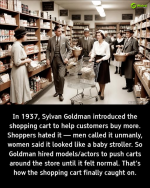
Sylvan Goldman introduced the first official shopping cart in 1937 in Oklahoma City. At the time, he owned a supermarket chain and noticed customers stopped shopping once their hand baskets got too heavy. His solution was a folding metal frame that held two wire baskets—basically a chair on wheels adapted for groceries.

The idea made practical sense, but shoppers hated it. Many men said pushing a cart felt weak or “unmanly.” Women avoided it because it reminded them of pushing a baby carriage. As a result, carts sat unused in stores at first.

Goldman responded with an unusual bit of social engineering. He hired well-dressed men and women to walk around the store pushing carts, making them look normal and even fashionable. He also stationed employees near the entrance to politely explain how carts worked and why they were helpful. Slowly, resistance faded.

Within a few years, the shopping cart became standard in American supermarkets. Goldman later refined the design, patented improvements, and built a business manufacturing carts—changing retail forever. What began as an awkward invention people mocked became one of the most profitable ideas in shopping history.

1769977184850.png
 
Hardly trivia but it doesn't really fit any place else

1770057631182.png

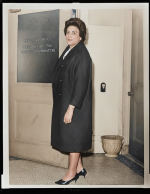
The courtroom in Jackson, Mississippi, was sweltering, but the air inside was frozen with hatred.

It was 1961.

The judge sat high on his bench. The opposing counsel all white men lounged in their chairs, smirking.

The defendant was a student trying to enter the University of Mississippi.

The lawyer representing him was standing at the podium.

She was tall, elegant, and Black.

Constance Baker Motley.

As she began to speak, citing federal statutes with perfect diction, the judge did something unthinkable.

He swiveled his leather chair around.

He literally turned his back on her.

He sat there, facing the wall, refusing to look at a Black woman who dared to act like a lawyer in his court.

The room went silent. The disrespect was total. It was designed to humiliate her, to make her stutter, to make her quit.

Constance didn't pause. She didn't raise her voice. She didn't cry.

She spoke to the back of the judge's head.

She laid out her argument with the precision of a surgeon, knowing that while the man in the chair wasn't listening, the court stenographer was typing every word.

She knew this case wasn't going to end in this sweaty room. It was going to the Supreme Court.

She wasn't arguing for the judge's approval. She was arguing for his reversal.

Constance Baker Motley was the legal architect of the Civil Rights Movement, but she is often ....

MORE>
 
And more in the same vein

1770058230797.png

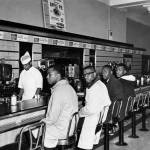
“Four college freshmen sat down at a lunch counter in 1960. America could not stay seated.”

On February 1, 1960, at 4:30 p.m., four African American students from North Carolina A&T—Joseph McNeil, Franklin McCain, Ezell Blair Jr. (later Jibreel Khazan), and David Richmond—entered the Woolworth’s on South Elm Street in Greensboro, North Carolina. They bought small items without issue, then took seats at the “whites-only” lunch counter. When refused service, they did not shout or leave. They sat quietly, homework in hand, until closing. Their disciplined silence was louder than any protest chant.

Day after day, they returned. Soon, dozens of students joined them. Within weeks, sit-ins spread across the South, organized by young people who had seen enough. Their nonviolent defiance made segregation visible in everyday life—not as a distant law, but as a humiliating reality faced over a cup of coffee.

The Greensboro Four didn’t just challenge a policy; they exposed the moral bankruptcy of Jim Crow with nothing but their presence and poise.

The sit-ins revolutionized activism, proving that strategic, peaceful resistance could mobilize a generation and pressure businesses faster than court rulings alone. By July 1960, that same Woolworth’s lunch counter was desegregated. The movement they sparked helped fuel the founding of the Student

Nonviolent Coordinating Committee (SNCC) and propelled civil rights into the national conscience.

Today, their legacy lives on in every silent sit-down, every peaceful occupation, every act of civil disobedience that says, “I, too, belong here.” The Greensboro Four remind us that courage isn’t always dramatic—sometimes, it’s simply taking a seat and refusing to be erased.

“Change does not always roar. Sometimes, it arrives in the quiet decision to stay.”
 
View attachment 3977

“Four college freshmen sat down at a lunch counter in 1960. America could not stay seated.”
On February 1, 1960, at 4:30 p.m., four African American students from North Carolina A&T—Joseph McNeil, Franklin McCain, Ezell Blair Jr. (later Jibreel Khazan), and David Richmond—entered the Woolworth’s on South Elm Street in Greensboro, North Carolina. #85

Iconic image.
Folklore has grown from this.

One such anecdote:
An African-American was belligerently informed from behind the lunch-counter "We don't serve [n-word plural] here."
The customer replied: I wasn't going to order that. Instead, I'll have a cheeseburger with fries please.

Another perhaps more familiar anecdote:
A dark-skinned diner patron was served the chicken entrée he ordered. But before he could take his first bite a White racist thug encroached and said: - Whatever you do to that chicken I'm going to do to you. -
So the diner patron leaned over, and kissed the entrée.

Tragically, Trump / MAGA demonstrates common human decency seldom lasts more than a generation in the U.S., and on Groundhog day 2026, must be relearned again.
 
Back
Top