
You are using an out of date browser. It may not display this or other websites correctly.
You should upgrade or use an alternative browser.
You should upgrade or use an alternative browser.
The war in Iran (or whose war is it anyways?)
- Thread starter Shiftless2
- Start date

Kimmel calls Trump Napoleon Bonespur. [spelling may need revision]"bones" Donald Trump, S2 #320
I'm not sure that's the ideal solution, BUT !"The solution to the situation with Iran is that someone should just give Iran a couple of nukes and call it over.
North Korea had hundreds, so could easily give up a few." R5 #321
I'm not sure there is an ideal solution here.
We can apply insight from the fable of Pandora's Box.
R5, your #321 inspires me to consider:
the intention seems to be oriented toward limiting nuclear weapons proliferation, particularly among notorious bad actors.
Seems sensible to me. BUT !!
At what cost?
It's not insensible to insure the "cure" is not worse than the disease.
And Trump's "cure" already includes the reported loss of over 100 Iranian school girls.
And so far, what have we gotten from the Trump administration about it? - oops - ?
Kimmel calls Trump Napoleon Bonespur. [spelling may need revision]
I'm not sure that's the ideal solution, BUT !
I'm not sure there is an ideal solution here.
We can apply insight from the fable of Pandora's Box.
R5, your #321 inspires me to consider:
the intention seems to be oriented toward limiting nuclear weapons proliferation, particularly among notorious bad actors.
Seems sensible to me. BUT !!
At what cost?
It's not insensible to insure the "cure" is not worse than the disease.
And Trump's "cure" already includes the reported loss of over 100 Iranian school girls.
And so far, what have we gotten from the Trump administration about it? - oops - ?
Since the US is the only one who ever considered deliberately wiping out whole cities of civilians with nukes, then it seems to me that the US is the only problem.
And to reduce the US being a nuclear problem, the only solution seems to be that as many other nations as possible need to also have nukes.
Only the treat of retaliation seems to have stopped nuked from being used by us again.
As fossil fuel runs out in 100 years, all countries will be enriching uranium for nuclear power, so eventually it will be a non-issue.
To me, the US is about the only real "bad actor".
For example, we would not allow Vietnam to elect their liberating hero as president, and killed 3 million Vietnamese in order to stop it.
Out of context it may seem that disgraceful."Since the US is the only one who ever considered deliberately wiping out whole cities of civilians with nukes, then it seems to me that the US is the only problem." R5 #323
In context, different.
The U.S. didn't attack Japan at Pearl Harbor.
And while the U.S. had non-nuclear options, some military experts have estimated if instead of nukes the U.S. had attempted to march to Tokyo in more conventional military combat style,
based on the casualty profile of the Pacific islands, the number of human lives lost might have been even larger.
There's room for speculation.
But history makes clear, the U.S. had a global nuclear weapons monopoly for long enough to have attempted global conquest.
It didn't.
Out of context it may seem that disgraceful.
In context, different.
The U.S. didn't attack Japan at Pearl Harbor.
And while the U.S. had non-nuclear options, some military experts have estimated if instead of nukes the U.S. had attempted to march to Tokyo in more conventional military combat style,
based on the casualty profile of the Pacific islands, the number of human lives lost might have been even larger.
There's room for speculation.
But history makes clear, the U.S. had a global nuclear weapons monopoly for long enough to have attempted global conquest.
It didn't.
I understand your perspective, but I see it from a different angle.
Japan has insufficient farm, mineral, or energy resource on its island limits, and what Admiral Perry's fleet visit did was threaten Japan.
Which forced Japan to then try to expand on the mainland and other Islands.
So while we think nothing of having naval bases in Hawaii, to Asians, that is an illegal invasion that threatens all of Asia.
The US then was criminal in imposing economic sanctions on Japan.
First with the 5-5-3 treaty, and later with embargoes on steel, oil, and coal.
The US supported Chang Kai Shek, who the Chinese considered an evil dictator.
They preferred the emperor that Japan supported.
After reading Truman's "Potsdam Diaries", it said that when Stalin told Truman about how Japan was trying to surrender through the Russian embassy in Japan, that Truman told him to pretend confusion, so that we could have the time to test our nukes.
Meaning we knew no invasion was necessary, since Japan was already trying to surrender a year earlier.
And the timing was not that simple.
The Russians were always almost equal to the US nuclear program, and conducted their first test detonations in 1949.
We did not detonate our first thermonuclear weapon until 1952.
So we really did not have much of an advantage, considering how Klaus Fuchs, Greenglass, the Rosenbergs, etc. kept Russia informed.
Remember that Russia got the German nuclear program.
Last edited:
Shiftless2
Well-known member
Amazing - this line of questioning, in fact this one simple question, upsets people

 www.facebook.com
820K views · 28K reactions | Dem's Line Of Questioning Sparks A GOP UPROAR | TYT Investigates | Facebook
Dem's Line Of Questioning Sparks A GOP UPROAR
www.facebook.com

The scale of Trump’s political blunder in Iran is coming into focus
Analysis by Aaron Blake, CNN / Mon, June 22, 2026 at 11:52 AM GMT-5The first major poll conducted since the Trump administration signed a memorandum of understanding with Iran has a point that seems like good news for Trump: Americans overwhelmingly agree he should end the war rather than push for more concessions.
But it's not because they actually like the agreement; it's because they think the war is a debacle, and they just want to be done with it.
A new CBS News-YouGov poll shows that even as Americans get their first glimpse — however tentative — of the finish line, it hasn't improved their views of the war one iota.
Americans think it's a bad deal
The poll shows 78% of Americans said they'd prefer to end the war now, while just 22% wanted to hold out — to "continue … until Iran gives up more."At least one Trump political adviser was celebrating that finding on Sunday. He suggested it showed the American people were on Trump and Vice President JD Vance's side on the accord with Iran.
But the rest of the poll makes it abundantly clear that's not true.
The scale of Trump’s political blunder in Iran is coming into focus
The first major poll conducted since the Trump administration signed a memorandum of understanding shows Americans just want to be done with the Iran war.
I've never seen a one-sided coin.
While this appears to be bad news for Trump's political fortunes in the twilight of his presidency,
it simultaneously appears to be a valuable gift to the Democrats for the mid-term elections, now less than a half year away. Oh D.J., you shouldn't have.
Shiftless2
Well-known member
When will the nuclear inspecgtors start work?
 www.facebook.com
America's been at war for months, and no one thought to call Iran's nuclear inspectors before 2am Sunday night? | The Daily Show | Facebook
America's been at war for months, and no one thought to call Iran's nuclear inspectors before 2am Sunday night?
www.facebook.com
Shiftless2
Well-known member
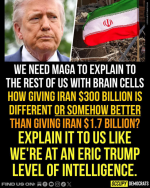
No problem, we're talkin' billions."Explain it to us like we're at an Eric Trump level of intelligence." #329
Eric Trump can count up to ten billion,
if his zipper is open.

Pape: US trying to ‘squeak out of strategic defeat’ after Iran
Political scientist Robert Pape argues the fallout of Iran war curbs US hubris and challenges Trump’s self-image.The war on Iran is “probably the true bookend to that idea that America can’t be beat”, argues Robert Pape, professor of political science at the University of Chicago.
Pape tells host Steve Clemons that the US is now trying to “squeak out” of the stipulations of the deal signed with Iran.
That deal turns Israel into “an isolated nuclear Sparta … and more of a garrison state than it is today”, says Pape.
Like Iran, Ukraine is deftly using drones to its advantage, Pape adds, and Russia should cut a deal soon because “it will just get worse and worse”.

Pape: US trying to ‘squeak out of strategic defeat’ after Iran
Political scientist Robert Pape argues the fallout of Iran war curbs US hubris and challenges Trump’s self-image.
Iranians chant ‘death to America’ during Ali Khamenei’s multi-day funeral
Didn't President Trump claim he was liberating the Iranians?
And now they chant ‘death to America’ ?
- ingrates ! -
Didn't President Trump claim he was liberating the Iranians?
And now they chant ‘death to America’ ?
- ingrates ! -
Iranians chant ‘death to America’ during Ali Khamenei’s multi-day funeral
Didn't President Trump claim he was liberating the Iranians?
And now they chant ‘death to America’ ?
- ingrates ! -
What I have read is that the US paid provocateurs to start the protests in Iran, and then stationed snipers to shoot both protestors and Iranian police.
Over 250 police were shot and killed.
This was very similar to what we did in 1953, when we paid the military to oust Mosaddegh in Operation Ajax.
The U.S. / CIA overthrow of Iran's duly elected Mossadegh is a very dark chapter in U.S. history. We have abandoned our principles, and lost our way. Happy birthday."What I have read is that the US paid provocateurs to start the protests in Iran, and then stationed snipers to shoot both protestors and Iranian police.
Over 250 police were shot and killed.
This was very similar to what we did in 1953, when we paid the military to oust Mosaddegh in Operation Ajax." R5 #333
"American people are friends of Liberty everywhere, but custodians only of their own." John Adams

Senate Democrats block $1 trillion defense bill in protest over Iran war
LISA MASCARO Updated Tue, July 14, 2026 at 3:14 PM GMT-5WASHINGTON (AP) — Senate Democrats blocked a $1 trillion annual defense bill Tuesday, refusing to advance the bipartisan package that would substantially increase Pentagon spending, including a pay raise for the troops, in protest of President Donald Trump's war against Iran.
Senate Democratic Leader Chuck Schumer announced his opposition and other key Democrats said they could not support the annual bill, known as the National Defense Authorization Act, as the war drags into a fifth month with no clear endgame in sight. The tally was 50-46, failing largely along party lines to reach the threshold needed.
"The NDAA cannot become a permission slip for that recklessness that we see occurring in Iran," Schumer, of New York, said ahead of voting.
"Donald Trump does not get to drag the American people deeper into a war he cannot explain and does not know how to end—and then demand that Congress look the other way."
The Senate vote comes a day after the White House formally notified Congress that it had resumed bombing strikes against Iran, effectively undoing the fragile ceasefire in the U.S.-Israel led conflict that has resulted in economic disruptions, including volatile gas prices ahead of the midterm elections.
Senate Democrats block $1 trillion defense bill in protest over Iran war
Senate Democrats blocked a $1 trillion annual defense bill Tuesday, refusing to advance the bipartisan package that would substantially increase Pentagon spending, including a pay raise for the troops...
What option does this leave Trump? $Spend the Pentagon budget down to $zero, then declare defeat, and call our warriors home?
The current U.S. War with Iraq was another Trump blunder. It shows Trump to be a Netanyahu dupe.
Trump was emphatic about his own dislike of Obama's JCPOA, the nuclear agreement with Britain, France, Germany, China, Russia, U.S. & Iran.
Yet Trump doesn't seem to have enough leadership skill to deliver a replacement that's as good as the one Trump unilaterally destroyed.
This conspicuous Trump incompetence sends a clear message Minority Leader Schumer [D-NY].
President Trump needs your help.
Certainly your own leadership position has its limitations, particularly with a thoughtless loose cannon for president.
None the less Senator Schumer, a competent poker player plays the hand he is dealt.
Shiftless2
Well-known member
Trump's problems with Obama's JCPOA was simple - it was Obama's.
Sadly so S2. Precisely so."Trump's problems with Obama's JCPOA was simple - it was Obama's." S2 #336
Same w/ Obamacare.
"You're going to have such great healthcare at a tiny fraction of the cost." candidate Trump 16/10/25 from campaign podium
"I am going to take care of everybody. I don't care if it costs me votes or not. Everybody's gunna be taken care of much better than they're taken care of now." Candidate Trump 15/09/27 to CBS Scott Pelly
That's why RFKj has taken a wrecking ball to it.
Trump's problems with Obama's JCPOA was simple - it was Obama's.
{...
Iran’s compliance with the nuclear-related provisions of the deal, known as the Joint Comprehensive Plan of Action (JCPOA ), is verified by the International Atomic Energy Agency (IAEA) according to certain requirements set forth in the agreement.
...}
https://www.armscontrol.org/factsheets/joint-comprehensive-plan-action-jcpoa-glance
iirc Trump did not withdraw the U.S. from Obama's agreement on basis of Iranian non-compliance."Iran’s compliance with the nuclear-related provisions of the deal, known as the Joint Comprehensive Plan of Action (JCPOA ), is verified by the International Atomic Energy Agency (IAEA) according to certain requirements set forth in the agreement." R5
Instead Trump's comment was, it's a bad deal.
It appears unlikely Trump will be able to negotiate a replacement agreement as good, including a fully, permanently open Hormuz Strait.
Shiftless2
Well-known member
But even Trump has been known to change his position on a treaty that he personally negotiated - think about his current position on CUSMA (the trade agreement between Canada, the US, and Mexico that he personally negotiated and said was the greatest thing ever).It appears unlikely Trump will be able to negotiate a replacement agreement as good, including a fully, permanently open Hormuz Strait.