The war in Iran (or whose war is it anyways?)

"Odd how the Straits of Hormuz are so important, since you would think they would have built more pipelines by now?" R5 #260
"... by now"?
Until now, there was no need, commerce flowed fairly freely, despite disruption here or there through motorized history.

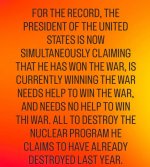
What has changed is, not only has President Trump glaringly advertised U.S. military limitations.
Trump has simultaneously educated Iran about how powerful its choke hold is on Earth's economies.

It was a dismally amateurish blunder on Trump's part.
Yet it was a predictable if not inevitable consequence of Trump surrounding himself with "yes-men" buffoons.

Any sensible field-grade commander could have / should have warned Trump of these risks before Day #1. They couldn't, after Trump cut them out of the loop.

When Trump bungles as an inept gambling casino owner it harms the casino.
When Trump bungles as president of the United States the harm is both global and severe.
 
This is an American mini-series that is heading to be a soap opera. And in the process, some 'connected' Wall Street wolves are making money out of every sway of stock/bond pricesvalues, especially of energy, financial & defense companies, which, by the way are also owned by the same wolves.

And who are the victims?

The ordinary people, not only Americans, but worldwide.

1779823175741.png

🚨
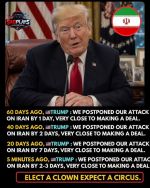
𝗪𝗛𝗘𝗡 𝗘𝗩𝗘𝗥𝗬 “𝗙𝗜𝗡𝗔𝗟 𝗪𝗔𝗥𝗡𝗜𝗡𝗚” 𝗚𝗘𝗧𝗦 𝗔 𝗡𝗘𝗪 𝗗𝗘𝗔𝗗𝗟𝗜𝗡𝗘, 𝗣𝗘𝗢𝗣𝗟𝗘 𝗦𝗧𝗔𝗥𝗧 𝗔𝗦𝗞𝗜𝗡𝗚 𝗤𝗨𝗘𝗦𝗧𝗜𝗢𝗡𝗦

For weeks, the message surrounding Iran has sounded almost the same every time:

• “Very close to a deal.”
• “Just a little more time.”
• “A final warning.”
• “A short delay.”

And each time, the deadline moves again.

Critics argue that repeated delays and shifting timelines make the situation start looking less like clear foreign policy strategy and more like political theater played out in public.

Supporters may say diplomacy takes time and delaying conflict is better than rushing into war.

But opponents argue that constant countdowns create uncertainty for:

• soldiers
• allies
• financial markets
• and ordinary people watching global tensions rise

The larger concern is credibility.

When warnings are repeated again and again without resolution, people eventually begin questioning whether the threats are strategic pressure — or simply political messaging.

Because wars are not television episodes.

And global conflict is not supposed to feel like a cliffhanger that keeps getting another extension.

💬
The bigger question now is this: when governments constantly extend “final” deadlines, does it strengthen deterrence — or weaken public trust in leadership altogether?
 
Back
Top