
You are using an out of date browser. It may not display this or other websites correctly.
You should upgrade or use an alternative browser.
You should upgrade or use an alternative browser.
The Second Term of Donald J. Trump as President of the United States of America
- Thread starter sear
- Start date
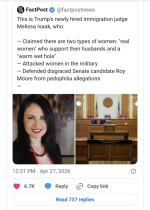
Sligh point in that Mellisa Isaak is not a judge, but a lawyer appointed as an executive administrator for immigration.
Shiftless2
Well-known member
Not sure about that - everything I can find refers to her as a judge.
That said, she supposedly founded her law firm to fight exclusively for the rights of men in family law.

 protectingmen.com
That said, she supposedly founded her law firm to fight exclusively for the rights of men in family law.
Melissa Isaak - Isaak Law Firm: Divorce Attorneys for Men
protectingmen.com
Not sure about that - everything I can find refers to her as a judge.
That said, she supposedly founded her law firm to fight exclusively for the rights of men in family law.
Melissa Isaak - Isaak Law Firm: Divorce Attorneys for Men
While the internet says there are not hard qualifications beyond having a law degree in order to become a judge, there is still an important distinction.
Which is that with a position as a judge, there is a hierarchy of appeals possible.
But with this immigration administrator position, there is no means of appeal.
Which then makes me infer it can not be a real judicial position.
When I ask the AI, it gives me this even more confusing answer:
{...
Immigration judges play a critical role in the U.S. immigration system, adjudicating cases involving asylum, deportation, and other immigration-related matters. A common question arises regarding their classification: Are immigration judges considered administrative law judges (ALJs)? While both roles involve adjudicating administrative matters, immigration judges are not formally classified as ALJs under the Administrative Procedure Act (APA). Instead, they operate within the Executive Office for Immigration Review (EOIR), a component of the U.S. Department of Justice, and are appointed by the Attorney General. Despite this distinction, immigration judges perform similar functions to ALJs, such as conducting hearings, interpreting laws, and rendering decisions, but their unique position within the immigration system sets them apart from the broader category of ALJs.
...}
Are Immigration Judges Administrative Law Judges? Understanding Their Role | LawShun
Explore the role of immigration judges and their distinction from administrative law judges. Understand their responsibilities and legal authority.
 lawshun.com
Shiftless2
Well-known member
That's a job title, not an educational one. If the individual in question is appointed as a judge they are a judge - their background, professional qualifications, and education don't come into play.While the internet says there are not hard qualifications beyond having a law degree in order to become a judge, there is still an important distinction.
Shiftless2
Well-known member
Re #3,105
That even extends to SCOTUS
Not all United States Supreme Court (SCOTUS) members were judges before being appointed. While many justices come from lower federal or state courts, the Constitution does not require previous judicial experience. Historically, justices have been appointed from backgrounds as private attorneys, government officials, or law professors, with some having never served on the bench
 YouTube +4
.
Key Details Regarding Judicial Experience:
That even extends to SCOTUS
Not all United States Supreme Court (SCOTUS) members were judges before being appointed. While many justices come from lower federal or state courts, the Constitution does not require previous judicial experience. Historically, justices have been appointed from backgrounds as private attorneys, government officials, or law professors, with some having never served on the bench
YouTube +4.
Key Details Regarding Judicial Experience:
- No Requirements: The U.S. Constitution outlines no specific educational, professional, or judicial requirements for a Supreme Court Justice
 YouTube
. - Diverse Backgrounds: Throughout history, many justices have had non-judicial backgrounds. For example, Earl Warren was a governor of California, and Felix Frankfurter was a law professor at Harvard before joining the Court.
- Modern Trends: In recent decades, it has become more common for justices to be appointed directly from the U.S. Courts of Appeals (federal judiciary)
 YouTube
. - Current Court: While most current members were appellate judges, others have come from roles such as assistant attorney general or private practice
 Supremecourt.gov +3
.
Shiftless2
Well-known member
RFK Jr (again)

 www.facebook.com
Tomorrow, RFK Jr. is back before the Senate to answer for the dangerous conspiracy theories he’s pushed from the highest seat in American public health. His own testimony made clear he was unfit for this role from the start. He should never have be
Tomorrow, RFK Jr. is back before the Senate to answer for the dangerous conspiracy theories he’s pushed from the highest seat in American public health. His own testimony made clear he was unfit...
www.facebook.com
That's a job title, not an educational one. If the individual in question is appointed as a judge they are a judge - their background, professional qualifications, and education don't come into play.
But there should be clear distinctions between the judiciary and the executive.
If these immigration administrators are appointed by the executive and if their cases do not follow the rule of law, such as being able to appeal to a higher court, then it seems to be this is violating the separation of powers portion of the Constitution?

"While the internet says there are not hard qualifications beyond having a law degree ..." R5 #3,104
That's a job title, not an educational one. If the individual in question is appointed as a judge they are a judge - their background, professional qualifications, and education don't come into play. S2 #3,105
The Constitution does not say that a Justice must be American born, a certain age, or hold any particular profession before being selected. However,

Qualifications To Become A Supreme Court Justice
Most Supreme Court nominees are personal acquaintances of the sitting President. Find out what qualifications you need to become a supreme court justice!
 thelawdictionary.org
I'm not much of a fan. BUTRFK Jr (again) S2 #3,107
Early in his elevated notoriety RFKj criticized some food dyes.
It seems they're still in use.
?
Shiftless2
Well-known member
Just says nobody took him seriously in those days either. And if Trump hadn't appointed him to a position he's not even vaguely qualified for nobody would take him seriously today either.Early in his elevated notoriety RFKj criticized some food dyes.
It seems they're still in use.
Yet he's already taken a wrecking ball to long-tenured standards, to the detriment of the People."Just says nobody took him seriously in those days either." S2 #3,110
Withholding red dye from ground beef might degrade the aesthetic (if any),
turning fresh looking red-shaded beef to grey.
But expert opinion supports RFKj's position on it.
So the Trump administration's position: only change that will be a detriment?
Shiftless2
Well-known member
Some things haven't changed

Shiftless2
Well-known member


Shiftless2
Well-known member
How to be dumb and racist

Shiftless2
Well-known member

I do not like gilding. It looks tacky to me.
Shiftless2
Well-known member
That looks like the sort of stuff you'd buy at your local arts and crafts store.I do not like gilding. It looks tacky to me.
Shiftless2
Well-known member


The biggest trading partner of every US state! | Chris Tuck | Facebook
The biggest trading partner of every US state!
www.facebook.com
Shiftless2
Well-known member
He's going to need a lot of ice for that burn