Photos, vids, etc ....

1778681999283.png

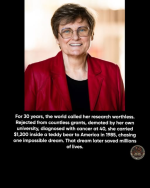
She arrived at the Philadelphia airport in 1985 with three suitcases, a two-year-old daughter, and a worn teddy bear stuffed with 1,200 dollars. Her name was Katalin Karikó. She was 30 years old, and she was about to become one of the most rejected scientists in modern history.

Hungary had only allowed her family to leave with 100 dollars. So she sold their car, exchanged the cash on the black market, and stitched the bills inside her daughter Susan's favorite teddy bear. Nobody at customs looked twice. That little bear carried everything they owned in the world.

Katalin had one wild idea. She believed messenger RNA, a fragile molecule that most scientists had given up on, could one day teach the human body to fight its own diseases. Cancer. Heart disease. Infections nobody could cure. She believed mRNA could become medicine itself.

The scientific world thought she was wrong.

For the next decade, she wrote grant proposal after grant proposal. Each one came back the same way: rejected. Too risky. Too unproven. Too strange. Colleagues whispered that her research was a dead end. Some openly told her to give up.

She refused.

Then 1995 arrived, and everything got worse. The University of Pennsylvania gave her a brutal choice: abandon mRNA, or accept a demotion with a pay cut. That same year, she was diagnosed with cancer. Her husband was stuck in Hungary because of a visa problem. She was alone, sick, and humiliated in front of every colleague she knew.

She took the demotion. She kept her research.

In 1997, beside a humming office photocopier, she met a quiet immunologist named Drew Weissman. He was working on HIV. She was working on mRNA. They started talking. They started thinking. They started trying.

For the next eight years, they wrestled with a single brutal problem. Every time mRNA was injected into a living body, the immune system attacked it like a deadly invader. The body destroyed the medicine before the medicine could do anything. Nobody had solved this. Most scientists had stopped trying.

In 2005, they finally cracked it. By changing one tiny building block inside the mRNA, they could slip it past the immune system. The body accepted it. The medicine worked.

They published their discovery in a smaller journal because Nature and Science had already rejected the paper. The world barely noticed. Karikó kept teaching, kept researching, kept being passed over for promotions, and kept believing.

Fifteen years passed.

Then, in early 2020, a new virus appeared. Within weeks, it was everywhere. Hospitals filled. Cities locked down. The world held its breath, waiting for a vaccine that normally takes a decade to build.

Two companies picked up Karikó's so-called "useless" technology and used it to build a solution in record time. By the end of 2020, the first doses were going into arms. Within two years, billions of doses had reached nearly every country on Earth. Researchers estimate that millions of lives were saved.

In October 2023, Katalin Karikó stood on a stage in Stockholm and received the Nobel Prize in Physiology or Medicine. She was 68 years old. She shared the prize with Drew Weissman, the same quiet man she had met beside that office photocopier 26 years earlier.

She donated most of her prize money to support science education back home in Hungary.

Her story is not really about a vaccine. It is about a quiet woman who was told no, again and again, for nearly 40 years, and who still answered the same question in a different way every single morning. It is about the difference between failure and not yet.

Somewhere in the world right now, there is a researcher staring at another rejection letter. There is a teacher who feels invisible. There is a builder, a writer, a parent, a dreamer doing work that nobody has noticed yet. They are tired. They are doubting themselves.

History whispers the same truth again and again. The ideas that change everything almost always look useless first.

So before we close another door, before we stop believing in another quiet dreamer, before we call another idea worthless, maybe we should pause and ask one honest question.

What if they are right?

SOURCE
 
View attachment 4989

She arrived at the Philadelphia airport in 1985 with three suitcases, a two-year-old daughter, and a worn teddy bear stuffed with 1,200 dollars. Her name was Katalin Karikó. She was 30 years old, and she was about to become one of the most rejected scientists in modern history.

Hungary had only allowed her family to leave with 100 dollars. So she sold their car, exchanged the cash on the black market, and stitched the bills inside her daughter Susan's favorite teddy bear. Nobody at customs looked twice. That little bear carried everything they owned in the world.

Katalin had one wild idea. She believed messenger RNA, a fragile molecule that most scientists had given up on, could one day teach the human body to fight its own diseases. Cancer. Heart disease. Infections nobody could cure. She believed mRNA could become medicine itself.

The scientific world thought she was wrong.

For the next decade, she wrote grant proposal after grant proposal. Each one came back the same way: rejected. Too risky. Too unproven. Too strange. Colleagues whispered that her research was a dead end. Some openly told her to give up.

She refused.

Then 1995 arrived, and everything got worse. The University of Pennsylvania gave her a brutal choice: abandon mRNA, or accept a demotion with a pay cut. That same year, she was diagnosed with cancer. Her husband was stuck in Hungary because of a visa problem. She was alone, sick, and humiliated in front of every colleague she knew.

She took the demotion. She kept her research.

In 1997, beside a humming office photocopier, she met a quiet immunologist named Drew Weissman. He was working on HIV. She was working on mRNA. They started talking. They started thinking. They started trying.

For the next eight years, they wrestled with a single brutal problem. Every time mRNA was injected into a living body, the immune system attacked it like a deadly invader. The body destroyed the medicine before the medicine could do anything. Nobody had solved this. Most scientists had stopped trying.

In 2005, they finally cracked it. By changing one tiny building block inside the mRNA, they could slip it past the immune system. The body accepted it. The medicine worked.

They published their discovery in a smaller journal because Nature and Science had already rejected the paper. The world barely noticed. Karikó kept teaching, kept researching, kept being passed over for promotions, and kept believing.

Fifteen years passed.

Then, in early 2020, a new virus appeared. Within weeks, it was everywhere. Hospitals filled. Cities locked down. The world held its breath, waiting for a vaccine that normally takes a decade to build.

Two companies picked up Karikó's so-called "useless" technology and used it to build a solution in record time. By the end of 2020, the first doses were going into arms. Within two years, billions of doses had reached nearly every country on Earth. Researchers estimate that millions of lives were saved.

In October 2023, Katalin Karikó stood on a stage in Stockholm and received the Nobel Prize in Physiology or Medicine. She was 68 years old. She shared the prize with Drew Weissman, the same quiet man she had met beside that office photocopier 26 years earlier.

She donated most of her prize money to support science education back home in Hungary.

Her story is not really about a vaccine. It is about a quiet woman who was told no, again and again, for nearly 40 years, and who still answered the same question in a different way every single morning. It is about the difference between failure and not yet.

Somewhere in the world right now, there is a researcher staring at another rejection letter. There is a teacher who feels invisible. There is a builder, a writer, a parent, a dreamer doing work that nobody has noticed yet. They are tired. They are doubting themselves.

History whispers the same truth again and again. The ideas that change everything almost always look useless first.

So before we close another door, before we stop believing in another quiet dreamer, before we call another idea worthless, maybe we should pause and ask one honest question.

What if they are right?

SOURCE

The mRNA technology can help with protein difficiencies and that is all.
When you reprogram the ribosomes in our own cells, in order to start doing odd things, the immune system detects and destroys those reprogrammed cells.
If the injected mRNA gets into valuable cells, like the heart or brain, you die.
If it only gets into capillaries, you just need aputations.
There is very little safe uses for mRNA.

And no, there is not one bit of evidence mRNA saved a single life, and instead it killed thousands.
Your "source" is an anonymous Facebook post.
 
You can add your claims to those of RFK Jr

 
3e9a9da01bf3013fbfc5005056a9545d
 

Mostly agree.
But do not agree Russia started the war with the Ukraine.
I believe the Ukraine started it by murdering, imprisoning, or expelling the legal government of the Ukraine elected in 2012, murdering over 30k ethic Russian citizens of the Ukraine, trying to stop Russian use of Sevastopol, and trying to violate treaties by joining alliances hostile to Russia.
There is no way Russia could allow NATO nukes in the Ukraine.
 
The Ukraine gave up it's nuclear arsenal because of guarantees (1994) it had received. As soon as it was confirmed that those weapons were gone, Russia attacked.


I disagree.

First of all, the Ukraine never had any nukes of its own.
Those were Russian built, owned, and manned nukes in the Ukraine.
So it was Russia who sacrificed by taking them out and reducing the size of the target the US had to aim for.

So the 1994 guarantees were the other way around.
It was the Ukraine who promised to "never join an alliance hostile to Russia", and to ensure perpetual use of Sevastopol.

But what then happened was not a Russian attack.
Instead what happened in 2014 is the US bribed the ethnic Polish generals in Kyiv, to conduct a military takeover, murdering over 30k ethnic Russian native of the Ukraine, blocking Russian use of Sevastopol, and an attempt to join NATO and the EU.
All of which are acts of war by violating treaties.

Even then Russia did not yet attack and instead tried to negotiate.
It was not until 2021 that the Ukraine broke off all negotiation with Russia, forcing Russia to finally attack.

It is my opinion the 2014 Maidan Coup was bribed by the cash Hunter Biden took with him on his trips to the Ukraine.
 
Back to the COVID vaccine - seems that the CDC (or at least RFK Jr) didn't like the results of the research on its effectiveness


I disagree.
The reason is that what the mRNA did was to mutate the DNA in the ribosomes in our own cells, to start growing spike proteins that would cause our own immune system to attack and kill them.
Sure that mutation of our own ribosome DNA that causes our immune system to attack will also attack any other pathogen like covid temporarily.
But simply hyping up our immune system for 2 months is not at all a vaccine.
It does not at all show that the immune system would later be able to identify and trigger on any covid invasion in the future.
So all the mRNA did was act like a treatment, to temporarily cause a hyper activation of our immune system for 2 months.

And while that could have some value as a treatment, it is not worth it since that hyper activation of our immune system also killed hundreds of people and caused dozens of amputations, as cells in the heart, brain, or capillaries were infected with this mRNA, started growing spike proteins, and had to be destroyed.
 
I disagree.
The reason is that what the mRNA did was to mutate the DNA in the ribosomes in our own cells, to start growing spike proteins that would cause our own immune system to attack and kill them.
Sure that mutation of our own ribosome DNA that causes our immune system to attack will also attack any other pathogen like covid temporarily.
But simply hyping up our immune system for 2 months is not at all a vaccine.
It does not at all show that the immune system would later be able to identify and trigger on any covid invasion in the future.
So all the mRNA did was act like a treatment, to temporarily cause a hyper activation of our immune system for 2 months.

And while that could have some value as a treatment, it is not worth it since that hyper activation of our immune system also killed hundreds of people and caused dozens of amputations, as cells in the heart, brain, or capillaries were infected with this mRNA, started growing spike proteins, and had to be destroyed.
Seems RFK Jr isn't the only one with a brain worm.

But thanks for reminding me - it's time to book an appointment for my next vaccination.
 
GBT #2,767
“You are entitled to your opinion. But you are not entitled to your own facts.” Senator Daniel Patrick Moynihan (D-NY)

ad hom #2,773
(n)

" mRNA " R5 #2,772
I've been puzzling over this counter-conventional perspective since you've been posting it here.
I've not yet made sense of it.

You know, I know, we know, a carpenter is not a potting shed.

Is this divergent contempt for mRNA an erroneous conflation of manufacturing technique with final product?
 
“You are entitled to your opinion. But you are not entitled to your own facts.” Senator Daniel Patrick Moynihan (D-NY)


(n)


I've been puzzling over this counter-conventional perspective since you've been posting it here.
I've not yet made sense of it.

You know, I know, we know, a carpenter is not a potting shed.

Is this divergent contempt for mRNA an erroneous conflation of manufacturing technique with final product?

It not really very complicated.
The tradition vaccine, like the Salk Polio vaccine, is where you grow polio cells in a vat, kill them with heat or something, inject them, and let the body figure out what to store as an epitope.

The only problem with traditional vaccines is that it takes years to culture them, and once they failed to kill them and they gave polio to hundreds of people.

So the idea with mRNA is to grow something in our own cells, that simulates the pathogen.
That saves the cost of culturing vats full of pathogens, and having to kill them.

But there are 2 main problems with mRNA.
One is that by reprogramming out own cells to grow spike proteins, we cause the immune system to detect these cells as damaged and needing to be destroyed.
That is no problem for arm muscle cells, but if the mRNA gets into the bloodstream, it can cause brain or heart cells to grow spikes and needing to be destroyed, in which case we die. If it even just gets into the capillaries, then the person can need amputations.
The second problem is that the spike protein can't be used as an epitope. Since the point of spike proteins is to get our ACE2 receptors in our cells to open, our own exosomes have to have a single spike protein. So then something else has to be used by the immune system to identify covid pathogens. The spike protein can't be used. It can't work.

Why does the mRNA seem to reduce symptoms?
Well by making our own cells grow spikes, the immune system detects they are defective and need to be destroyed.
And so many cells start growing spikes that the immune system then is highly stimulated, to destroy all these defective cells.
Which them means this stimulated immune system will also kill more covid cells as well.
But that is not at all how a vaccine works, and it is more like a treatment, a very risky one.
 
It not really very complicated.
The tradition vaccine, like the Salk Polio vaccine, is where you grow polio cells in a vat, kill them with heat or something, inject them, and let the body figure out what to store as an epitope.

The only problem with traditional vaccines is that it takes years to culture them, and once they failed to kill them and they gave polio to hundreds of people.

So the idea with mRNA is to grow something in our own cells, that simulates the pathogen.
That saves the cost of culturing vats full of pathogens, and having to kill them.

But there are 2 main problems with mRNA.
One is that by reprogramming out own cells to grow spike proteins, we cause the immune system to detect these cells as damaged and needing to be destroyed.
That is no problem for arm muscle cells, but if the mRNA gets into the bloodstream, it can cause brain or heart cells to grow spikes and needing to be destroyed, in which case we die. If it even just gets into the capillaries, then the person can need amputations.
The second problem is that the spike protein can't be used as an epitope. Since the point of spike proteins is to get our ACE2 receptors in our cells to open, our own exosomes have to have a single spike protein. So then something else has to be used by the immune system to identify covid pathogens. The spike protein can't be used. It can't work.

Why does the mRNA seem to reduce symptoms?
Well by making our own cells grow spikes, the immune system detects they are defective and need to be destroyed.
And so many cells start growing spikes that the immune system then is highly stimulated, to destroy all these defective cells.
Which them means this stimulated immune system will also kill more covid cells as well.
But that is not at all how a vaccine works, and it is more like a treatment, a very risky one.
Your brain worm seems to be eating well
 
Back
Top