
You are using an out of date browser. It may not display this or other websites correctly.
You should upgrade or use an alternative browser.
You should upgrade or use an alternative browser.
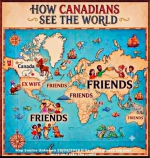
For my Canadian friends
- Thread starter Shiftless2
- Start date
Shiftless2
Well-known member
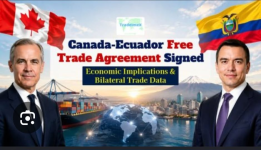
Canada CUTS the Cord from the USA as Mark Carney SEALS Ecuador FTA while American farmers are losing $41B. Canada just signed a Free Trade Agreement with Ecuador and Trump didn't even notice. He should have. That signing was the final piece of a 24-month strategic architecture Ottawa quietly assembled while the U.S. economy was busy unraveling itself.
The Ecuador trade deal immediately eliminates tariffs on 99.6% of Ecuador's exportable goods — opening 600 distinct product lines to Canadian consumers with zero duty friction. Bananas, cocoa, fresh-cut flowers, high-grade shrimp, petroleum oils, and precious metals now flow directly into Canadian deep-water ports, bypassing the contaminated and politically volatile U.S. transit grid entirely. Canada now holds active free trade agreements with every single country along the South American Pacific coast. Ottawa has finished constructing the Pacific Wall — a tariff-free maritime shipping lane stretching from the
Arctic Circle straight down the entire western spine of South America.
While the U.S. food system collapses into a $41 billion economic crater projected for 2027 — with $31 billion in agricultural losses, Canada engineered a clean, secured supply chain alternative that Washington cannot buy back into, cannot tariff, and cannot stop.
Shiftless2
Well-known member
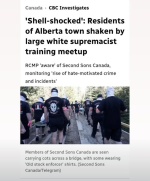
Residents of a small Alberta community say they were "shell-shocked" to learn that one of Canada's most prominent white supremacist groups had quietly held a large national training event at their local volunteer-run community hall.
As CBC Investigates reports, Second Sons Canada, a group founded by Jeremy MacKenzie, gathered more than 60 masked members for military-style drills, marches, combat training and organizational exercises near Millarville, Alberta. CBC's visual investigations team identified the location using publicly available clues from the group's own social media posts.
According to the report, Second Sons leaders have welcomed neo-Nazis into their ranks, called for the mass deportation of non-white Canadians "at gunpoint," and said Canadian politicians should be executed as traitors.
The community hall's volunteer board says the group never identified itself when booking the facility. Had volunteers known who was behind the event, they say it would never have been approved.
This is not an isolated incident. CBC notes that Second Sons has repeatedly booked community spaces across Canada under false pretences, including a similar gathering in Ontario last year. Experts say this tactic is common among white nationalist organizations because most communities would refuse to host them if they disclosed their true identity.
The RCMP says it is aware of Second Sons Canada and is monitoring the rise of hate-motivated crimes and incidents across the country, while emphasizing that investigations focus on criminal activity rather than ideology alone.
This investigation is another reminder of why investigative journalism matters. CBC didn't simply repeat a press release. Its reporters and visual investigations team pieced together publicly available evidence, identified the location, spoke with local residents, the community association, experts and police, and brought important information into the public interest.
How should communities protect themselves from extremist groups booking public spaces under false pretences while respecting civil liberties? Where should that balance be drawn?
SOURCE with comments

Canada can deal."How should communities protect themselves from extremist groups booking public spaces under false pretences while respecting civil liberties? Where should that balance be drawn?" cbc #563
In the U.S. we have The Bill of Rights which includes our First Amendment right to free speech. BUT !
Popular speech, "I love you Mommy!" doesn't need much protection.
It's unpopular speech which our First Amendment most prominently protects.
Our Skokie precedent provides insight into this. https://www.aclu.org/news/free-spee...-to-represent-the-free-speech-rights-of-nazis
Inciting to riot may be speech, but it is not protected by 1A. Neither is betraying State secrets, or libel, or perjury, or ..."No right is absolute. Conversely, no government authority is absolute." lawyer, law Professor and former ACLU head Nadine Strossen
Shiftless2
Well-known member
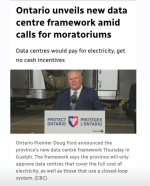
On Thursday, Doug Ford stood behind a podium reading “PROTECT ONTARIO” as he unveiled his government’s new framework for approving data centres. But with communities already calling for a pause, Ontarians might reasonably ask: who and what are we protecting?
CBC News reports the province says new data centres will pay the full cost of their electricity, receive no cash incentives and that projects using closed-loop cooling systems will be prioritized. Ford says the expansion will help keep Canadian data in Canada, while the province projects its AI strategy could generate $122 billion in economic growth by 2035 and 17,000 jobs annually.
But there are serious environmental and infrastructure questions that haven't gone away. Data centres can consume enormous amounts of electricity, require significant land and, depending on their cooling systems, put additional pressure on water resources. There are also broader questions about how rapidly expanding electricity demand will affect Ontario's grid and the province's climate commitments.
And some communities would rather understand those consequences before the building boom begins.
Oakville voted this week for a one-year moratorium. Mississauga is considering one. More than 5,000 Toronto residents have signed petitions raising concerns, while Ontario Green Leader Mike Schreiner is calling for a provincewide pause until stronger protections are established.
Schreiner also points to an important distinction in Ford's announcement: the government says it will prioritize closed-loop cooling systems rather than require them.
Ford dismissed some municipal resistance, saying it “doesn't add up” to oppose data centres when communities rely on computers, social media and AI.
But using technology doesn't mean communities have to accept every proposed data centre without first understanding its environmental footprint.
A moratorium could give Ontario time to independently assess the cumulative impacts on water, energy, land and emissions, and establish enforceable standards before approving more projects. That's not inherently anti-technology. It's asking government to know what we're getting into before committing communities to it.
So seeing “PROTECT ONTARIO” on Ford's podium raises a fair question about what that slogan means in practice.
If protecting Ontario's communities and environment ever conflicts with billions of dollars in investment, do Ontarians trust Doug Ford's government to put the public interest first? (Shift's comment - no!)
Or is “Protect Ontario” ultimately more about the money?
CBC's reporting gives Ontarians the information to start asking those questions before these decisions become irreversible.
What do you think? Should Ontario pause new data-centre approvals while their environmental and community impacts are independently assessed?
SOURCE with comments
?"Data centres would pay for electricity" S2 #565
Don't they anyway?
They may pay for both electric, & perhaps water too.
The problem is their disproportionate consumption drives the cost up for the others drawing from the same source.
Canada can deal.
In the U.S. we have The Bill of Rights which includes our First Amendment right to free speech. BUT !
Popular speech, "I love you Mommy!" doesn't need much protection.
It's unpopular speech which our First Amendment most prominently protects.
Our Skokie precedent provides insight into this. https://www.aclu.org/news/free-spee...-to-represent-the-free-speech-rights-of-nazis
Inciting to riot may be speech, but it is not protected by 1A. Neither is betraying State secrets, or libel, or perjury, or ...
Oddly enough, even "inciting to riot" can be protected by the 1A, if the riot is the only way left to preserve rights.
If you go back to the American Revolution, storming the Bastille, or the Russian Revolution, they were all mass riots actually.
View attachment 6058
On Thursday, Doug Ford stood behind a podium reading “PROTECT ONTARIO” as he unveiled his government’s new framework for approving data centres. But with communities already calling for a pause, Ontarians might reasonably ask: who and what are we protecting?
CBC News reports the province says new data centres will pay the full cost of their electricity, receive no cash incentives and that projects using closed-loop cooling systems will be prioritized. Ford says the expansion will help keep Canadian data in Canada, while the province projects its AI strategy could generate $122 billion in economic growth by 2035 and 17,000 jobs annually.
But there are serious environmental and infrastructure questions that haven't gone away. Data centres can consume enormous amounts of electricity, require significant land and, depending on their cooling systems, put additional pressure on water resources. There are also broader questions about how rapidly expanding electricity demand will affect Ontario's grid and the province's climate commitments.
And some communities would rather understand those consequences before the building boom begins.
Oakville voted this week for a one-year moratorium. Mississauga is considering one. More than 5,000 Toronto residents have signed petitions raising concerns, while Ontario Green Leader Mike Schreiner is calling for a provincewide pause until stronger protections are established.
Schreiner also points to an important distinction in Ford's announcement: the government says it will prioritize closed-loop cooling systems rather than require them.
Ford dismissed some municipal resistance, saying it “doesn't add up” to oppose data centres when communities rely on computers, social media and AI.
But using technology doesn't mean communities have to accept every proposed data centre without first understanding its environmental footprint.
A moratorium could give Ontario time to independently assess the cumulative impacts on water, energy, land and emissions, and establish enforceable standards before approving more projects. That's not inherently anti-technology. It's asking government to know what we're getting into before committing communities to it.
So seeing “PROTECT ONTARIO” on Ford's podium raises a fair question about what that slogan means in practice.
If protecting Ontario's communities and environment ever conflicts with billions of dollars in investment, do Ontarians trust Doug Ford's government to put the public interest first? (Shift's comment - no!)
Or is “Protect Ontario” ultimately more about the money?
CBC's reporting gives Ontarians the information to start asking those questions before these decisions become irreversible.
What do you think? Should Ontario pause new data-centre approvals while their environmental and community impacts are independently assessed?
SOURCE with comments
This also is coming up in New Mexico, with a data center called Project Jupiter.
The factors I measure are whether it is closed loop cooling and provides its own electricity, which then can allow the positive of 4000 construction jobs and 1500 permanent jobs to not be offset by anything.
?
Don't they anyway?
They may pay for both electric, & perhaps water too.
The problem is their disproportionate consumption drives the cost up for the others drawing from the same source.
Past data centers were not paying their fair share of electricity and were not closed loop, so residents were paying the energy costs and were getting pollution in the water.
Project Jupiter in NM claims to prevent those problems.
Shiftless2
Well-known member
Unlike the US where Hegseth is determined to shape the US military into an evangelical Christian entity

 www.facebook.com
The Canadian Armed Forces is now requiring religious neutrality at official military events. Christians can still pray and worship freely; they just can’t use a government platform to impose their beliefs. It’s a lesson Pete Hegseth and the U.S.
The Canadian Armed Forces is now requiring religious neutrality at official military events. Christians can still pray and worship freely; they just can’t use a government platform to impose their...
www.facebook.com
Shiftless2
Well-known member
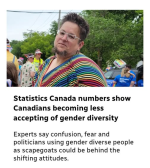
This is a troubling shift, and one worth paying attention to.
New Statistics Canada data reported by CBC News shows Canadians have become less accepting of gender diversity since 2018. In 2025, 77% of women and 70% of men surveyed agreed that people should be free to express their gender however they choose, down from 85% and 78% respectively in 2018.
The numbers are lowest in Saskatchewan, where acceptance among women fell a striking 14 percentage points.
The CBC report also asks an important question: what has happened around us during those years?
Researchers interviewed by CBC point to the increasing politicization of trans and gender-diverse people, particularly during periods when people are already worried about housing, jobs and affordability. When marginalized communities become convenient political targets, rhetoric doesn't necessarily stay in legislatures or election campaigns. It can change how neighbours see one another.
And Canada's political conversation doesn't exist in isolation. Political commentator Jack Saddleback notes that the survey overlapped with the 2024 U.S. election, while Saskatchewan and Alberta have both introduced legislation directly affecting trans and gender-diverse youth.
There is another number worth remembering, though: even after this decline, a clear majority of Canadians surveyed still support people's freedom to express their gender as they choose.
This is exactly where public-interest journalism matters. CBC can take a national statistic and bring it into communities, speaking with the people affected as well as people with different perspectives about why attitudes may be changing. It gives Canadians something more substantial to discuss than the outrage and misinformation that thrive on social media.
As j wallace skelton told CBC, trans and gender-diverse people "belong in our communities."
They do.


What do you think is driving this decline in acceptance in Canada? Have you noticed attitudes changing in your own community, and what do you think could help turn that trend around?
SOURCE with comments
a) Indeed."Statistics Canada numbers show Canadians becoming less accepting of gender diversity." meme #571
"This is a troubling shift, and one worth paying attention to." S2 #571
b) The issue is clearly defined here, a detrimental trend in public opinion.
For the health of the nation, for the benefit of humanity, should basic diversity tolerance be taught at successive levels starting in elementary school?
If not that, what?
Shiftless2
Well-known member
Apologies for the profanity ....
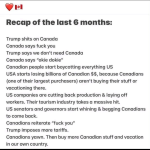
Trump didn't invent Machiavellianism. He has burnished it extensively."Apologies for the profanity ...."
#573
"America First" might seem appealing in casual xenophobic consideration. #573 demonstrates, however paradoxical Trump's attempt to make the U.S. first has failed. It is a net detriment.
The flaw in Trump's simpleminded policy results from ignoring synergy.
In "zero sum" dynamics, a decrease for one means an increase for the other. That's Trump's worldview.
But civilization doesn't work that way. When the U.S. & Canada participate as partners, both prosper.
That's not a hypothetical platitude. Decades, generations, centuries of history corroborate it. Trump has forfeited the successful synergy dynamic for a destructive political slogan. "America First"

Shiftless2
Well-known member
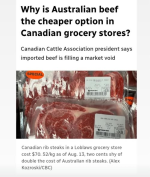
Canadian beef, raised here at home, travelling a fraction of the distance, yet Australians can ship theirs halfway around the planet and still sell it to Canadians for dramatically less. That's bound to raise some eyebrows at the grocery store.
CBC Saskatchewan found Canadian rib steaks selling at $70.52/kg at a Loblaws store, nearly twice the price of Australian rib steaks.
So how does that happen?
The Canadian Cattle Association points to several factors. Australia has a different, largely grass-based production system, its beef production has increased while North American cattle supplies have tightened, and retailers can use cheaper imported meat as a “loss leader” to attract shoppers.
Trade policy plays a role too. Since 2018, the CPTPP trade agreement has given Australian beef greater access to Canada, while also giving Canadian producers better access to markets including Japan and Vietnam.
Canadian cattle producers aren't necessarily sounding the alarm. Association president Tyler Fulton says imports can fill temporary gaps in domestic supply, while Canadian beef generally commands a premium because of characteristics such as marbling.
But consumers are confronting a much simpler reality: price.
One Saskatchewan shopper told CBC that beef has become such a luxury that, aside from ground beef, she hasn't eaten it since 2024. Another said he'd rather buy Canadian and local, but acknowledged that affordability increasingly dictates people's choices.
That tension is worth talking about. Supporting Canadian farmers sounds straightforward until families standing in a grocery aisle are being asked to pay substantially more to do it.
It's also the kind of everyday economic story public broadcasting is particularly good at telling. CBC Saskatchewan didn't just report that food is expensive. It went into the grocery stores, compared prices, talked to producers and shoppers, and asked why Canadians are seeing something seemingly counterintuitive on the shelf.
If Australian beef can travel thousands of kilometres and still substantially undercut Canadian beef, what does that tell us about our domestic food system?
Should Canadian-produced food be more affordable for Canadians? How much extra are you willing or able to pay to buy Canadian? And have high grocery prices changed what your family eats?
SOURCE with comments
View attachment 6106
Canadian beef, raised here at home, travelling a fraction of the distance, yet Australians can ship theirs halfway around the planet and still sell it to Canadians for dramatically less. That's bound to raise some eyebrows at the grocery store.
CBC Saskatchewan found Canadian rib steaks selling at $70.52/kg at a Loblaws store, nearly twice the price of Australian rib steaks.
So how does that happen?
The Canadian Cattle Association points to several factors. Australia has a different, largely grass-based production system, its beef production has increased while North American cattle supplies have tightened, and retailers can use cheaper imported meat as a “loss leader” to attract shoppers.
Trade policy plays a role too. Since 2018, the CPTPP trade agreement has given Australian beef greater access to Canada, while also giving Canadian producers better access to markets including Japan and Vietnam.
Canadian cattle producers aren't necessarily sounding the alarm. Association president Tyler Fulton says imports can fill temporary gaps in domestic supply, while Canadian beef generally commands a premium because of characteristics such as marbling.
But consumers are confronting a much simpler reality: price.
One Saskatchewan shopper told CBC that beef has become such a luxury that, aside from ground beef, she hasn't eaten it since 2024. Another said he'd rather buy Canadian and local, but acknowledged that affordability increasingly dictates people's choices.
That tension is worth talking about. Supporting Canadian farmers sounds straightforward until families standing in a grocery aisle are being asked to pay substantially more to do it.
It's also the kind of everyday economic story public broadcasting is particularly good at telling. CBC Saskatchewan didn't just report that food is expensive. It went into the grocery stores, compared prices, talked to producers and shoppers, and asked why Canadians are seeing something seemingly counterintuitive on the shelf.
If Australian beef can travel thousands of kilometres and still substantially undercut Canadian beef, what does that tell us about our domestic food system?
Should Canadian-produced food be more affordable for Canadians? How much extra are you willing or able to pay to buy Canadian? And have high grocery prices changed what your family eats?
SOURCE with comments
Beef is so high in the US, I switched entirely to pork, chicken, or fish.
"Beef is so high in the US, I switched entirely to pork, chicken, or fish." R5 #577
"I have every sympathy with the American who was so horrified by what he had read of the effects of smoking that he gave up reading." Lord Conesford
I'm pro-choice, I prefer only the choicest cuts of cattle.
Shiftless2
Well-known member
This doesn't mean that Canadians will buy them
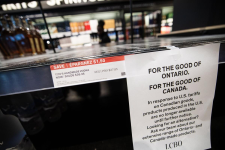
Even if American booze is returned to Ontario LCBO shelves, a poll this week found 42 per cent of respondents would still boycott U.S. wine and spirits.
There’s still no signed trade deal, but the LCBO is getting ready to put U.S. booze back on the shelves.
Several alcohol industry sources told the Star that the LCBO is preparing to restock American products as soon as Saturday, in case a trade deal with the U.S. is finalized and they’re told to restock by the Ontario government.
The LCBO declined a request for comment, but sources familiar with the preparations described usually-full storage areas at stores being “cleared out” to make ....
CONTINUED
LCBO getting ready to restock American alcohol ahead of potential Canada-U.S. trade deal
American booze was pulled from LCBO shelves by Premier Doug Ford more than a year ago in retaliation for Trump’s massive tariffs on Ontario goodsEven if American booze is returned to Ontario LCBO shelves, a poll this week found 42 per cent of respondents would still boycott U.S. wine and spirits.
There’s still no signed trade deal, but the LCBO is getting ready to put U.S. booze back on the shelves.
Several alcohol industry sources told the Star that the LCBO is preparing to restock American products as soon as Saturday, in case a trade deal with the U.S. is finalized and they’re told to restock by the Ontario government.
The LCBO declined a request for comment, but sources familiar with the preparations described usually-full storage areas at stores being “cleared out” to make ....
CONTINUED
Shiftless2
Well-known member
Re #579 - since the trade talks have collapsed it looks like that ain't happening (not that anyone was looking forward to it)
Trade negotiations between the United States and Canada fell apart on Friday night, shortly before a midnight deadline for 50% tariffs to take effect on $20 billion worth of Canadian products.
U.S. Customs and Border Protection issued a bulletin to businesses Friday warning that its officers would be ensuring importers complied with the new rates starting immediately after the deadline passed.
Canadian Prime Minister Mark Carney said late Friday that "Canada will match those tariffs dollar for dollar to protect our workers and businesses."
In a statement shared on social media, Carney said important progress had been made in recent weeks toward "improving Canada's position as having the best deal in the world with the U.S." That progress, however, did not meet Canada's objectives, he said, adding: "As a result ....
CONTINUED
Have to say that I've always figured was the best approach would be for Canada to impose export duties on anything shipped to the US - and those duties should exactly match the tariffs that the US imposes on Canadian goods.
U.S.-Canada trade talks collapse just before deadline for tariffs
Updated August 22, 20269:20 AM ETTrade negotiations between the United States and Canada fell apart on Friday night, shortly before a midnight deadline for 50% tariffs to take effect on $20 billion worth of Canadian products.
U.S. Customs and Border Protection issued a bulletin to businesses Friday warning that its officers would be ensuring importers complied with the new rates starting immediately after the deadline passed.
Canadian Prime Minister Mark Carney said late Friday that "Canada will match those tariffs dollar for dollar to protect our workers and businesses."
In a statement shared on social media, Carney said important progress had been made in recent weeks toward "improving Canada's position as having the best deal in the world with the U.S." That progress, however, did not meet Canada's objectives, he said, adding: "As a result ....
CONTINUED
Have to say that I've always figured was the best approach would be for Canada to impose export duties on anything shipped to the US - and those duties should exactly match the tariffs that the US imposes on Canadian goods.
Last edited: