Shiftless2
Well-known member
And that would be the end of the US housing industry, the auto industry, and others. Farmers need Canadian potash for fertilizer.
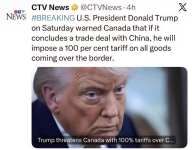
This is exactly what many of us warned about.
When a U.S. president can openly threaten Canada with 100 percent tariffs for simply pursuing its own trade relationships, that is not partnership. It is economic coercion.
What makes this worse is the timing.
This threat did not come out of nowhere. It follows directly after Prime Minister Mark Carney’s Davos speech, where he urged smaller and mid sized countries to push back against economic bullying by major powers. The message from Washington is clear. Speak out and there will be consequences.
The numbers matter. About three quarters of all Canadian exports go to the United States. Roughly half of our imports come from there as well. No other advanced economy is this dependent on a single trading partner.
That imbalance gives Washington enormous leverage, and this threat shows how quickly it can be deployed when Canada steps out of line politically.
Let’s be honest about the China angle.
Canada trading with China is not radical or new. We already do it, just as the United States does. American companies manufacture there, source components there, and sell into that market every day. The outrage only appears when Canada asserts the same right. That hypocrisy tells you this is not about values or security. It is about power and control.
A 100 percent tariff would not just hurt Canada. It would hammer American consumers and businesses almost immediately. Auto manufacturing, energy, agriculture, construction materials, and food supply chains are deeply integrated across the border. Prices would rise fast, investment would stall, and jobs would be lost on both sides. Even as a threat, it injects instability into an already fragile global economy.
This is why trade diversification is no longer optional. Canada has already begun moving in that direction. Trade with the European Union has grown under CETA. Indo Pacific trade is expanding. New agreements and broader market access reduce the ability of any single country to dictate terms through fear.
Diversification is not anti American. It is pro Canadian resilience. We can value the U.S. relationship while acknowledging reality. When one partner holds most of the leverage, it will eventually use it.
The Davos backlash proves that dependence is not safety. It is risk.
SOURCE
This is exactly what many of us warned about.
When a U.S. president can openly threaten Canada with 100 percent tariffs for simply pursuing its own trade relationships, that is not partnership. It is economic coercion.
What makes this worse is the timing.
This threat did not come out of nowhere. It follows directly after Prime Minister Mark Carney’s Davos speech, where he urged smaller and mid sized countries to push back against economic bullying by major powers. The message from Washington is clear. Speak out and there will be consequences.
The numbers matter. About three quarters of all Canadian exports go to the United States. Roughly half of our imports come from there as well. No other advanced economy is this dependent on a single trading partner.
That imbalance gives Washington enormous leverage, and this threat shows how quickly it can be deployed when Canada steps out of line politically.
Let’s be honest about the China angle.
Canada trading with China is not radical or new. We already do it, just as the United States does. American companies manufacture there, source components there, and sell into that market every day. The outrage only appears when Canada asserts the same right. That hypocrisy tells you this is not about values or security. It is about power and control.
A 100 percent tariff would not just hurt Canada. It would hammer American consumers and businesses almost immediately. Auto manufacturing, energy, agriculture, construction materials, and food supply chains are deeply integrated across the border. Prices would rise fast, investment would stall, and jobs would be lost on both sides. Even as a threat, it injects instability into an already fragile global economy.
This is why trade diversification is no longer optional. Canada has already begun moving in that direction. Trade with the European Union has grown under CETA. Indo Pacific trade is expanding. New agreements and broader market access reduce the ability of any single country to dictate terms through fear.
Diversification is not anti American. It is pro Canadian resilience. We can value the U.S. relationship while acknowledging reality. When one partner holds most of the leverage, it will eventually use it.
The Davos backlash proves that dependence is not safety. It is risk.
SOURCE