F o o d

sear

Administrator
Staff member

Why is healthy food so expensive in America? Blame the Farm Bill that Congress always renews to make burgers cheaper than salad​

BY Gene Baur July 21, 2023

The 2023 Farm Bill is projected to spend $700 billion over the next five years, with powerful industry lobbyists directing funds to enrich themselves at the expense of agricultural communities, human health, animal welfare, and environmental sustainability. It’s far from its original intention: to help struggling farmers and hungry citizens during The Great Depression and Dustbowl. This year, with growing awareness about the myriad harms of our factory farm system, we have a critical opportunity to shift Farm Bill programs to serve our nation and our planet better.

Most Americans have never heard of this massive omnibus bill, which Congress reauthorizes every five or so years, yet it impacts us every day. It shapes our food system–from subsidizing factory farms to funding food and nutrition programs, and it is why burgers are artificially cheap and salads cost more than they should.
How did this happen? Farm Bill policies have been hijacked, resulting in the demise of family farms, the proliferation of food that makes us sick, and widespread ecological destruction.
After World War II, to meet the needs of a booming U.S. population and a growing export market, the Farm Bill invested heavily in monocrops, including millions of acres of corn and soy, used to feed animals on industrialized farms. We subsidize the overproduction of fat-laden animal products and highly processed foods, making unhealthy food cheap and accessible. This contributes to heart disease and other chronic diet-related illnesses that cost our nation billions of dollars annually in preventable health care costs.
Farm Bill programs should be revised to incentivize fruits, vegetables, and other healthy foods and to make them more accessible and affordable. Nine out of 10 U.S. adults do not consume nutritionists’ recommended fruits and vegetables, and access to fresh produce is especially limited in lower-income communities. The Farm Bill can be crucial in supporting Americans’ nutritional needs by making healthy food accessible where it’s most needed.
Factory farming is capital and resource intensive, and it is inefficient. In the U.S., 10 times more farmland goes to feed farm animals than to feed people, destroying ecosystems and biodiversity, while wasting water and other increasingly scarce resources.

https://fortune.com/2023/07/21/why-...-renews-make-burgers-cheaper-salad-gene-baur/

Anatomically modern humans emerged less than 400,000 years ago; we have been around for less than 0.01 per cent of the Earth’s story. ... The oldest Homo sapiens remains date from 315,000 years ago, and until 12,000 years ago all humans lived as hunter-gatherers.

https://aeon.co/essays/we-will-never-be-able-to-live-on-another-planet-heres-why
Compared to life in 3rd millennium U.S. society, the hunter-gatherer existence is labor intensive. Without refrigeration and other modern food storage techniques acquiring food and maintaining shelter left little time to hunter-gatherers for other pursuits.

By hunter-gatherer standards today's U.S. food supply is $cheap, and well regulated and safe.

But these congressional farm subsidies are promoted in context of "constituent service", farm State congressmen seeking to benefit voters in their congressional district.

Does this tinkering with the economics of our food supply really benefit the U.S. population as a whole? And with global trade, and the U.S. being both food importer & exporter, doesn't it affect all humanity?

The following excerpted from U.S. Presidential candidate Libertarian Andre Marrou's 1992 stump speech, added for context.
It's a mistake to perceive it as gospel truth. But despite flaws, it calls attention to congress' institutional rejection of laissez-faire market dynamics.


The annual subsidy for each American dairy cow is between $600-$700 dollars a year.
This is greater than the per capita income of half of the worlds population. And what do
we get for that? We get a price for milk and other dairy products that's double the
world's level.
Who does this impinge on? Primarily poor people with children. Rich people could care
less what the price of milk is. Poor people without children, they don't use much milk.
It's the poor people with children who are primarily hurt by this.

 

Food Waste and Food Rescue

When we stop food waste, we take a big step toward ending hunger.
America has more than enough food for everyone to eat. But each year, billions of pounds of perfectly good food go to waste. Meanwhile, 34 million face hunger in the United States.
As the country's largest food rescue organization, Feeding America partners with food manufacturers, grocery stores, restaurants, and farmers to rescue food and deliver it to food banks serving our neighbors.

What is food waste?

Food waste is safe, high-quality food that is thrown away rather than eaten. Food waste occurs for a variety of reasons, including:
  • Uneaten food that is thrown out at homes, stores, and restaurants
  • Crops left in fields because of low crop prices or too many of the same crops being available
  • Problems during the manufacturing and transportation of food
  • Food not meeting retailers' standards for color and appearance

How much food waste is there in the United States?

Each year, 119 billion pounds of food is wasted in the United States. That equates to 130 billion meals and more than $408 billion in food thrown away each year. Shockingly, nearly 40% of all food in America is wasted.
Food goes to waste at every stage of food production and distribution - from farmers to packers and shippers, from manufacturers to retailers to our homes. Food waste in our homes makes up about 39% of all food waste - about 42 billion pounds of food waste. While commercial food waste makes up about 61% of all food waste or 66 billion pounds of food waste. Feeding America focuses on reducing food waste on farms and in food service, manufacturing, and retail.

What is Feeding America doing about food waste?

[ article continues @ https://www.feedingamerica.org/our-work/reduce-food-waste ]
 

“The works of the roots of the vines, of the trees, must be destroyed to keep up the price, and this is the saddest, bitterest thing of all. Carloads of oranges dumped on the ground. The people came for miles to take the fruit, but this could not be. How would they buy oranges at twenty cents a dozen if they could drive out and pick them up? And men with hoses squirt kerosene on the oranges, and they are angry at the crime, angry at the people who have come to take the fruit. A million people hungry, needing the fruit- and kerosene sprayed over the golden mountains. And the smell of rot fills the country. Burn coffee for fuel in the ships. Burn corn to keep warm, it makes a hot fire. Dump potatoes in the rivers and place guards along the banks to keep the hungry people from fishing them out. Slaughter the pigs and bury them, and let the putrescence drip down into the earth.

There is a crime here that goes beyond denunciation. There is a sorrow here that weeping cannot symbolize. There is a failure here that topples all our success. The fertile earth, the straight tree rows, the sturdy trunks, and the ripe fruit. And children dying of pellagra must die because a profit cannot be taken from an orange. And coroners must fill in the certificate- died of malnutrition- because the food must rot, must be forced to rot. The people come with nets to fish for potatoes in the river, and the guards hold them back; they come in rattling cars to get the dumped oranges, but the kerosene is sprayed. And they stand still and watch the potatoes float by, listen to the screaming pigs being killed in a ditch and covered with quick-lime, watch the mountains of oranges slop down to a putrefying ooze; and in the eyes of the people there is the failure; and in the eyes of the hungry there is a growing wrath. In the souls of the people the grapes of wrath are filling and growing heavy, growing heavy for the vintage.” ~ John Steinbeck, The Grapes of Wrath

 
I've read implausible news reports from authoritative journalistic sources of fresh dairy milk being spilled into the sewer because the retail market price didn't justify wholesale or retail marketing.

I'm trying to relate Steinbeck's dystopian description to U.S. Depression era history. I don't recall specific examples. But "Burn corn to keep warm, it makes a hot fire" does summon gasohol to mind. Corn State senators thought adding corn-based ethanol to automotive fuel would raise the market price for corn, for the voting farmers in their districts.
But corn had been a low cost staple food for the poor.


Tortilla prices are going up, causing hardship for the poor in Mexico, apparently because of all the use of ethanol in the U.S.

The U.S. is making lots of ethanol out of corn, to use as an alternative to gasoline — creating a shortage of corn for people wanting to make tortillas. Indeed, there some 100 more ethanol plants being planned, which will eat up even more corn — and this comes despite doubts about whether using corn ethanol for environmental reasons is really worth it. It has marginal benefits.

https://venturebeat.com/business/et...n-shortages-spiking-price-price-of-tortillas/


There must be a better way?
Neither the Soviets nor the Chi-Comms found it. And so we continue ...
Up to 811 million people — about 10% of the world’s population — regularly go to bed hungry. The war in Ukraine has made conditions worse, as conflict restricts global food supplies, drives up prices, and threatens the world’s most vulnerable people and countries.
Here are 10 facts you should know about global hunger and food insecurity: more at

https://www.worldvision.org/hunger-news-stories/world-hunger-facts
Q: What has a hundred ears but can’t hear?
A: A cornfield.
 
"... crickets, for example, need 12 times less feed than cattle" so skip the burger, and munch bugs !

1770694881243.png
So, why should we eat bugs?

In 2013, a report by the Food and Agriculture Organization *(FAO) of the United Nations, urged global citizens to eat more bugs for three reasons:
  1. They’re healthier for you…and tasty too!
    • Bugs are a healthy, nutritious alternative to mainstream staples such as chicken, pork, beef, and fish (from ocean catch).
    • Many insects are rich in protein, good fats, and high in calcium, iron, and zinc.
    • Insects already form a traditional part of many regional and national diets.
    • Bugs can be used as an ingredient substitute for almost any recipe. Here’s a link with ideas on how to make some delicious bug treats!
  2. They’re safer for the environment
    • Bugs promoted as food emit 75 percent fewer greenhouse gases (GHGs) than most livestock.
    • Insect rearing is not necessarily a land-based activity and does not require as much land as livestock.
    • Because they are cold-blooded, insects are efficient at converting feed into protein (crickets, for example, need 12 times less feed than cattle, four times less feed than sheep, and half as much feed as pigs and broiler chickens to produce the same amount of protein).
    • According to the Harvard Political Review, producing one pound of beef requires 10 pounds of feed, 1,000 gallons of water, and 200 square feet of pasture. In contrast, producing one pound of insects only requires two pounds of feed, one gallon of water, and two cubic feet of land space.
  3. They’re lower in cost
    • Bug harvesting/rearing is a low-tech, low-capital investment option that offers economic opportunities to all levels of society.
    • Insect rearing can be low-tech or very sophisticated, depending on the level of investment.
Recent advances in research and development show edible bugs to be a promising alternative to meat for both human consumption and as feedstock. But to make this a reality, regulatory frameworks for safety and nutrition will need to be developed and government, industry, and academia will need to work together.

In the meanwhile, knowing the benefits can help turn disgust to hunger when tarantulas or crickets appear on the menu… Something to think about!

*Links are no longer active as the original sources have removed the content, sometimes due to federal website changes or restructurings.
 
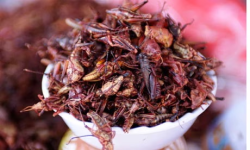
Here you go (deep fried and ready to eat)

1770725868002.png

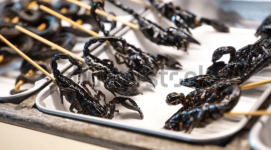
And if you want something a little more exotic here's deep fried scorpions typically sold as street food0


1770725691911.png
 
"deep fried scorpions" #6
Six drumsticks ! Allah be praised !

Some good news, and some bad news:
The good news, by 2030 over half the drinking water in the U.S. will come from sewage treatment plants.
The bad news, there won't be enough of it to meet demand. [inspired by Paul Harvey]
 
Back
Top