Below The Fold ...

Billie Eilish sparks firestorm for ‘very privileged’ take on meat eaters who love animals​

Eilish told ELLE Magazine 'y'all not gonna like me for this one' before sharing her take on veganism​

By Janelle Ash Fox News / Published May 8, 2026 9:00am EDT
Billie Eilish is in the middle of another media frenzy and has been called a "hypocrite" for slamming people who love animals but eat meat.
"Y’all not gonna like me for this one... Eating meat is inherently wrong," the singer began.

"Inherently wrong", and delicious.

And Billie, you look like a girl !


om·ni·vore (ŏmnə-vôr′)
n. Eating food of any kind, including animals and plants.
1. An omnivorous animal: "Humans are quintessential omnivores" (Paul Rozin).

[From New Latin Omnivora, omnivores, from neuter pl. of Latin omnivorus, omnivorous; see OMNIVOROUS.]
The American Heritage® Dictionary of the English Language, Fifth Edition copyright ©2022 by HarperCollins Publishers. All rights reserved.

Fallon180704b.JPG

Fallon181115b.JPG
 
1778271595452.png

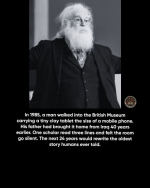
The man at the desk that day was Dr. Irving Finkel, a curator at the British Museum and one of the very few people alive who can sight-read cuneiform, the wedge-shaped writing of ancient Mesopotamia. He had translated thousands of clay tablets in his career. Contracts. Prayers. Grocery lists. Lullabies. Magic spells. He was, by all accounts, a man who had earned the right to be hard to surprise.
The visitor was Douglas Simmonds. His father, Leonard, had served with the RAF in the Near East at the end of the Second World War and brought home a small bag of antiquities. Douglas had inherited the collection and wanted Finkel to take a look.
Finkel picked up one tablet. He read the first line. Then the second. Then the third.
"Wall, wall! Reed wall, reed wall! Atra-hasis…"
These are the famous opening lines of the Babylonian Flood Story. Finkel asked, almost shaking, if he could keep the tablet to translate. Douglas politely refused and walked out of the museum with it in his bag.
Finkel waited. One year. Five years. Ten years.
It was not until 2009, twenty-four years later, that Douglas finally agreed to bring the tablet back for proper study. By then, he had even had it professionally fired so it would not crumble. Finkel locked himself in his office with a lamp, a lens, and a freshly sharpened pencil.
What he found was not just a story.
It was a manual.
The Babylonian god Enki, sympathetic to humanity, was telling a man named Atra-hasis exactly how to build a boat to survive a coming flood. Materials. Quantities. Dimensions. Methods. Sixty lines of practical Bronze Age shipbuilding instructions, written down between 1900 and 1700 BCE — almost 4,000 years ago.
But here was the part that stopped Finkel cold.
The boat was round.
It was a giant Mesopotamian coracle, a basket-shaped river craft of the kind people in southern Iraq still used until the 1970s. The instructions called for palm-fibre rope, wooden ribs, and hot bitumen to seal the hull. The base was about 3,600 square metres, roughly two-thirds the size of a football field, with walls about 6 metres high.
Then, near the bottom of the tablet, came the line that truly shocked the scholarly world.
The instruction for the animals.
"Two by two."
For centuries, those three words had been considered a unique signature of the Book of Genesis. A phrase printed on every children's book, every Sunday school illustration, every Hollywood Noah film. They turned out to be a fixed Babylonian phrase already a thousand years old when the Hebrew authors of Genesis began writing.
When Finkel published his findings in 2014 in the book "The Ark Before Noah," the response was enormous. But he wanted to know one more thing.
Did the ancient instructions actually work?
So he helped build the boat. A team of about 40 traditional craftsmen in Kerala, India, spent six months constructing a roughly one-fifth scale replica, following the recipe in the clay. Palm-fibre rope. Wooden ribs. Hot bitumen.
When they pushed it into the water, it floated.
It also leaked, and a small pump was used to manage the seepage. Finkel himself was honest about the limits. He said he was "107 percent convinced" no real ark ever existed at full scale. The Babylonians, he explained, did not have the wood-splicing technology to build the real thing. But the design, the principle, the engineering memory of how to make a giant basket float on rising water — that was real. That was four thousand years old. And it worked.
Mesopotamian, Hebrew, Greek, Hindu, Chinese — civilisations across thousands of miles and thousands of years all carried different versions of the same memory. The rains came. The rivers rose. Someone built something that floated. And someone else lived to tell the story.
The Ark Tablet itself is small enough to hold in one hand. It is privately owned and rarely on public display. Most people will never see it.
But for four thousand years, in a piece of dried Iraqi clay, the answer to one of the oldest questions humans have ever asked sat quietly waiting.
How do we survive when everything is lost?
We make something that floats. We bring what we love. We help each other into the boat.
And we tell the story afterwards, so the next time the water rises, somebody else will know what to do.
#AncientHistory #NoahsArk #Mesopotamia #Archaeology #BritishMuseum
~Unusual Tales

SOURCE

 
"He said he was "107 percent convinced" no real ark ever existed at full scale. The Babylonians, he explained, did not have the wood-splicing technology to build the real thing. But ..." #282
Benjamin Franklin may have invented the lightning rod. He did not invent the flood.

Boat manufacturing technology aside, the notion that one man & extended family could have collected two of every kind, viable breeding pairs from around the globe, multiple continents within the animal's breeding lifetime, not plausible.

And in the context of anthropogenic global warming, and sea-level rise, where did enough water come from to make the summit of Mt. Ararat a small ocean island? And where did the water go so quickly afterward?

Didn't the Biblical account claim it rained for 40 days and 40 nights?
If so wouldn't that mean Noah's arc would have had to have a roof?
An open boat subjected to such rain would founder under such conditions.

The Holy Bible is an interesting storybook. It's more likely that it reveals the fantasies of the authors, than objective historic accounts.

Want to know about stories? Ask a priest, an imam, or a rabbi.
Want to know about history? Ask a paleontologist.

end P1 of 2
 
P2 of 2
Noah majestically rammed his arc aground, dropped the gangplank, and commanded: "GO FORTH AND MULTIPLY!"
The stampede emptied the arc, but left two snakes behind, sobbing inconsolably on the gangplank.
"What's the matter now?!" Noah snarled

"We're adders" the snakes replied.
 
BTW, while it only rained for forty days and forty nights they were onboard (afloat) for a full year (feeding the animals for that long is just another reason that the entire story is impossible)

1778324821784.png
 
a) ha
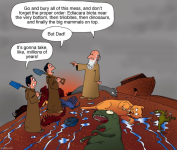
b) Though it took millions of years, they completed it in only a few thousand. Impressive if not miraculous.

from sear's notes:
According to author Simon Winchester:
Irish Bishop James Ussher claimed that the 6 Biblical days of creation began 9:AM Monday 23 October 4004 BC.

And while this may be regarded by some as religious (Christian) doctrine, there is some contradictory evidence, including the fossil record, satirized in #285.

And because the fossil evidence refutes the 6 day creation idea, the doctrinal solution of vis plastica [spelled "vis plastica" on Internet] (plastic force) was created. This divine plastic force supposedly inserted fossils into rock to remind us of the omniscience and omnipotence of god. The fossils therefore were not, according to vis plastica, evidence of life in general or evolution [more gradual than 6 days] in particular. Instead they were claimed to simply be evidence of god’s presence in the universe.

Thank you Simon. I did not know that.
"BTW, while it only rained for forty days and forty nights they were onboard (afloat) for a full year (feeding the animals for that long is just another reason that the entire story is impossible)" S2 #286
I did not know that.
Might have been at sea even longer were it not for the astrolabe stored on the bridge next to the binnacle.

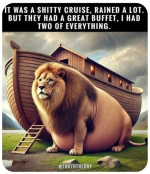
"... I had two of everything" #286
He's lion !

end P1 of 2
 
2 of 2
"The fact that somebody over-sells an idea doesn't make it a bad idea. It makes them a bad salesman." Rep. Barney Frank (D-MA ret)
Is an explanation differing from that our Holy Bible provides substantially less miraculous? It's the same result either way. So it's a quibble not about what, but how.
"I would rather have a mind opened by wonder than one closed by belief." Gerry Spence, Attorney at Law

"A closed mind is an empty mind." David Ogden Stiers in the role of Dr. Charles Emerson Winchester III / M*A*S*H
 
Back
Top