Anthropogenic Global Warming ... how hot is it ?

"My personal opinion is that for these herbicides and pesticides to be so successful, they have to be much riskier than they are willing to admit." R5 #619
 
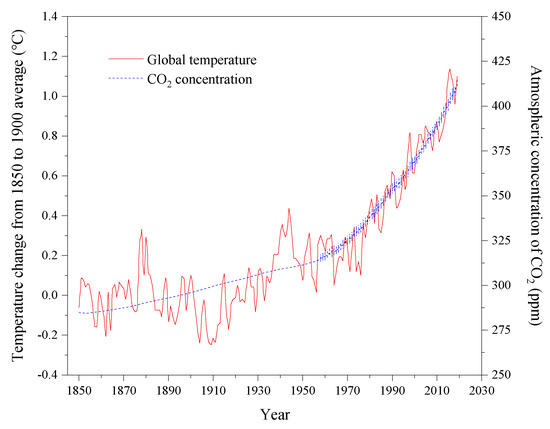
What is scary is that the CO2 levels are accelerating.
574707-rgies_13_00600_g001_550_1_.jpg
 
"What is scary is that the CO2 levels are accelerating." R5 #623
The rate Carbon concentration is increasing is alarming. BUT !
It's not only about Carbon. The genuine alarm is about the consequence of Carbon, global warming.

Those that have dimmed & brightened lighting with a rheostat are familiar with the instantaneous command response.

It seems atmospheric Carbon doesn't work that way, with consequences that may lag or linger for years, decades, or centuries.
 
The rate Carbon concentration is increasing is alarming. BUT !
It's not only about Carbon. The genuine alarm is about the consequence of Carbon, global warming.

Those that have dimmed & brightened lighting with a rheostat are familiar with the instantaneous command response.

It seems atmospheric Carbon doesn't work that way, with consequences that may lag or linger for years, decades, or centuries.

Yes, we do not know what the equilibrium point is from the CO2 we already put into the atmosphere.
It could already be enough to exterminate all life on the planet after a couple hundred years of heat accumulation.
 

El Niño is here and scientists say this one could become a Godzilla event


El Niño has officially begun. The recurring climate pattern, marked by unusually warm water spreading across the central and eastern tropical Pacific, can shift weather around the world for months. What was building beneath the tropical Pacific is no longer just a warning sign. The warm-water pulse we reported on in May has now surfaced into a full El Niño, with NOAA confirming that the event has begun and is expected to ....

CONTINUED
 

El Niño is here and scientists say this one could become a Godzilla event


El Niño has officially begun. The recurring climate pattern, marked by unusually warm water spreading across the central and eastern tropical Pacific, can shift weather around the world for months. What was building beneath the tropical Pacific is no longer just a warning sign. The warm-water pulse we reported on in May has now surfaced into a full El Niño, with NOAA confirming that the event has begun and is expected to ....

CONTINUED

While I can see the concern, New Mexico normally has a June to Sept monsoon of heavy rain, but has not had one in years now.
So we are actually looking forward to this year's El Nino deluge for restoring the ground water levels.
 
🌧️


&

Greenland’s Thawing Ancient Garbage Heaps Are Releasing a 4,500-Year Bacterial Record​

Learn how bacterial DNA preserved in Greenland’s ancient middens traces 4,500 years of settlement and why thawing permafrost poses little risk for now.

Written by Anastasia Scott Jun 16, 2026, 11:01 PM

A study published in Frontiers in Microbiology analyzed the bacteria preserved inside ancient garbage heaps, known as middens, at sites spanning 4,500 years of human habitation in Greenland. The researchers found bacterial signatures from human and animal activity still detectable centuries after the people who left them had gone, including bacteria linked to food poisoning, botulism, and toxic shock syndrome. As Arctic temperatures rise and permafrost thaws, the question of what happens to those bacteria is becoming harder to ignore.

“These middens in the cold Arctic acted like long-term natural experiments. Human- and animal-associated bacterial signals, including opportunistic bacteria and bacteria carrying antibiotic resistance genes, have remained detectable in them many centuries later as the legacy of human activity: for example, livestock farming by the ancient Norse,” said co-author Frank Møller Aarestrup in a press release.

Read More: Greenland's Glacier Fronts Are Ideal Feeding Spots for Ringed Seals

Ancient Greenland Middens Preserve Centuries of Bacterial DNA

Between 2020 and 2021, Aarestrup and colleagues collected samples from middens across West and South Greenland, identified through the Greenland National Museum and Archives registry. The sites covered multiple waves of human settlement, from Paleo-Inuit cultures dating back to around 2,500 B.C.E., to Norse descendants of Vikings who lived there between the 10th and 15th centuries, to early modern Danish settlers arriving in 1721.

At Norse sites, the team also collected soil samples from historic winter enclosures and summer grazing grounds, looking for traces of the animals those communities kept. They used DNA sequencing to reconstruct bacterial communities from the samples and compared their findings to soil taken from permafrost areas with no history of human settlement.


It's not just Greenland.
The risk of thawed pathogens such as smallpox thought to have been eradicated, may threaten a catastrophic pandemic sweeping through Earth's globalized human population with little if any resistance.

"Drill baby drill!" presidential candidate Trump
 
Back
Top