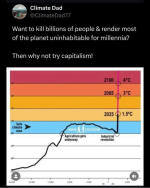
Anthropogenic Global Warming ... how hot is it ?

Again they've probably never read their policies. And if they did they probably didn't understand it - that's a reason to go over your policy with your agent (or broker as the case may be).

But why would the insurance company pay more than the policy says it covers (i.e., the amount of protection that the policy holder actually purchased)?

I suppose the wealthy had better policies, but they seemed much more satisfied with the payouts than the poor, who felt discriminated against and forced to leave.
 
I suppose the wealthy had better policies, but they seemed much more satisfied with the payouts than the poor, who felt discriminated against and forced to leave.
Much more likely the "wealthy" actually understood their policies and what was covered. And they probably bought better coverage including adequate limits - "Insurance to Value" can take a big bite out of a settlement if you haven't purchased adequate limits.
 
"Interesting, but fragile.
In order to be able to use the pressure differential, they have to run a tube from down deep, up to the surface." R5 #500
Correct.

"Interesting, but fragile." R5 #500
This can be reduced to cost per gallon.
Whether that "cost" is measured in BTU of energy consumed, or dollars expended, the water thus produced will not be inexpensive.

This AP article [#498] thus raises questions about alternatives. For example,
would / could single-pass solar distillation produce a gallon of potable water at lower cost?

note:
Solar photo-voltaic commercial power generation is criticized because our ability to buffer this energy source against transients like overcast sky is limited by current technology.

That may be less of a problem with solar water distillation, because water may be easier to buffer, to store than electricity.
 
Much more likely the "wealthy" actually understood their policies and what was covered. And they probably bought better coverage including adequate limits - "Insurance to Value" can take a big bite out of a settlement if you haven't purchased adequate limits.

I do not remember all the details, but I think part of the problem was that where Blacks had been living was actually below sea-level, and should never have been zoned for human occupation.
So then more modern standards would not allow them to rebuild.
But then there also is the question of whether the same was actually true for white neighborhoods that were rebuilt?
 
Correct.


This can be reduced to cost per gallon.
Whether that "cost" is measured in BTU of energy consumed, or dollars expended, the water thus produced will not be inexpensive.

This AP article [#498] thus raises questions about alternatives. For example,
would / could single-pass solar distillation produce a gallon of potable water at lower cost?

note:
Solar photo-voltaic commercial power generation is criticized because our ability to buffer this energy source against transients like overcast sky is limited by current technology.

That may be less of a problem with solar water distillation, because water may be easier to buffer, to store than electricity.

Yes, the problem of wind and solar is inconsistency, and by using it instead to generate something easier to store than electricity then makes sense.
If they used the wind and solar to create hydrogen, then you could use the hydrogen for kinetic energy, heat, or fresh water.

I have to wonder if transporting fresh water off glaciers might be less expensive than desalination?
Greenland?
 
"Yes, the problem of wind and solar is inconsistency, and by using it instead to generate something easier to store than electricity then makes sense." R5 #505
If you'll pardon a little Sunday afternoon soapbox action:
I believe the commercial power grid is a self-inflicted vulnerability,
and that a decentralized power model may be better suited to the new millennium.

As you know our commercial power grid is preposterously inefficient.
We use commercial power at ~120 VAC or ~240 VAC, BUT !
we transmit such commercial power over long distances by using transformers to boost the voltage as high as 765 kV.
Then we drop the voltage down in stages to the level we get at the wall outlet.

We could eliminate the inefficiency of cross-country transmission if an individual home generated its own electricity.

Major Problem:
storage capacity, buffering capability can be expensive. BUT !
As electric powered automobiles proliferate, homes have their own large storage battery.

It's not ideal as described here.
But it's the basis for beginning a commercial power decentralization transition. BUT !

As usual, the status quo is an entrenched constituency.
We have countrymen that are gainfully employed, investors that are $profiting from the current system. Dismantling it undermines them.

"I have to wonder if transporting fresh water off glaciers might be less expensive than desalination?
Greenland?" R5 #505
I've read proposals of busting off barge-sized chunks from accessible antarctic polar ice, and tugging it to places like Dubai
where the economics might justify it.

 
But then there also is the question of whether the same was actually true for white neighborhoods that were rebuilt?
I'm sure the insurance companies couldn't have supported rebuilding in an area where building would have been against code. And regardless of whether the neighborhood was white or black they'd still have to obtain building permits in order to rebuild the neighborhood. And that should answer your question.
 
Back
Top