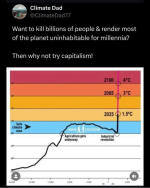
Anthropogenic Global Warming ... how hot is it ?

Again they've probably never read their policies. And if they did they probably didn't understand it - that's a reason to go over your policy with your agent (or broker as the case may be).

But why would the insurance company pay more than the policy says it covers (i.e., the amount of protection that the policy holder actually purchased)?

I suppose the wealthy had better policies, but they seemed much more satisfied with the payouts than the poor, who felt discriminated against and forced to leave.
 
I suppose the wealthy had better policies, but they seemed much more satisfied with the payouts than the poor, who felt discriminated against and forced to leave.
Much more likely the "wealthy" actually understood their policies and what was covered. And they probably bought better coverage including adequate limits - "Insurance to Value" can take a big bite out of a settlement if you haven't purchased adequate limits.
 
"Interesting, but fragile.
In order to be able to use the pressure differential, they have to run a tube from down deep, up to the surface." R5 #500
Correct.

"Interesting, but fragile." R5 #500
This can be reduced to cost per gallon.
Whether that "cost" is measured in BTU of energy consumed, or dollars expended, the water thus produced will not be inexpensive.

This AP article [#498] thus raises questions about alternatives. For example,
would / could single-pass solar distillation produce a gallon of potable water at lower cost?

note:
Solar photo-voltaic commercial power generation is criticized because our ability to buffer this energy source against transients like overcast sky is limited by current technology.

That may be less of a problem with solar water distillation, because water may be easier to buffer, to store than electricity.
 
Much more likely the "wealthy" actually understood their policies and what was covered. And they probably bought better coverage including adequate limits - "Insurance to Value" can take a big bite out of a settlement if you haven't purchased adequate limits.

I do not remember all the details, but I think part of the problem was that where Blacks had been living was actually below sea-level, and should never have been zoned for human occupation.
So then more modern standards would not allow them to rebuild.
But then there also is the question of whether the same was actually true for white neighborhoods that were rebuilt?
 
Correct.


This can be reduced to cost per gallon.
Whether that "cost" is measured in BTU of energy consumed, or dollars expended, the water thus produced will not be inexpensive.

This AP article [#498] thus raises questions about alternatives. For example,
would / could single-pass solar distillation produce a gallon of potable water at lower cost?

note:
Solar photo-voltaic commercial power generation is criticized because our ability to buffer this energy source against transients like overcast sky is limited by current technology.

That may be less of a problem with solar water distillation, because water may be easier to buffer, to store than electricity.

Yes, the problem of wind and solar is inconsistency, and by using it instead to generate something easier to store than electricity then makes sense.
If they used the wind and solar to create hydrogen, then you could use the hydrogen for kinetic energy, heat, or fresh water.

I have to wonder if transporting fresh water off glaciers might be less expensive than desalination?
Greenland?
 
"Yes, the problem of wind and solar is inconsistency, and by using it instead to generate something easier to store than electricity then makes sense." R5 #505
If you'll pardon a little Sunday afternoon soapbox action:
I believe the commercial power grid is a self-inflicted vulnerability,
and that a decentralized power model may be better suited to the new millennium.

As you know our commercial power grid is preposterously inefficient.
We use commercial power at ~120 VAC or ~240 VAC, BUT !
we transmit such commercial power over long distances by using transformers to boost the voltage as high as 765 kV.
Then we drop the voltage down in stages to the level we get at the wall outlet.

We could eliminate the inefficiency of cross-country transmission if an individual home generated its own electricity.

Major Problem:
storage capacity, buffering capability can be expensive. BUT !
As electric powered automobiles proliferate, homes have their own large storage battery.

It's not ideal as described here.
But it's the basis for beginning a commercial power decentralization transition. BUT !

As usual, the status quo is an entrenched constituency.
We have countrymen that are gainfully employed, investors that are $profiting from the current system. Dismantling it undermines them.

"I have to wonder if transporting fresh water off glaciers might be less expensive than desalination?
Greenland?" R5 #505
I've read proposals of busting off barge-sized chunks from accessible antarctic polar ice, and tugging it to places like Dubai
where the economics might justify it.

 
But then there also is the question of whether the same was actually true for white neighborhoods that were rebuilt?
I'm sure the insurance companies couldn't have supported rebuilding in an area where building would have been against code. And regardless of whether the neighborhood was white or black they'd still have to obtain building permits in order to rebuild the neighborhood. And that should answer your question.
 
Attention humans:
stop acting stupid.

Don't buy or build a home on a floodplain.
Don't buy or build a home in a volcano.
And don't buy or build in the forest any home made of tinder.

hob.JPG

It may be cheaper to hire a bulldozer for a day to make a berm to build on
than to have to replace your washer and dryer every few years. AND !

You may just get an in-ground swimming pool out of the deal.
 
If you'll pardon a little Sunday afternoon soapbox action:
I believe the commercial power grid is a self-inflicted vulnerability,
and that a decentralized power model may be better suited to the new millennium.

As you know our commercial power grid is preposterously inefficient.
We use commercial power at ~120 VAC or ~240 VAC, BUT !
we transmit such commercial power over long distances by using transformers to boost the voltage as high as 765 kV.
Then we drop the voltage down in stages to the level we get at the wall outlet.

We could eliminate the inefficiency of cross-country transmission if an individual home generated its own electricity.

Major Problem:
storage capacity, buffering capability can be expensive. BUT !
As electric powered automobiles proliferate, homes have their own large storage battery.

It's not ideal as described here.
But it's the basis for beginning a commercial power decentralization transition. BUT !

As usual, the status quo is an entrenched constituency.
We have countrymen that are gainfully employed, investors that are $profiting from the current system. Dismantling it undermines them.


I've read proposals of busting off barge-sized chunks from accessible antarctic polar ice, and tugging it to places like Dubai
where the economics might justify it.

While the EV may provide a battery, it could not power the home when the vehicle is being driven or needs to be recharged,
And you still need a power source to recharge, so are you suggesting each house have wind or solar?
When I went solar in Edgewood NM, batteries for off grid would have been about $10k more, so passed on the batteries.

Greenland melt off water would be easier than actual ice, since it could be towed in long/skinny bladders.
 
I'm sure the insurance companies couldn't have supported rebuilding in an area where building would have been against code. And regardless of whether the neighborhood was white or black they'd still have to obtain building permits in order to rebuild the neighborhood. And that should answer your question.

I am not totally familiar with the details after Katrina, so did an AI question.
Here is the answer it came back with:
{...

Were white areas rebuilt after Katrina even though below sea level?​

Yes, white areas in New Orleans were rebuilt after Katrina, even though they were located below sea level. The rebuilding process involved the construction of floodwalls and levees to protect these areas from future flooding. The city's levee system was designed to prevent damage caused by seasonal flooding, and the floodwalls were constructed to pump water from the city streets out to Lake Pontchartrain. These measures aimed to protect the city's infrastructure and prevent further damage from natural disasters.
...}

I do not trust AI all that much, but that is the impression I got as well, that white areas below sea level were rebuilt but Black areas below sea level were not.
It was only Blacks forced to leave for Texas.
 
And while this is an oversimplification, for purpose of demonstrating that completely dismissing the idea 100% is also in error, we can add:
" While the EV may provide a battery, it could not power the home when the vehicle is being driven or needs to be recharged," R5 #509
And therefore if that means the EV is only online & available for this purpose 20% of the time, that suggests it's only 20% of the solution.
It also demonstrates it is not zero% of the solution.

"And you still need a power source to recharge, so are you suggesting each house have wind or solar?" R5 #509
Or cellulosic ethanol?
Instead of composting lawn clippings, dump them into the digester, & ...
I'm not sure one or two thousand gallon ethanol tanks would be too burdensome.

"When I went solar in Edgewood NM, batteries for off grid would have been about $10k more, so passed on the batteries." R5 #509
And?
For how many months did you reside there without batteries?
If you had it to do over again, how long a stay there would you need to justify the $10K ? (bearing in mind it might save you a deep-freezer full of food now & then)

"Greenland melt off water would be easier than actual ice, since it could be towed in long/skinny bladders." R5 #509
The only other mention of this technology I've ever encountered was a brief video plug I saw on broadcast television back in the '60's.
The plug was for emergency drinking water distribution. The attendant video was about a gallon of water triple-bagged in clear plastic, and hurled out of a helicopter at about 100' AGL.
 
And while this is an oversimplification, for purpose of demonstrating that completely dismissing the idea 100% is also in error, we can add:

And therefore if that means the EV is only online & available for this purpose 20% of the time, that suggests it's only 20% of the solution.
It also demonstrates it is not zero% of the solution.


Or cellulosic ethanol?
Instead of composting lawn clippings, dump them into the digester, & ...
I'm not sure one or two thousand gallon ethanol tanks would be too burdensome.


And?
For how many months did you reside there without batteries?
If you had it to do over again, how long a stay there would you need to justify the $10K ? (bearing in mind it might save you a deep-freezer full of food now & then)


The only other mention of this technology I've ever encountered was a brief video plug I saw on broadcast television back in the '60's.
The plug was for emergency drinking water distribution. The attendant video was about a gallon of water triple-bagged in clear plastic, and hurled out of a helicopter at about 100' AGL.

When I did solar without batteries, the idea was that the local electric company got my excess generated electricity, and then returned it to me at night.
My bill dropped from $80/month to $20/month, and the electric company essentially was my batteries.
Their goal was to subsidize solar so that they could decommission old coal plants they were being fined for.
I was not rural, so did not need to ever worry about being "off the grid".
 
"When I did solar without batteries, the idea was that the local electric company got my excess generated electricity, and then returned it to me at night.
My bill dropped from $80/month to $20/month, and the electric company essentially was my batteries.
Their goal was to subsidize solar so that they could decommission old coal plants they were being fined for.
I was not rural, so did not need to ever worry about being "off the grid"." R5 #512
Figgers.
Seems to me I get some commercial electric bills that charge more for "Delivery Services" (rent on the wire) than for "Supply Services" (a stampede of electrons).
So seems to me the bonus of separating from the commercial electric provider should dispense with both charges.

The benefit?
Pay the $10K up front, and you build equity in the investment.
Save the $10K and you just keep $buying that wire over & over again.

That's what Ma Bell was up to, renting telephones in the '50's.
Buying the telephone, the better deal, unless your house goat gnaws the phone in two.

I don't know the life expectancy on a whole house Uninterruptible Power Supply (UPS).
I imagine most of them are Li Ion.

Does a Li Ion UPS boost home resale $value?
 
Figgers.
Seems to me I get some commercial electric bills that charge more for "Delivery Services" (rent on the wire) than for "Supply Services" (a stampede of electrons).
So seems to me the bonus of separating from the commercial electric provider should dispense with both charges.

The benefit?
Pay the $10K up front, and you build equity in the investment.
Save the $10K and you just keep $buying that wire over & over again.

That's what Ma Bell was up to, renting telephones in the '50's.
Buying the telephone, the better deal, unless your house goat gnaws the phone in two.

I don't know the life expectancy on a whole house Uninterruptible Power Supply (UPS).
I imagine most of them are Li Ion.

Does a Li Ion UPS boost home resale $value?

What was interesting to watch was that the meter turned backwards during the day when the solar was generating.
I spent about $13k on the solar, and it slightly increased the value of the home when I sold it.
 

What worries me is that what CO2 does is not create heat, but prevent it from leaving so that it is retained.
And we don't know how much heat will be retained until it reaches equilibrium.
It could be like Venus, where heat was retained until it reached over 400 degrees F.
In which case there will be no life at all left on the planet.
We have no way of knowing ahead of time.
We just have to wait and see, because it could take a thousand years to reach equilibrium.
 
"And we don't know how much heat will be retained until it reaches equilibrium." R5 #516
So some may believe.
I suspect the relationship is roughly proportional, and if not linear, at least predictable.

I thought the climatologist's predictions have proven fairly accurate so far, right down to the rate at which sea level is rising.
The once per decade occurrence of once per century weather events corroborates this.
 
So some may believe.
I suspect the relationship is roughly proportional, and if not linear, at least predictable.

I thought the climatologist's predictions have proven fairly accurate so far, right down to the rate at which sea level is rising.
The once per decade occurrence of once per century weather events corroborates this.

If we go with the theory of proportionality, the normal warming from CO2 was calculated to be around 40 degrees F.
So then by doubling the CO2, we will end up adding an additional 40 degrees F.

Here is the average temperature range for New York State:
{...
The temperature range in New York typically varies as follows:
  • In an average year, temperatures usually range between 8°F (-13°C) and 97°F (36°C).

...}

If we add another 40 degrees F by doubling the CO2, then we are talking about a future temperature range of 48 degrees F to 137 degrees F.
I do not think many plants could survive that heat.

With ocean rise, it again is not an instantaneous event.
The ice packs on places like Greenland and Antarctica are over a mile thick, and could take many centuries to melt, causing ocean rise to continue for thousands of years, even if we stopped adding CO2.
 
"If we go with the theory of proportionality, the normal warming from CO2 was calculated to be around 40 degrees F.
So then by doubling the CO2, we will end up adding an additional 40 degrees F." R5 #518
No.
The graph found here: https://www.climate.gov/news-featur...ate/climate-change-atmospheric-carbon-dioxide

"With ocean rise, it again is not an instantaneous event.
The ice packs on places like Greenland and Antarctica are over a mile thick, and could take many centuries to melt, causing ocean rise to continue for thousands of years, even if we stopped adding CO2." R5 #518
Yes, that can happen. It's not the only way.
Another way which shaves that duration down from thousands of years to a day or two:
when a ginormous chunk of ice supported by solid rock, thus not affecting sea level, suddenly breaks off into floating in the sea, it doesn't have to melt, even though it will.
Simply by surrendering its rock support, and instead being buoyed by the ocean, it raises sea level.
 
No.
The graph found here: https://www.climate.gov/news-featur...ate/climate-change-atmospheric-carbon-dioxide


Yes, that can happen. It's not the only way.
Another way which shaves that duration down from thousands of years to a day or two:
when a ginormous chunk of ice supported by solid rock, thus not affecting sea level, suddenly breaks off into floating in the sea, it doesn't have to melt, even though it will.
Simply by surrendering its rock support, and instead being buoyed by the ocean, it raises sea level.

Not sure what you mean, but if you mean we have not yet quite doubled the CO2, the massive acceleration shows we soon will.
With ocean level rise, remember that ice break off can only happen on the shoreline, not inland.

dashboard-carbon-dioxide-emissions-vs-atmospheric-concentration-1751-2024.png
 
Back
Top