- trivia -

"Oh, you're in a red state? Your bio says Texas" HTA #280
a) ha !
b) Fine. BUT !
c) Texas remains red until blue is sworn in next year.

Macho Texas men?
There's more to being a man than wearing high-heeled boots.
How can you pretend to superior machismo when your State's panhandle is bigger than West Virginia? Panhandle !
Texas' claim to fame? We're better than Oklahoma ?
Texas: when you're as good as Delaware, let us know. 😉
 
"Trumps crypto coin now worth 1.17 from $75 meaning if you had $10,00.00 dollars worth now worth $157. 00" S2 #283
They $lost. I get that. $BUT !

Is it any more complicated than a zero-sum game?
Some reports indicate Trump made $millions this way.
Does that mean the $money Trump made is the money the other investors lost?

The American story is one of innovation. From the railroads that linked sea to shining sea, to the internet that connected the entire world, American entrepreneurs have led the buildout of next generation technologies in every generation since our founding. Crypto should be no different.

end P1 of 2
 
"I'm sure it's AI but ..." S2 #286
In decades past photographic modification / falsification was also possible, but the tools to do so were more rudimentary,
and therefore the telltale signs more obvious.

However illusory, the U.S. has had First Amendment Constitutional protections including freedom of the press for centuries.

The potentially alarming change A.I. introduces is, the distinction between satire and reality has been severely diminished if not demolished.

" it makes a point " S2 #286
More than one.
And what some may consider / perceive as a secondary point may ultimately be the more consequential.

President Trump's second term demonstrates a charlatan can simply lie his way into the most powerful office in the solar system
twice.

We can't explain that away by declaring: Bruce is a dumbo, they shouldn't let him vote.
Bruce didn't put Trump in the white house without help. Lots & lots of help.

This dismally guileless electorate demonstrates how vulnerable we are to distraction, to fraud, to deception.
#283 may be harmless enough. The next one may not be.
“Toto, I have a feeling we’re not in Kansas anymore.” Dorothy
 
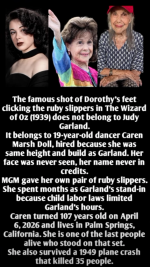
"Caren Doll" #289
Thank you S2.
The Wizard of Oz is a standout in modern movie making.
It did not win best picture that year, an honor that instead went to Gone With The Wind.

I encountered a plot summary which initially struck me as sneaky, deceptive.
I've had a few years to adapt to it, doesn't seem quite as bad as it did at first:
A Kansas school girl is transported to a surreal landscape where she kills the first person she meets,
and then teams up with strangers to kill again.
- gosh -
Perhaps they should mention, it's a musical too !

"There never will be talking pictures." D.W. Griffith

Of all the arts, the cinema is the most important. Vladimir Ilich "Nikolai" Lenin 1870-1924


Dorothy
Your Majesty, If you were King, you wouldn't be afraid of anything?
Lion
Not nobody, not nohow!
Tin Man
Not even a rhinoceros?
Lion
Imposserous!
Dorothy
How about a hippopotamus?
Lion
Why, I'd trash him from top to bottomamus!
Dorothy
Supposin' you met an elephant?
Lion
I'd wrap him up in cellophant!
Scarecrow
What if it were a brontosaurus?
Lion
I'd show him who was King of the Forest!
All Four
How?
Lion
How?
Courage! What makes a King out of a slave?
Courage! What makes the flag on the mast to wave?
Courage! What makes the elephant charge his tusk, in the misty mist or the dusky dusk?
What makes the muskrat guard his musk?
Courage! What makes the sphinx the seventh wonder?
Courage! What makes the dawn come up like thunder?
Courage! What makes the Hottentot so hot? What puts the "ape" in apricot?
What have they got that I ain't got?
All Four [Dorothy, scarecrow, tin man, and cowardly lion]
Courage!
Lion
Then you can say that again!

 
1794746562868.png

In 1969, Grace Hopper received a computer science award called “Man of the Year.”

By then, she had spent decades advancing a field whose language still treated male achievement as the default.

Hopper had earned her mathematics doctorate at Yale in 1934 and was teaching at Vassar College when she joined the U.S. Naval Reserve during the Second World War. Assigned to Harvard, she became one of the earliest programmers of the Mark I, an enormous machine used for wartime calculations.

She also edited and wrote substantial parts of its operating manual, helping explain how this new technology worked.

After the war, she stayed at Harvard as a research fellow. When that fellowship ended in 1949, she left because there were no permanent positions for women.

The barrier was institutional. Her ability was already established.

Hopper moved into the computer industry, where she challenged how programming was done. Her early compiler work automated parts of the process, assembling reusable pieces of code rather than requiring programmers to repeat the same painstaking work.

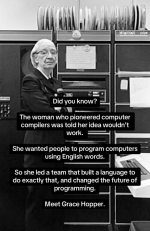
Then she pushed further: people should be able to write computer instructions using English words.

When she proposed the idea in 1953, she was told it wouldn’t work.

Her team went on to develop FLOW-MATIC, a language that used English words in precise, structured commands. It was designed for business data processing and reflected a conviction that guided her career: computers should become easier for more people to use.

FLOW-MATIC helped shape COBOL, developed by a wider group in 1959. Hopper championed its adoption, and COBOL still runs important banking and government systems today.

Her contribution extended through invention, leadership, teaching and the work of persuading people to reconsider what computers could do.

She retired from the Navy as a rear admiral at seventy-nine and received the National Medal of Technology in 1991. She took particular pride in the young people she had trained.

Her career shows both what women contributed to computing and the restrictions they faced while doing it.

Those contributions belong in the main story of technological progress. Grace Hopper was one of the people who made that progress possible.

SOURCE with comments

 
" Grace Hopper " #292
You're a pioneer Madame Hopper.
Thank you for helping to change the world for the better.

" FLOW-MATIC helped shape COBOL, developed by a wider group in 1959 " #292

CO·BOL (kōbôl′)
n.
A programming language developed in the late 1950s and early 1960s, widely used for business applications. It has some syntactic features that resemble English.
[Co(mmon) B(usiness-)O(riented) L(anguage).]

The American Heritage® Dictionary of the English Language, Fifth Edition copyright ©2022 by HarperCollins Publishers. All rights reserved.


Grace Hopper deserves little if any blame, but may be connected to the Y2K mainframe computer scare.
When computers entered this realm of U.S. business, computing was so expensive the business decision was made to only use a two digit designation for the year,
instead of 1949, only 49.
It worked fine for decades, because the two digits that preceded were 19, UNTIL
Y2K.
The dire warning turned out to be exaggerated. But those dire warnings may have helped avoid severe problems.

"Space is cheaper than sort [& has been since 2006]." cryptographer Bruce Schneier
Because storing computer bits and bytes was so expensive, it was often cost effective to cull through what was in computer storage,
and purge extraneous data.
The Schneier quotation refers to the consequence of progressive price reduction. In about 2006 the cost effective way to get more memory was to buy it, despite extraneous clutter already in storage.

Though the A.I. binge has reversed the price reduction trend, long term it's been impressive.

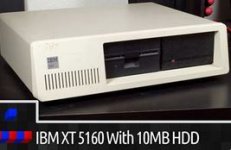
The IBM PC entered the consumer market competing against Sinclair, Commodore, & Radio Shack.
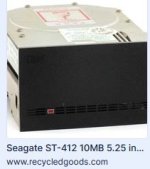
IBM's major upgrade to the PC was the XT (extended technology). It had a 10 Meg. hard drive.

IBMXT10megHDDa.JPG

IBMXT10megHDDb.JPG

Contrast that to the cost of storage today:

IBMXT10megHDDc.JPG

This microSDXC module may be familiar to you, approximately the size of a 25cent coin.

By my math that's 25,000 times more storage in a tiny fraction of the space the IBM XT 10 meg HDD occupied,
all at a small fraction of the $cost.
 
And the lead up to Y2K resulted in a lot of retired programmers being hired as consultants to work on "fixes" for the problem - by that time nobody was using COBOL anymore so the then current generation of programmers had no knowledge (or experience) with it. And there were still lots of legacy programs that had been written in COBOL and remained completely unchanged for years (decades?)
 
"And the lead up to Y2K resulted in a lot of retired programmers being hired as consultants to work on "fixes" for the problem - by that time nobody was using COBOL anymore so the then current generation of programmers had no knowledge (or experience) with it. And there were still lots of legacy programs that had been written in COBOL and remained completely unchanged for years (decades?)" S2 #295
Perhaps that's testament to how fast-paced the technological evolution is, those retired from the field were still employable.

Historic review:
Humans are not the only tool users on Earth. Chimpanzees have been observed in the wild fishing ants from an ant-hill with a straw probe.

For stuff humans couldn't shove into place bare-handed, we invented the hammer, a tool (somewhat more advanced than straw). BUT !

We have smart people, "engineers" they calls 'em, but they don't look like this much like this little guy waving out the window: 🚂

Today's engineers can take a bucket of sand, and turn it into a machine smart enough to do your taxes for you.
That's a tool too.

We have come a long, long way. So much so we witness miracles daily, and shrug it off as commonplace.

AND !

We're just getting started! The sky is no longer the limit.

E = mc²
π are round
 
Back
Top