News Related To The Ukraine / Russian War

"In theory a benevolent dictatorship can be better than a democratic republic, but the risk is too high and there is the problem of succession." R5 #399
I asked my 9th grade history teacher, what's the most efficient form of government.
He said: "Benevolent despotism."

Succession is indeed a problem. Lookit what it's done to North Korea.

" Ukraine should be returned to Russia." R5 #400
R5, you obviously understand what's right, and what's wrong politically here.
Setting all that aside, do you have an opinion on what would be best for the quality of life of Ukrainians?

If for example a Ukrainian plebiscite demonstrated >70% majority of Ukraine favored maintaining Ukraine sovereignty at borders as they existed a year before Russia's invasion including Crimea,
would you support their preference? Or
would you instead say:
" Ukraine should be returned to Russia." R5 #400
 
I asked my 9th grade history teacher, what's the most efficient form of government.
He said: "Benevolent despotism."

Succession is indeed a problem. Lookit what it's done to North Korea.


R5, you obviously understand what's right, and what's wrong politically here.
Setting all that aside, do you have an opinion on what would be best for the quality of life of Ukrainians?

If for example a Ukrainian plebiscite demonstrated >70% majority of Ukraine favored maintaining Ukraine sovereignty at borders as they existed a year before Russia's invasion including Crimea,
would you support their preference? Or
would you instead say:

If the 2014 Maidan Coup had not committed treaty violations, then I don't think Russia had a problem with an independent Ukraine.
Look at how long they negotiated with Kyiv, from 2014 to 2022, before being forced to resort to war.
And in fact, Russia showed no hostility towards the Ukraine being independent from 1992 to 2014.

But what the majority of the Ukrainians want is not relevant.
The majority of Ukrainians are descendants of the failed Polish invasion of 1700.
So if they are racist and want to murder the ethnic Russian minority, that can not be allowed.
Their attempt to prevent Russian use of Sevastopol can not be allowed.
Their attempt to join NATO and put US nukes on Russia's border can not be allowed.
 
"But what the majority of the Ukrainians want is not relevant." R5 #402
Fine. BUT !
Self-determination is the premise of U.S. sovereignty.

So it appears either you're applying a double-standard, it's OK for U.S., but not for them, OR
you undermine the legitimacy, the right of sovereignty of the Peoples of the United States.
 
Fine. BUT !
Self-determination is the premise of U.S. sovereignty.

So it appears either you're applying a double-standard, it's OK for U.S., but not for them, OR
you undermine the legitimacy, the right of sovereignty of the Peoples of the United States.

Self-determination is not the basis of any republic in my opinion.
The premise for US sovereignty was defense from the violation of rights, like taxation without representation.
What if the majority of WWII Germans believed in the Holocaust?
It would still be illegal in my opinion.
The ethnic Polish in the Ukraine should be grateful they were not kicked out or murdered when their invasion attempt failed in 1700.
They should also be grateful they were not punished for running Hitler's death camps during WWII.
The movie, "Tarus Bulba" shows some of the historic conflicts between the Polish and Russian Cossacks.
 
"Self-determination is not the basis of any republic in my opinion." R5 #404
Founder Thomas Jefferson was explicitly clear in his Declaration of Independence:

"We hold these truths to be self-evident, that all men are created equal, that
they are endowed by their Creator with certain unalienable Rights, that
among these are Life, Liberty and the pursuit of Happiness.— That to
secure these rights, Governments are instituted among Men, deriving their
just powers from the consent of the governed ..." TJ / DOI


"The premise for US sovereignty was defense from the violation of rights, like taxation without representation." R5 #404
That's self-determination.
 
Founder Thomas Jefferson was explicitly clear in his Declaration of Independence:

"We hold these truths to be self-evident, that all men are created equal, that
they are endowed by their Creator with certain unalienable Rights, that
among these are Life, Liberty and the pursuit of Happiness.— That to
secure these rights, Governments are instituted among Men, deriving their
just powers from the consent of the governed ..." TJ / DOI


That's self-determination.

I think you are over simplifying.
A republic is the defense of inherent individual rights.
If the majority want to do something like slavery of a minority, that is "self-determination", but not legal in a republic.
Majority rule can be a lynch mob sometimes, so requires codified safeguards and judiciary to protect the rights of individuals from an abusive majority.
The majority of the Ukrainians want to murder all the ethnic Russian in the Ukraine.
But the ethnic Russians were there first and have treaty rights as well.

I don't have proof, but I think it actually is much worse than that.
I think the millions Hunter Biden got from Burisma Holdings were kickbacks from much large bribes the US sent to the Ukraine secretly.
So I think the whole Maidan Coup of 2014 was an illegal plot by the US.
I do not thing the ethnic Polish generals in Kyiv would have alienated Moscow unless the US had already started delivering weapons.
 
"I think you are over simplifying." R5 #406
For brevity perhaps, not to misstate or mislead.

"A republic is the defense of inherent individual rights." R5 #406
The first definition is from AHD. The second, Webster.

re·pub·lic (rĭ-pŭblĭk)
n. 1. A political order whose head of state is not a monarch and in modern times is usually a president.
2.a. A political order in which the supreme power lies in a body of citizens who are entitled to vote for officers and representatives responsible to them.
[French république, from Old French, from Latin rēspūblica : rēs, thing; see rē- in the Appendix of Indo-European roots + pūblica, feminine of pūblicus, of the people; see PUBLIC.]
The American Heritage® Dictionary of the English Language, Fifth Edition copyright ©2022 by HarperCollins Publishers. All rights reserved.


republic
noun
1a : a form of government in which the power belongs to a body of citizens entitled to vote and is exercised by the leaders and representatives elected by those citizens to govern according to law


Please note the term "individual rights" does not appear in either definition.
 
For brevity perhaps, not to misstate or mislead.


The first definition is from AHD. The second, Webster.

re·pub·lic (rĭ-pŭblĭk)
n. 1. A political order whose head of state is not a monarch and in modern times is usually a president.
2.a. A political order in which the supreme power lies in a body of citizens who are entitled to vote for officers and representatives responsible to them.
[French république, from Old French, from Latin rēspūblica : rēs, thing; see rē- in the Appendix of Indo-European roots + pūblica, feminine of pūblicus, of the people; see PUBLIC.]
The American Heritage® Dictionary of the English Language, Fifth Edition copyright ©2022 by HarperCollins Publishers. All rights reserved.


republic
noun
1a : a form of government in which the power belongs to a body of citizens entitled to vote and is exercised by the leaders and representatives elected by those citizens to govern according to law


Please note the term "individual rights" does not appear in either definition.

Those definitions are obviously wrong, since those are the definitions of a democracy, based on majority rule.
Majority rule is often ridiculed by the term "mob rule".
It is not at all similar to a real republic.

{...
Democracy and republic, while often used interchangeably, have distinct meanings, origins, and implications. Democracy is a system of government in which laws, policies, leadership, and major undertakings of a state or other polity are directly or indirectly decided by the “people,” a group historically constituted by only a minority of the population (e.g., all free adult males in ancient Athens or all sufficiently propertied adult males in 19th-century Britain) but generally understood since the mid-20th century to include all (or nearly all) adult citizens. In contrast, a republic is a form of government in which a state is ruled by representatives of the citizen body.

The terms also differ in etymology. The word democracy has Greek roots and is derived from dēmokratia, which means “rule by the people,” while republic has Latin roots and is derived from the expression res publica, which means “public good” or “public affair.” In ancient Greece democracy originally referred to direct democracy, a system in which people voted on laws and decisions themselves. In ancient Rome republic simply meant a state or country and described a system where leaders were elected to represent the people.

In a “pure democracy” sovereignty is directly exercised by the people, either through direct voting or through mechanisms that allow for public participation in decision-making. In a republic, sovereignty rests with the people, but it is exercised through elected representatives.
...}

It is more complex than that really, in that a republic requires a Constitution or other codified protections of individual rights.
But this was the first response.

 
Excellent.
Please quote with link a dictionary of your alternate preference which provides a definition more to your liking.

This is an abstraction on inherent international law on human rights.
Which is pretty much the most recent definition of a republic.


We don't need a link to define a democracy since that has not changes, and is still just majority rule.
 
In a Truth Social post on Sunday, Mr. Trump criticized Zelenskyy for targeting Russian diesel refineries and said, "he doesn't want to end this war, and probably never did."
"He could have made a better deal two years ago than he can now. His country is in shambles, a large portion of his land is lost, his oceans and seas are gone, and his male population is low, wounded, and/or dead," Mr. Trump wrote.
https://www.cbsnews.com/news/ukraine-russia-drone-st-petersburg-oil-facilites/

Trump Vowed to End the Ukraine War Before Taking Office. The War Rages On.
Donald J. Trump's promise to broker peace between Russia and Ukraine in 24 hours, "before I even become president," proved to be untrue.

https://www.nytimes.com/2025/01/19/us/politics/trump-promise-ending-ukraine-war.html

Trump's groundless insult against Zelenskyy is a vulgarity.
No surprise, from a president whose 2nd term is an atrocity.

These Trump quotations are stark warning.
Candidate Trump's promise to end the Ukraine War before Trump's second inauguration mirrors many of Trump's other empty, broken promises.
It appears Trump hoped to gain votes from undecided voters by offering miraculous performance as reward for reelecting Trump.

Does that help clarify Trump's promise of $5,000.oo ?
Goes along with these

Trump accounts: tax-advantaged investment vehicles for children under 18. Started July 2026. The government issues $1000 for every account I think - not totally sure. 70 million USA kids in total benefited from it.

Elon Musk will donate 1 SpaceX share to all the kids in the USA in 2027, after the SpaceX IPO share lock up ~1 year is done. That's a total estimated value of ~10 billion dollars.
 
Trump's groundless insult against Zelenskyy is a vulgarity.
No surprise, from a president whose 2nd term is an atrocity.

These Trump quotations are stark warning.
Candidate Trump's promise to end the Ukraine War before Trump's second inauguration mirrors many of Trump's other empty, broken promises.
It appears Trump hoped to gain votes from undecided voters by offering miraculous performance as reward for reelecting Trump.

Does that help clarify Trump's promise of $5,000.oo ?

I disagree.
I think the US illegally started the war in the Ukraine with billions in bribes, that resulted in the murder of over 30k native ethnic Russians in the Ukraine, by the Azov Battalion.
Since Zelensky did nothing to punish these crimes and instead recruited the Azov Battalion, Zelensky became a war criminal.

It is Zelensky who prevented this war from ending, and has to go.
He is the one who started attacking civilians, utilities, and Russia.
 
1792756105365.png

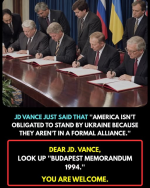
Dear JD Vance, before reducing America’s relationship with Ukraine to whether there is a formal alliance, please revisit the Budapest Memorandum of 1994.

Ukraine agreed to relinquish the nuclear weapons inherited from the Soviet Union. In connection with that decision, the United States, Britain, and Russia gave security assurances, including commitments to respect Ukraine’s independence, sovereignty, and existing borders.

Let’s be precise: that memorandum did not create a NATO alliance or an automatic obligation for American troops to fight. But America’s signature still carries political and moral weight. The absence of a mutual defense treaty does not erase the history of those assurances.

Russia’s aggression makes that history especially important. What message does it send to other countries if giving up nuclear weapons leaves them feeling that the assurances they received were worthless?

We can debate the form and extent of American support. We should also ask what American credibility is worth.

Budapest, 1994. It deserves more than a footnote when discussing Ukraine’s future.

You’re welcome.

SOURCE with comments
 
a)
"America isn't obligated to stand by Ukraine because they aren't in a formal alliance." JD Vance

JD,
here's a snack for you:
rottenTomatoS


b) Are signatories to a memorandum not in alliance?

mem·o·ran·dum (mĕm′ə-răndəm)

n. pl. me·mo·ran·dums or me·mo·ran·da (-də)
1. A short note written as a reminder.
2. A written record or communication, as in a business office. See Synonyms at letter.
3. Law
a. A short document outlining the terms of an agreement, especially as a draft leading to a formal, detailed contract: a memorandum of understanding.
b. A writing submitted to a court by a party arguing an aspect of a case; a brief.
c. A decision of an appellate court, particularly one that is not accompanied by any detailed explanation of the basis for the decision: a memorandum decision.
4. A business statement made by a consignor about a shipment of goods that may be returned.
5. A brief, unsigned diplomatic communication.
[Middle English, to be remembered (used as a manuscript notation), from Latin, neuter sing. gerundive of memorāre, to bring to remembrance; see MEMORABLE.]
The American Heritage® Dictionary of the English Language, Fifth Edition copyright ©2022 by HarperCollins Publishers. All rights reserved. bold emphasis sear's


al·li·ance (ə-līəns)
n.
1. a. A close association of nations or other groups, formed to advance common interests or causes: an alliance of labor unions opposing the bill.
b. A formal agreement establishing such an association, especially an international treaty of friendship.
2. a. A connection based on kinship, marriage, or common interest; a bond or tie: the shifting alliances within a large family.
b. A long-term association of two or more animals of the same species, in which members cooperate for a purpose such as gaining access to mates or defending territory.
3. Close similarity in nature or type; affinity: the ancient alliance between mathematics and music.
4. The act of becoming allied or the condition of being allied: the church, acting in alliance with community groups.
[Middle English, from Old French aliance, from alier, to ally; see ALLY.]
The American Heritage® Dictionary of the English Language, Fifth Edition copyright ©2022 by HarperCollins Publishers. All rights reserved.
 
View attachment 6939

Dear JD Vance, before reducing America’s relationship with Ukraine to whether there is a formal alliance, please revisit the Budapest Memorandum of 1994.

Ukraine agreed to relinquish the nuclear weapons inherited from the Soviet Union. In connection with that decision, the United States, Britain, and Russia gave security assurances, including commitments to respect Ukraine’s independence, sovereignty, and existing borders.

Let’s be precise: that memorandum did not create a NATO alliance or an automatic obligation for American troops to fight. But America’s signature still carries political and moral weight. The absence of a mutual defense treaty does not erase the history of those assurances.

Russia’s aggression makes that history especially important. What message does it send to other countries if giving up nuclear weapons leaves them feeling that the assurances they received were worthless?

We can debate the form and extent of American support. We should also ask what American credibility is worth.

Budapest, 1994. It deserves more than a footnote when discussing Ukraine’s future.

You’re welcome.

SOURCE with comments

The article is incorrect.
The nukes in the Ukraine were owned and operated by Russia, not the Ukraine.
And it was Russia who gave up security by taking them out.
The Ukraine gained by no longer being targeted by the US.
So the Budapest Memorandum was to reward Russia, not the Ukraine.
Russia was promised that the Ukraine would "not join any alliances hostile to Russia".
Which the Ukraine then violated a half dozen times by trying to join NATO and the EU.
The Ukraine also illegally tried to prevent Russian use of Sevastopol and allowed the Azov Battalion to murder over 30k ethnic Russian Ukrainians.
 
"The article is incorrect.
The nukes in the Ukraine were owned and operated by Russia, not the Ukraine." R5 #416
If it were that simple, why was Ukraine even involved in any negotiation at all?
If ownership and custody was all ways only Soviet (Russia), then ...

BUT !
No.
History clearly demonstrates Ukraine had a choice to make,
and made that choice as the West preferred,
in exchange for commitments now apparently broken. Committing to defend Ukraine, and then allowing a years long War costing the lives of tens of thousands of Ukrainians.

"Russia was promised that the Ukraine would "not join any alliances hostile to Russia"." R5 #416
Then how do you explain the Budapest Memorandum of 1994?
A terrible breach so outrageously unacceptable Russia / Putin allowed a few decades to elapse before responding?

Your perspective in interesting here R5. But you and Putin may be among the extremely few that share it. https://www.pravda.com.ua/eng/
 
If it were that simple, why was Ukraine even involved in any negotiation at all?
If ownership and custody was all ways only Soviet (Russia), then ...

BUT !
No.
History clearly demonstrates Ukraine had a choice to make,
and made that choice as the West preferred,
in exchange for commitments now apparently broken. Committing to defend Ukraine, and then allowing a years long War costing the lives of tens of thousands of Ukrainians.


Then how do you explain the Budapest Memorandum of 1994?
A terrible breach so outrageously unacceptable Russia / Putin allowed a few decades to elapse before responding?

Your perspective in interesting here R5. But you and Putin may be among the extremely few that share it. https://www.pravda.com.ua/eng/

Did the US lose anything by the Russians removing their nukes?
No.

Did the Ukraine lose anything by no longer being target by US nukes?
No.

The only country that lost anything was Russia.
They had a smaller retaliator force that was not as spread out, so was easier to target.

So the whole point of the Budapest Memorandum, was the US was supposed to ensure there were no more attempts to threaten Russia with nearby nukes, like we did in Turkey.
And yet, that is exactly what the Ukraine wants, to join NATO and have US nukes on Russia's border.

And the reason that is bad is because the Ukraine is inside the Russian defense grid because it used to have Russian nukes.
If US nukes were put in the Ukraine, Russia could not detect a launch and would not know until they detonated.
So that is why the Ukraine can never be allowed into NATO.
If they try, then Russia would have no choice but to hit the US with a pre-emptive nuclear strike first.
 
"Did the US lose anything by the Russians removing their nukes?
No." R5 #418
So if by your standard it's not clearly, unambiguously a "loss", then the U.S. has no standing?

The U.S. has legitimate concern about such weapons in general, and particularly those on delivery systems (missiles) that threaten, have sufficient range to harm U.S. assets, allies, & or interests.

"Did the Ukraine lose anything by no longer being target by US nukes?
No." R5 #418
Whopping PIFFLE !
a) Contrary to the enduring precedent of all history, first use of nuclear weapons is considered a "red line".
b) First use of nuclear weapons tends to legitimize nuclear retaliation, precisely as with non-nukes.
c) Some claim the only legitimate first use of nukes is national defense.
"Did the Ukraine lose anything by no longer being target by US nukes?
No." R5 #418
By Ukraine forfeiting CUSTODY of its Soviet nukes, it forfeited the Ukrainian national security that may well otherwise have not merely provided Ukraine a viable means to retaliate against Putin EFFECTIVELY,
but may very plausibly have provided sufficient deterrent to have prevented Putin / Russian invasion in the current War,
and perhaps the annexation of Crimea as well.
"Did the Ukraine lose anything by no longer being target by US nukes?
No." R5 #418
Yes.
Entirely yes!
Gargantuan YES !

"the whole point of the Budapest Memorandum, was the US was supposed to ensure there were no more attempts to threaten Russia" R5 #418
Then why was Ukraine signatory?
Your characterization suggests it was an agreement, NOT a formal treaty, between the U.S. and Russia.
 
Back
Top