HEADLINES: 2026

1786380561869.png

While a judge in a Paris courtroom finished reading her verdict, police walked over and arrested Bruno Lafont. He's 69, the former CEO of Lafarge, the largest cement manufacturer in the world. He's now serving a 6 year prison sentence, and his former second-in-command is serving 5.

When corporations cause real harm in pursuit of profit, when they poison rivers, flood communities with deadly drugs, or fund violence to keep a factory running, the typical outcome is a fine. The company pays out, the executives keep their jobs or retire quietly or move on to a board seat somewhere else, and almost no one personally goes to prison. We see this massively in the pharmaceutical field.

But this ruling may change things moving forward.

What Lafarge actually did

Between 2013 and 2014, as Syria collapsed into civil war, Lafarge paid roughly 6.5 million dollars to ISIS and two other groups designated as terror organizations. The payments bought safe passage through ISIS checkpoints, which meant the company's Syrian cement plant could keep running and keep generating revenue.

Nobel laureate Nadia Murad and more than 400 other Yazidi survivors, all of them American citizens, eventually ....

CONTINUED with comments

And this

 
View attachment 6000

While a judge in a Paris courtroom finished reading her verdict, police walked over and arrested Bruno Lafont. He's 69, the former CEO of Lafarge, the largest cement manufacturer in the world. He's now serving a 6 year prison sentence, and his former second-in-command is serving 5.

When corporations cause real harm in pursuit of profit, when they poison rivers, flood communities with deadly drugs, or fund violence to keep a factory running, the typical outcome is a fine. The company pays out, the executives keep their jobs or retire quietly or move on to a board seat somewhere else, and almost no one personally goes to prison. We see this massively in the pharmaceutical field.

But this ruling may change things moving forward.

What Lafarge actually did

Between 2013 and 2014, as Syria collapsed into civil war, Lafarge paid roughly 6.5 million dollars to ISIS and two other groups designated as terror organizations. The payments bought safe passage through ISIS checkpoints, which meant the company's Syrian cement plant could keep running and keep generating revenue.

Nobel laureate Nadia Murad and more than 400 other Yazidi survivors, all of them American citizens, eventually ....

CONTINUED with comments

And this


That seems very odd since it should not be illegal to pay extortion?
And in fact, not only did the US likely create ISIS to begin with, but it seems to me the US caused Assad to lose and ISIS to win in Syria?
 
"That seems very odd since it should not be illegal to pay extortion?" R5 #343
Isn't ransom extortion?
I gather the FBI opposes paying ransom, but leaves the final decision to the ones extorted.

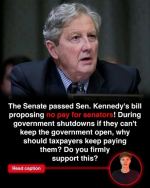
"no pay for senators! During government shutdowns" meme #344

"While it's a step in the right direction it's not likely to have much, if any, effect since the Senators are all wealthy in their own right." S2 #344
If you'll pardon argument by metaphor:
Two different approaches to a roof leak.
a) Place a bucket to catch the drips.
b) Repair the roof.

Your #344 is true enough.
But my perception is less about how to punish senators, than how to prevent the crises.

I've read the U.S. is the only nation on Earth with a "debt ceiling".
It was instituted with the most splendid of intentions, a practical means to restrain congress from flagrant deficit spending.

It doesn't work.
It's not gunna.

Removing the U.S. debt ceiling is long overdue.

The wealth of senators is a serious issue, but a separate issue.
 
Isn't ransom extortion?
I gather the FBI opposes paying ransom, but leaves the final decision to the ones extorted.


If you'll pardon argument by metaphor:
Two different approaches to a roof leak.
a) Place a bucket to catch the drips.
b) Repair the roof.

Your #344 is true enough.
But my perception is less about how to punish senators, than how to prevent the crises.

I've read the U.S. is the only nation on Earth with a "debt ceiling".
It was instituted with the most splendid of intentions, a practical means to restrain congress from flagrant deficit spending.

It doesn't work.
It's not gunna.

Removing the U.S. debt ceiling is long overdue.

The wealth of senators is a serious issue, but a separate issue.

Not sure I agree with removing the debt ceiling?
I look at deficit spending as stealing from our descendants who are the ones who have to pay off our debt.
I do not mind deficit spending in an emergency like war, but otherwise it would seem to be inherently illegal.
 
"Not sure I agree with removing the debt ceiling?" R5 #346
Thanks in part to Trump / Musk / RFKj policy-slashing measures the U.S. federal government is projected to add $2 $Trillion $Dollars to the U.S. federal debt this fiscal year.

It appears we both oppose non-emergency deficit spending. AND !
if the debt ceiling helped to ameliorate such spending I'd be resolutely in favor.

a) The U.S. federal debt ceiling does not work.
b) Instead of solving congress' excessive spending problem, the debt ceiling merely adds an additional problem resulting in costly government shutdowns.

"I look at deficit spending as stealing from our descendants who are the ones who have to pay off our debt." R5 #346
"... everyone's for big government. The American People say we hate big government, but we like our social security and medicare. That's 38% of government right there. The biggest components of government are the most popular components of government."

"What's pernicious about deficits for conservatives is this. It makes big government cheap.
What we're doing, we're turning to the country, the "conservative" administration turns to the country and says: We're going to give you a dollar's worth of government, we're going to charge you seventy five cents for it. And we're going to let your kids pay the other quarter." George Will Nov 30, 2003
By George !

"I do not mind deficit spending in an emergency like war, but otherwise it would seem to be inherently illegal." R5 #346
I consider it stealing from the unborn.
WE determine how THEY spend THEIR money, by spending it for them. On what?
On military fiascos like Trump's Iran stalemate boondoggle, and NASA space adventures.

- hideous -
- disgraceful -
 
Thanks in part to Trump / Musk / RFKj policy-slashing measures the U.S. federal government is projected to add $2 $Trillion $Dollars to the U.S. federal debt this fiscal year.

It appears we both oppose non-emergency deficit spending. AND !
if the debt ceiling helped to ameliorate such spending I'd be resolutely in favor.

a) The U.S. federal debt ceiling does not work.
b) Instead of solving congress' excessive spending problem, the debt ceiling merely adds an additional problem resulting in costly government shutdowns.


By George !


I consider it stealing from the unborn.
WE determine how THEY spend THEIR money, by spending it for them. On what?
On military fiascos like Trump's Iran stalemate boondoggle, and NASA space adventures.

- hideous -
- disgraceful -

While Social Security and Medicare are large, they are self funding, so should not really be considered when one is trying to divide the federal pie.
The term for what is after the mandatory programs like Social Security and Medicare are removed, is discretionary spending.
And the biggest single item that is over 50% of discretionary spending, is the military.
So it seems the "Industrial Military Complex" Eisenhower tried to warn us about, is still in control.
 
While Social Security and Medicare are large, they are self funding, so should not really be considered when one is trying to divide the federal pie.
Agreed. Those programs are supposed to be self-funding but the combined funding shortfall (i.e., the amount by which the promised benefits exceed the trust funds) is in the order of $150 Trillion (yes, that's with a "T")
 
"While Social Security and Medicare are large, they are self funding, so ..." R5 #348
S2 a little bit beat me to it.
Social Security is by treacherous design a monumental curse on the Peoples of the United States.
Social Security might be considered to have direct revenue. BUT !
Regardless of what statute requires, congress has been slushing Social Security revenues into the general treasury.

Compounding that, Social Security is structurally a pyramid scheme. Ask anyone that knows the name Bernie Madoff. Pyramid schemes collapse.
Social Security revenues are premised on a viable labor market, and deficit funding.

We may be careening toward a confluence of synergistic destruction:
- Social Security liabilities extrapolating the trend since inception,
- while the labor market evaporates, workers replaced by more specialized automation in the form of robots, and A.I., and ... ? .
 
Regardless of what statute requires, congress has been slushing Social Security revenues into the general treasury.
It's not quite that simple - given the long tailed nature of Social Security liabilities those funds have to be invested in truly secure funds and US treasuries are the only things that qualify (BTW, when I say the liabilities are "long tailed" I mean they will take decades to pay out - the first Social Security recipient got her first check in 1940 and collected until her death 35 years later. But it's worse than that sounds - someone who starts paying into SS now will be in their early 20's and can expect to live 65 or 70 years more. And even tho they won't collect until they're 65 (or 67) the liabilities being incurred today will remain until they die and stop collecting.

Compounding that, Social Security is structurally a pyramid scheme. Ask anyone that knows the name Bernie Madoff. Pyramid schemes collapse.

Even actuaries have referred to SS as a giant Ponzi scheme - more charitably it's a PAYGO (Pay As You Go) program. The benefits you receive today were paid by the taxes paid by your parents and grandparents. Your taxes will go towards paying the benefits due to your children and grandchildren.

And while there is a trust fund it doesn't come close to being able to pay all the promised benefits.

Shifting gears for a minute - that's one of the reasons the US needs significant numbers of immigrants - there simply aren't enough native born Americans to support the system.
 
Agreed. Those programs are supposed to be self-funding but the combined funding shortfall (i.e., the amount by which the promised benefits exceed the trust funds) is in the order of $150 Trillion (yes, that's with a "T")

Social Security is self funding.
It collects MORE than the 3% interest that it pays out.

There is likely to be a Social Security shortfall eventually, but that is because the large boomer demographic and ICE eliminating immigrant replacements.
But at most the short fall might mean a 10% reduction in SS benefit payments.
Its not like SS would totally go under.
 
S2 a little bit beat me to it.
Social Security is by treacherous design a monumental curse on the Peoples of the United States.
Social Security might be considered to have direct revenue. BUT !
Regardless of what statute requires, congress has been slushing Social Security revenues into the general treasury.

Compounding that, Social Security is structurally a pyramid scheme. Ask anyone that knows the name Bernie Madoff. Pyramid schemes collapse.
Social Security revenues are premised on a viable labor market, and deficit funding.

We may be careening toward a confluence of synergistic destruction:
- Social Security liabilities extrapolating the trend since inception,
- while the labor market evaporates, workers replaced by more specialized automation in the form of robots, and A.I., and ... ? .

There is nothing remotely like a pyramid scheme with Social Security.
Social Security is just what you paid in with only a tiny 3% interest.
If there are tough times, you could eaily forgo the 3% interest and just pay back exactly what was paid in.
It is true congress has been slushing the Social Security revenues into the general treasury in order to pay off the interest on the national debt, but that should not make any difference.
It makes no sense to pay interest on the national debt if you instead can borrow from the Social Security surplus at 0% interest.
So in no way is Social Security a pyramid scheme.
A pyramid scheme is where you only temporarily pay an unreasonable return, like 20%, and Social Security does nothing like that.
 
It's not quite that simple - given the long tailed nature of Social Security liabilities those funds have to be invested in truly secure funds and US treasuries are the only things that qualify (BTW, when I say the liabilities are "long tailed" I mean they will take decades to pay out - the first Social Security recipient got her first check in 1940 and collected until her death 35 years later. But it's worse than that sounds - someone who starts paying into SS now will be in their early 20's and can expect to live 65 or 70 years more. And even tho they won't collect until they're 65 (or 67) the liabilities being incurred today will remain until they die and stop collecting.


Even actuaries have referred to SS as a giant Ponzi scheme - more charitably it's a PAYGO (Pay As You Go) program. The benefits you receive today were paid by the taxes paid by your parents and grandparents. Your taxes will go towards paying the benefits due to your children and grandchildren.

And while there is a trust fund it doesn't come close to being able to pay all the promised benefits.

Shifting gears for a minute - that's one of the reasons the US needs significant numbers of immigrants - there simply aren't enough native born Americans to support the system.

I agree that we would do well to greatly increase immigration.
It is not social security itself that is in such default, but the national debt and the way we have abused Social Security in order to pay down the national debt interest.
 
It is not social security itself that is in such default, but the national debt and the way we have abused Social Security in order to pay down the national debt interest.
It doesn't work that way - those Social Security funds have to be invested somewhere and, because of the long tailed nature of the associated liabilities the only place that's secure enough is US treasuries. So the monies in the Trust Fund are invested in special issue Treasury bills - basically loaned to the Government who will repay the loan (with interest) by redeeming the T-bills at maturity. And the interest on those Social Security funds goes into the SS trust fund. The problem is, the Trust Fund is nowhere near large enough to cover all the promised benefits.


But one thing worth noting - the US government taxes people in order to obtain the monies to fund the trust fund - as I said those monies are then invested in US treasuries but, when it comes time for the government to redeem those treasuries (i.e., repay the loan with interest) they have only one way to obtain the money to do so - more taxes. So people are taxed twice.
 
It doesn't work that way - those Social Security funds have to be invested somewhere and, because of the long tailed nature of the associated liabilities the only place that's secure enough is US treasuries. So the monies in the Trust Fund are invested in special issue Treasury bills - basically loaned to the Government who will repay the loan (with interest) by redeeming the T-bills at maturity. And the interest on those Social Security funds goes into the SS trust fund. The problem is, the Trust Fund is nowhere near large enough to cover all the promised benefits.


But one thing worth noting - the US government taxes people in order to obtain the monies to fund the trust fund - as I said those monies are then invested in US treasuries but, when it comes time for the government to redeem those treasuries (i.e., repay the loan with interest) they have only one way to obtain the money to do so - more taxes. So people are taxed twice.

Simply not true.

First of all, incoming Social Security funds do not "have to be invested somewhere".
They instead could be allowed to just accumulate.
But since we do have a national debt that is accruing interest, it is in our favor to allow that surplus be used to finance the national debt.

But what is really wrong is the claim, "the Trust Fund is nowhere near large enough to cover all the promised benefits."
It most certainly is and always has been.
The outgoing interest on your social security is only about 3% and the incoming interest on T-bills is 5%, so there had never been a significant short fall yet.

It is NOT true, "the US government taxes people in order to obtain the monies to fund the trust fund."
Almost all the money going out from Social Security has almost always come from money being paid in by current worker paycheck SS deductions.

Due to various reasons, a shortfall is predicted, but not until 2032.
And there are lots of possible solutions.

{...

Social Security’s trust fund is projected to be depleted by late 2032, after which benefits would continue but likely at about 78% of scheduled amounts unless Congress acts.

Timeline and Projections​

The Old-Age and Survivors Insurance (OASI) trust fund is expected to run out of reserves in the fourth quarter of 2032, one year earlier than previous estimates due to legislation reducing revenue and demographic shifts such as lower birth rates and immigration numbers CNBCCNBC+2. After depletion, Social Security will still collect payroll taxes and other income, but benefits would be automatically reduced by roughly 22% to match incoming revenue CNBCCNBC+2.
Some earlier reports suggested 2033–2034 as the depletion date, but the 2026 Trustees Report confirms 2032 as the most current projection CNBCCNBC+1. Even after the trust fund is exhausted, Social Security will not disappear, but retirees may receive only a portion of their scheduled benefits, approximately 78% of full benefits CNBCCNBC+2.

Causes of the Shortfall​

Key factors driving the shortfall include:

  • Demographics: The aging population and longer life expectancy increase the number of beneficiaries, while lower birth rates reduce the future worker base 24/7 Wall St.24/7 Wall St.+1.
  • Legislation: Tax cuts and benefit expansions, such as the One Big Beautiful Bill Act and the Social Security Fairness Act, have reduced revenue and increased costs CNBCCNBC+1.
  • Income inequality: A growing share of wages above the taxable cap limits payroll tax revenue, reducing funds available for the trust fund 24/7 Wall St.24/7 Wall St..

Potential Solutions​

Congress has several options to address the shortfall:

  • Increase payroll taxes or raise the taxable wage cap.
  • Reduce benefits through adjustments to the formula or delaying full retirement age.
  • Combination approaches that share the burden between workers and retirees CNBCCNBC+2.
    Historically, Social Security has faced funding crises, such as in 1983, when reforms including raising the retirement age and taxing benefits were implemented to restore solvency
...}


The most obvious solution is to stop protecting high income earners from not having to pay SS on all of their income.
Its is an easy fix.

 
First of all, incoming Social Security funds do not "have to be invested somewhere".
They instead could be allowed to just accumulate.
Stashing those monies in a mattress doesn't do anything - like any pension system SS is counting on the interest to be able to pay the benefits.

But since we do have a national debt that is accruing interest, it is in our favor to allow that surplus be used to finance the national debt.

There is no surplus. Or didn't you read the Trustee's Report I linked above?

But what is really wrong is the claim, "the Trust Fund is nowhere near large enough to cover all the promised benefits."
It most certainly is and always has been.

Guess I shouldn't have wasted my time by taking all those actuarial exams. If you read the Trustees Report you'd know that the Trust Fund is due to be depleted in the relatively near future.

The outgoing interest on your social security is only about 3% and the incoming interest on T-bills is 5%, so there had never been a significant short fall yet.

What do you mean "yet"? Social Security liabilities take a very long time to pay out - a twenty-five year old entering the workforce and retiring at 67 can expect to receive pension payments for 20 or so years after that - so his benefits will end some 60 years from now.
 
Stashing those monies in a mattress doesn't do anything - like any pension system SS is counting on the interest to be able to pay the benefits.


There is no surplus. Or didn't you read the Trustee's Report I linked above?


Guess I shouldn't have wasted my time by taking all those actuarial exams. If you read the Trustees Report you'd know that the Trust Fund is due to be depleted in the relatively near future.


What do you mean "yet"? Social Security liabilities take a very long time to pay out - a twenty-five year old entering the workforce and retiring at 67 can expect to receive pension payments for 20 or so years after that - so his benefits will end some 60 years from now.

There almost always has been a SS surplus.
The Trustee's Report is predicting the first significant shortfall will not happen until 2032, and that can easily be avoided.
There are lots of simple solutions, like allowing more immigration, eliminating the cap on how much income has to pay SS withholding, etc.

SS is a pretty good system, that no only provides for the elderly, but keeps national debt interest the lowest possible.
 
"There is nothing remotely like a pyramid scheme with Social Security." R5 #353
Not only "like" a pyramid scheme. Social Security PRECISELY matches the dictionary definition exactly.

pyramid scheme
n.
A fraudulent moneymaking scheme in which early participants are paid out of money received from later recruits, with the final recruits putting money in and getting nothing back.

The American Heritage® Dictionary of the English Language, Fifth Edition copyright ©2022 by HarperCollins Publishers. All rights reserved.

"A pyramid scheme is where you only temporarily pay an unreasonable return, like 20%, and Social Security does nothing like that." R5 #353
Key words in your assertion / ostensible refutation, "temporarily" & "unreasonable return" do not appear in AHD's ® definition.

Social Security is a pyramid scheme, a Ponzi scam. And a system similar in purpose but substantially different in design could be serving in its stead, with apparent perpetual solvency. Congress has severely sabotaged U.S.
 
Not only "like" a pyramid scheme. Social Security PRECISELY matches the dictionary definition exactly.

pyramid scheme
n.
A fraudulent moneymaking scheme in which early participants are paid out of money received from later recruits, with the final recruits putting money in and getting nothing back.

The American Heritage® Dictionary of the English Language, Fifth Edition copyright ©2022 by HarperCollins Publishers. All rights reserved.


Key words in your assertion / ostensible refutation, "temporarily" & "unreasonable return" do not appear in AHD's ® definition.

Social Security is a pyramid scheme, a Ponzi scam. And a system similar in purpose but substantially different in design could be serving in its stead, with apparent perpetual solvency. Congress has severely sabotaged U.S.

I disagree.
When it says, "early participants are paid out of money received from later recruits, with the final recruits putting money in and getting nothing back."
That means the high returns are only temporary, and that later returns are ZERO.
The original high returns cannot be continued because they are unreasonably high just to motivate more investors.

Since Social Security only pays out only 3% interest, it is not at all unreasonable, unsustainable, and should be perpetually solvent.
The only reason there could be a shortfall in 2032 is that the large Boomer population is all getting SS payouts, while the US has cut immigration, employment, and capped SS taxes so much that there will only be a tiny shortfall for only a few years.
That does not at all condemn the whole SS system.
Removing the cap on the amount of income that has to pay SS would fix it.
 
Back
Top