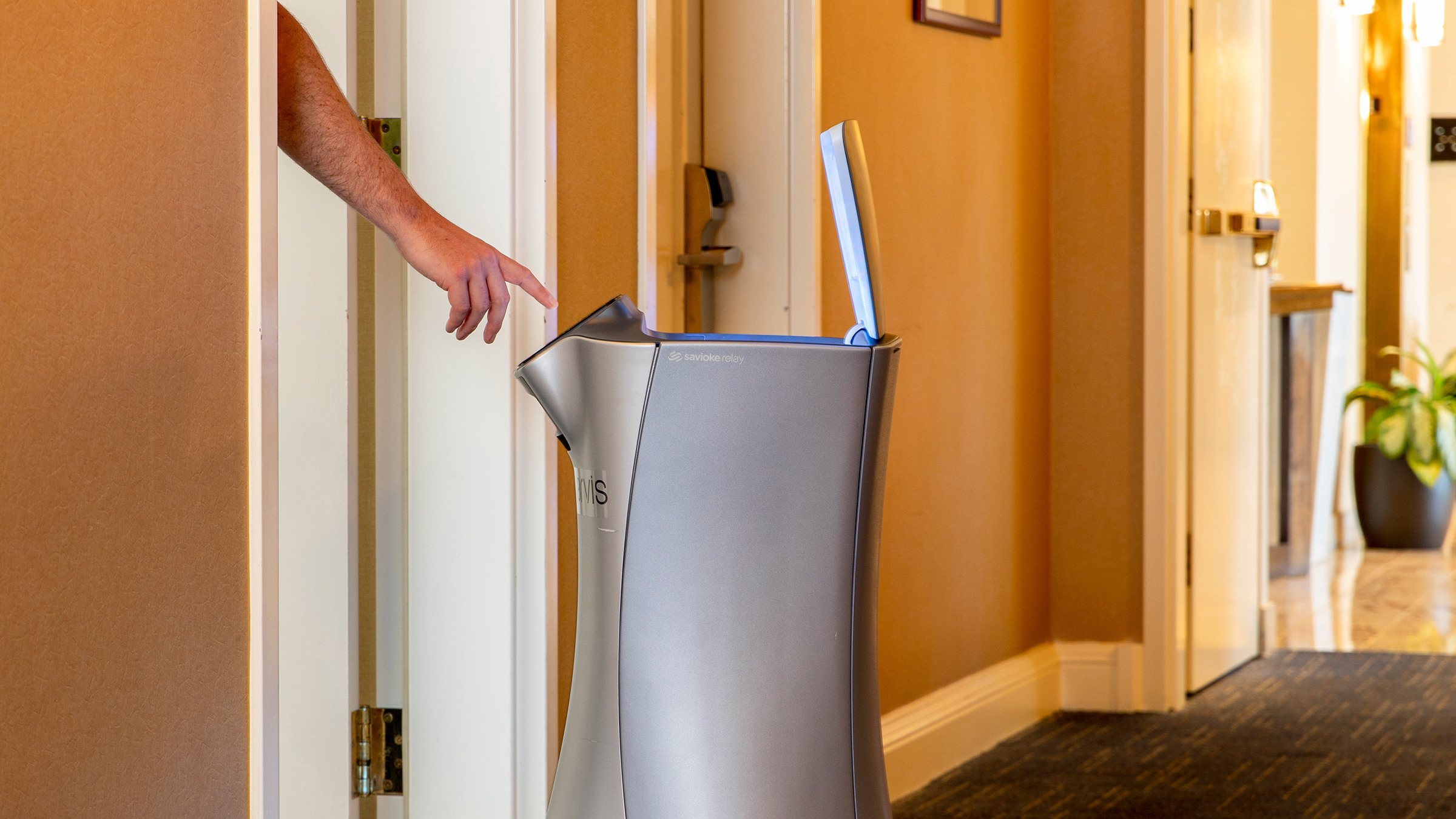
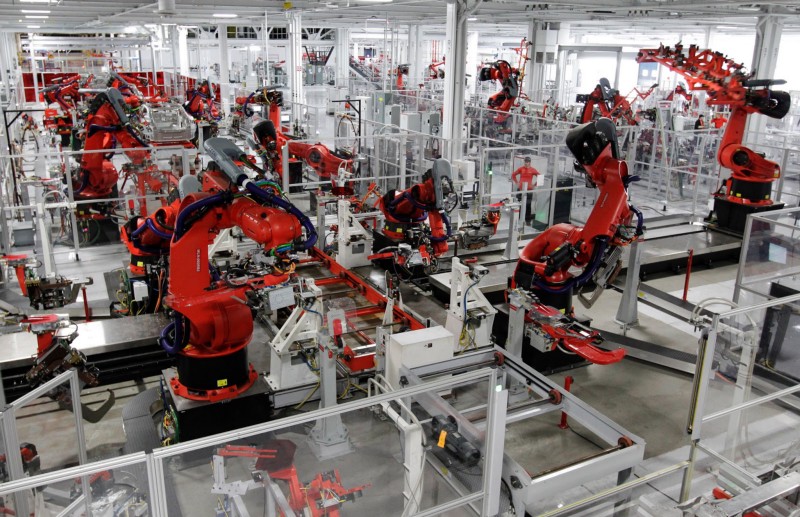
As we switch from jobs being labor to jobs being controlling high tech equipment, the US is going to be left out of the market unless we have free post high school education.
Agreed. Even "burger-flipper" jobs are going the way of the dinosaur. There are now high tech hamburger machines that can produce gourmet quality hamburgers at what sounds like an impossible rate of speed.
Commercial burger machines typically produce between 120 and 400+ burgers per hour, depending on whether they are automated cooking bots or specialized patty-forming machines. High-volume, fully automated cooking robots can create 360–400 burgers per hour, while compact, fast-cooking machines can output over 200 per hour.
So much for those part time and entry level jobs. And yes those machines require someone to run and maintain them but it's not the guy with a high school diploma that used to work on the line in the factory.
This from 2023
Millions of Americans Have Lost Jobs in the Pandemic—And Robots and AI Are Replacing Them Faster Than Ever
The drive to replace humans with machinery is accelerating as companies struggle to avoid workplace infections of COVID-19

time.com
And it's been going on since long before that. This from 2017
Those jobs are gone forever. Let’s gear up for what’s next.
“Generals always fight the last war.” — an old World War II saying Manufacturing jobs were a huge part of America’s post-World War II economic miracle. In the early 1980’s, 20 million Americans worked in factories, assembling consumer products like ...

www.freecodecamp.org
The article goes on to point out that
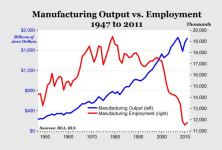
American manufacturing hasn't necessarily declined, In fact it has increased. What has declined is the number of workers required to produce those goods. And that's summed up in this graph
=========================================
And it's not just manufacturing and other jobs we think of as "labor". Thinking back to when my daughter was doing university tours to decide where she wanted to go, one of the schools we visited was the university I had attended as a Masters student. The main library is immense - it's four stories above ground and I honestly don't know how many below ground (I never had a need to go that deep into the place because the math department had it's own library so). In the day you had to find the a book you wanted and then go get it or you could place an order with a librarian and they'd get it for you - pick it up at the front desk the next morning. Now, you go on line, find the book you want, and then you can go immediately to the library and your book will be waiting (even if a student is living in the graduate residences which are less than a five minute walk away). The reason you can do this is simple - there are now robots in the library and those robots will retrieve the requested book from the stacks and deliver it to the front desk. You merely have to sign it out (and you do that by scanning your student card and the bar code inside the book). When you return the book it's scanned back in and replaced on the shelves by a robot. [I'm sure the rare book section doesn't work like this but I doubt you can remove anything from there in any case.]
The library still employs librarians but their role is primarily to answer questions, help students with research, and the like.
=========================================
And it's not just happening in America (or the western world in general). This from the above article
Dongguan — a city near Hong Kong that’s basically the manufacturing capital of the world — recently launched their first automated factory.
The Changying Precision Technology Company manufactures parts for mobile phones. It has 60 robot arms that work on 10 production lines that run 24 hours a day, 7 days a week. Each production line has 3 human workers who monitor the robots.
Before these new robots arrived, the factory needed 650 human workers to be able to operate. Now it just needs 30.
Since this factory laid off 95% of its workers, and handed over the task of manufacturing to the machines, its defect rate has dropped by 400%, and its overall output has nearly tripled.
More production, fewer people.
BTW, those people moaning about wanting more manufacturing to return to America haven't thought it thru. If it does come back those jobs won't be the equivalent of the 650 jobs in that mobile phone company. They'll be equivalent of the 30 that are currently employed. And those jobs won't be accessible to someone whose education stops with high school.
I already mentioned fast food - don't know about wrapping them yet but as I said there are "burger machines" that can produce several hundred gourmet quality burgers in an hour. Far faster (and cheaper) than hiring even part time high school students to do the work. And again, the average high school graduate is not going to be employed servicing those machines.
One of the airports I regularly fly thru has replaced its old style restaurant with counters and the menus are now iPads - you simply enter your order and it's relayed to the cooks (yes there are two people running the grill, one person delivering the food and clearing the counter when you leave, and one other who roams around and helps anyone having difficulty ordering)