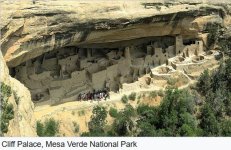
Obituary: ... there they go !

"Very few primitives traveled." R5 #160
"We move toward pleasure, and away from pain." psychologist Joy Browne

cliffDwell.JPG
These guys moved on.
Why?
I suspect it's because some fundamental reason compelled it. Whether that means their water supply dried up,
or their food source fizzled, or ... ?

"The only reason why someone on the "Alone" series had to spend so much time on food is because they were new to the area." R5 #160
That's certainly a contributing factor. The unanswered question: how much of a factor? Whatever else
we know life expectancy has doubled or tripled since we stopped living like that.

 
"We move toward pleasure, and away from pain." psychologist Joy Browne

View attachment 3776
These guys moved on.
Why?
I suspect it's because some fundamental reason compelled it. Whether that means their water supply dried up,
or their food source fizzled, or ... ?


That's certainly a contributing factor. The unanswered question: how much of a factor? Whatever else
we know life expectancy has doubled or tripled since we stopped living like that.


Mesa Verde is proof that native Americans were NOT nomadic.
They clearly lived in one place for over 1000 years.
And that is almost always the case.
It takes time to discover the best locations for a trapline, fishing holes, deer blinds, etc.
Once you do, then it makes no sense to move and throw all that work and information away.
Moving once due to drought or invasion by enemies, is not being nomadic.

The typical false stereotype is the tepee on plains, but that was only AFTER the Euro invasion had displaced over half the native population and forced them onto the Great Plains, which they normally did not populate at all.
That is the same case with almost all the groups the reference claims were no nomadic.
The reality is that almost none of them were nomadic until after Columbus.

As far as life expectancy, the natives actually tended to live longer than we do.
The reason the average life span is lower is actually only due to very high infant mortality, which strongly skews what appears to be the average.
 
Eventually. Probably not with the first square foot to be plowed.
Slash & burn figures in here somewhere, probably mostly before the plow I imagine.


Food insecurity has been a way of life for most of human history, and basically all animal history.
Food security, surplus freed clan leaders for other pursuits, a boon to innovation.


We understand, they didn't leap from gnawing on the remains the wolves left behind, to planting a thousand acres of soy.
Today in the new millennium we can deplete our soil, & recover w/ fertilizer, etc.
The Nile floods, so depleted soils there were naturally replenished.

An agricultural field may be many things, but portable it is not.
They didn't have GPS tractors, so toil in the fields would have been a prominent feature in their daily routine.


The History Channel ran a TV series titled Alone, about survivalists competing to see who could survive in the forest the longest.
One of the many things I learned from this series:
despite the fact each competitor / participant had with him about as much modern gear as he could carry, they rarely got a day off.
They were either attending to their shelter, gathering wood for fuel, hauling water, or otherwise on an almost perpetual hunt for food.
When such primitive living was an individual's only option life was difficult, dangerous, and short.


It's easier to stay than to go.
You know that.
I know that.
They knew that.

So we can deduce, nomads traveled for a reason.
Such reasons may include soil depletion. When the area they occupied simply couldn't feed their population, they'd move on. No huge sacrifice. They didn't live in mansions. They lived in huts.

Actually primitives tended to not live in huts.
It was much more efficient for them to live in large communal lodges.
They then shared large kitchen kivas and cooked meals communally.
It is highly inefficient for each family to do their own individual cooking and fires.
In places like Mesa Verde or Chaco Canyon, there were hundreds of families living there, but there were less than half a dozen kivas for cooking.
 
Back
Top