What to call this thread?

And in Virginia

1793826792663.png

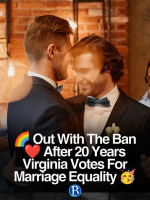
In 2006, Virginia voters wrote a gay marriage ban into their constitution.

Twenty years later, voters have chosen to replace it with marriage equality.

That’s a powerful anniversary present.

Virginians have approved Question 2, removing the old ban and adding constitutional protections for lawful marriages between two adults regardless of sex, gender or race.

Same-sex couples can already marry in Virginia.

But the language excluding them was still there in the state’s constitution, long after courts made it unenforceable.

Now it will be replaced with an explicit promise of equal treatment.

The amendment takes effect January 1, 2027, strengthening state protections amid concerns about the future of federal marriage rights.

For gay men who remember the marriage-ban campaigns of the 2000s, this is more than a change of wording.

It’s watching voters reconsider what families like theirs deserve.

Twenty years of husbands, anniversaries, shared homes and ordinary life.

And now a constitution that makes room for them.

SOURCE with comments
 
"Virginia Votes For Marriage Equality" #2,101
Atta girl Ginny !

note:
Seems sad in the 3rd millennium we're reduced to including these among our victories.
ARTICLE 6. 2
This Constitution ... shall be the supreme Law of the Land; and the Judges in every State shall be bound thereby, any Thing in the Constitution or Laws of any State to the Contrary notwithstanding.
And?
ARTICLE #14: Ratified July 9, 1868
SECTION1. No State shall ... deny to any person within its jurisdiction the equal protection of the laws."
Seems clear enough.
It knit?
 
CNN
Supreme Court prepared to rule that publicly funded religious schools can reject children of same-sex couples
John Fritze, CNN Tue, November 3, 2026 at 2:22 PM GMT-5
The U.S. Supreme Court in Washington, D.C., U.S., June 25, 2026 - Elizabeth Frantz/Reuters
A majority of the Supreme Court signaled on Tuesday it would allow Catholic preschools receiving taxpayer money to deny enrollment to children of same-sex couples, potentially delivering another significant win for religious rights in schools.
Broadly, the case represents a clash between First Amendment religious protections and laws intended to protect gay and transgender Americans from discrimination. When those conflicts have come to the Supreme Court in recent years, religious claims have won time after time. And there was no indication over the course of two hours of an Election


PU !
 
"#2,103 - just another case of the Supremes ruling based on personal religious beliefs rather than the law." S2 #2,104
I consider it a conspicuous outright betrayal.

Such discrimination is obviously not permitted in U.S. "public" schools, "public" being a euphemism for "government".

Why?

Public schools, government schools are government funded.
If a school is "receiving taxpayer money" (the wording in #2,103) is it not obliged to conform to the same standards other publicly funded schools do?

:mad: S2 #2,103
☑️
If they've sworn to uphold the Constitution, such ruling perjures that oath. Right?
 
If they've sworn to uphold the Constitution, such ruling perjures that oath. Right?
They did the same with Roe v Wade - during their confirmation hearings they all said (under oath) that it was "settled law" and not up for debate but as soon as they had a chance .....
 
Re #2,107

That reminds me - when a neighbor asked how to keep the rabbits away from their tomato plants one of the solutions was "coyote pee" - you can find it in the sporting goods section where it's used as a lure.
 
1794057376831.png

The officer opened the bedroom door without knocking. It triggered a Supreme Court gay rights case that took decades to fix. He was standing inside a private home in Atlanta, Georgia. The date was August 3, 1982. The resident had no idea a police officer was inside the house.

It was August 1982. Michael Hardwick was twenty-nine. He worked at a local bar and kept to himself. Weeks earlier, he received a citation for carrying an open beer bottle outside a club. He missed his court date by a few hours. He went to the courthouse and paid the fifty-dollar fine. The clerk processed the payment. A warrant for his arrest had already been generated. Nobody canceled it.

This minor administrative error would eventually become the defining Supreme Court gay rights case of its era.

Officer Keith Torick arrived at the Virginia Avenue house that morning with the expired warrant. A houseguest was asleep on the living room couch. Torick woke him. The guest pointed toward the back hallway, indicating where Michael was sleeping.

The bedroom door was slightly ajar. Torick walked down the hall. He did not announce his presence. He pushed the door wide open. Morning light spilled across the room. Michael was in bed with another man.

The officer stood in the doorway. He watched the two men in complete silence for nearly a minute. He then pulled out his handcuffs and informed them they were under arrest. The charge was not the unpaid ticket. It was a violation of the Georgia anti-sodomy law. A felony carrying up to twenty years in prison.

At the time, the Georgia statute did not technically single out same-sex couples. The written law criminalized specific private acts regardless of gender or marital status. Arrest records from the 1980s show the statute was almost exclusively enforced to search, harass, and arrest gay men, effectively making their private existence illegal.

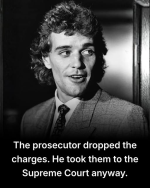
The district attorney reviewed the arrest report. He decided not to present the felony charge to a grand jury. The charges were dropped. The system expected Michael to walk away. That was how the institutional mechanism functioned. Police would intimidate and arrest, then prosecutors would drop the charges before anyone could challenge the law in front of a judge.

Michael did not walk away. He filed a federal lawsuit against the state of Georgia. The petition demanded the law answer for itself in the case that became known as Bowers v. Hardwick. He put his full name on the public filing. The local papers printed it immediately. He forced the court to look at the law directly.

The legal battle consumed four years. Michael struggled under the extreme public pressure. He drank heavily to cope with the stress. Employment became difficult to maintain. He retreated from the public eye, terrified of the intense exposure and physical threats. The case reached Washington in 1986. Michael stayed away from the oral arguments. The Supreme Court ruled against him in a 5-4 decision. The majority opinion called the idea of a fundamental right to homosexual conduct facetious. They upheld the law.

The system relied on people walking away quietly. He refused to walk away.

Michael died in 1991 at age thirty-eight. He did not live to see the correction. In 2003, the Supreme Court struck down all remaining anti-sodomy laws nationwide in Lawrence v. Texas. The justices explicitly cited the 1986 defeat as a failure of the court. Lewis Powell, the justice who cast the deciding swing vote against Michael, admitted on record four years later that he made a mistake. The Georgia law is gone. The house on Virginia Avenue where the officer walked in was eventually sold. Other people live there now.

Michael Hardwick: the man who absorbed the defeat so others could win.

Source: Michael Hardwick's 1982 arrest records and ACLU case files.

Verified via: The National Archives (Bowers v. Hardwick Supreme Court records), Library of Congress.

(Some details summarized for brevity.)

SOURCE with comments
 
Back
Top