Shiftless2
Well-known member
There are 10 types of people in the world. Those who understand binary and those who don't .....
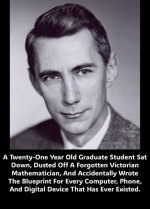
August 10, 1937. Massachusetts Institute of Technology.
A twenty-one year old submitted his master's thesis in electrical engineering. The title was dry and technical and almost aggressively forgettable. Nobody outside the department paid any attention. It was just another graduate student completing another degree requirement.
That thesis would become the foundation of the entire digital age.
His name was Claude Shannon. He had grown up in Gaylord, Michigan, a small town where he built model planes, tinkered with radios, and delivered telegraph messages for Western Union as a teenager. He loved puzzles. He loved taking things apart to understand how they worked. He loved the elegance of mathematics the way some people love music.
In college, he took a philosophy course on symbolic logic and encountered the work of George Boole, a nineteenth century English mathematician who had developed a system of algebra built entirely on true and false, yes and no, one and zero. Boole had died in 1864. His ideas had been sitting largely unused for nearly a century. Most people considered Boolean algebra interesting theoretical mathematics, beautiful perhaps, but utterly impractical. A curiosity with no real world application.
Shannon looked at it and saw something nobody else had seen.
Electrical circuits operate the same way. A switch is either ....
CONTINUED with comments
August 10, 1937. Massachusetts Institute of Technology.
A twenty-one year old submitted his master's thesis in electrical engineering. The title was dry and technical and almost aggressively forgettable. Nobody outside the department paid any attention. It was just another graduate student completing another degree requirement.
That thesis would become the foundation of the entire digital age.
His name was Claude Shannon. He had grown up in Gaylord, Michigan, a small town where he built model planes, tinkered with radios, and delivered telegraph messages for Western Union as a teenager. He loved puzzles. He loved taking things apart to understand how they worked. He loved the elegance of mathematics the way some people love music.
In college, he took a philosophy course on symbolic logic and encountered the work of George Boole, a nineteenth century English mathematician who had developed a system of algebra built entirely on true and false, yes and no, one and zero. Boole had died in 1864. His ideas had been sitting largely unused for nearly a century. Most people considered Boolean algebra interesting theoretical mathematics, beautiful perhaps, but utterly impractical. A curiosity with no real world application.
Shannon looked at it and saw something nobody else had seen.
Electrical circuits operate the same way. A switch is either ....
CONTINUED with comments