Shiftless2
Well-known member
That still doesn't explain what your claim that "schools are too oppressive, demeaning, and dictatorial" have to do with him shooting up a school (that he wasn't attending).

That still doesn't explain what your claim that "schools are too oppressive, demeaning, and dictatorial" have to do with him shooting up a school (that he wasn't attending).
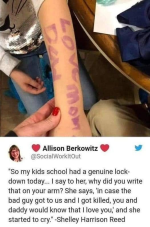

"So there is also that sense of injustice, that might actually be better described as envy?" R5 #302
That story is potentially far more complicated than it superficially appears."From 2 years ago" S2 #303
jeal·ous (jĕləs)
adj.
1. Fearful or wary of losing one's position or situation to someone else ...
Usage Note: Traditional usage holds that we are jealous when we fear losing something that is important to us and envious when we desire that which someone else has. In this view, one might experience jealousy upon seeing one's spouse flirt with another (because of the fear of losing the spouse), while one might experience envy upon seeing a friend with an attractive date (because of one's desire to have an attractive date of one's own). In common usage, this distinction is not always observed, and jealousy and jealous are often used in situations that involve envy. Our 2015 survey shows that the distinction is alive and well: large majorities of the Usage Panel approved the traditional uses of jealousy (She was jealous when she saw her husband having dinner with another woman) and envy (He was envious of the expensive sports car his neighbor bought), while only a minority accepted the switched uses: 29 percent accepted envious for the suspicious dinner, and 34 percent accepted jealous for the expensive sports car. The last figure does mean, though, that a third of the Panelists accept jealous meaning "envious," and an even larger minority (43 percent) accept it when the entity being coveted is a person rather than an object, as in Never having been popular myself, I'm jealous of your many friends. It is evident from these results that many careful writers prefer to see the distinction between the two words maintained, with jealous being reserved for situations where one fears losing something and envious used for situations where one wants what one does not have.
The American Heritage® Dictionary of the English Language, Fifth Edition copyright ©2022 by HarperCollins Publishers. All rights reserved.
That story is potentially far more complicated than it superficially appears.
Stockholm Syndrome for obvious example.
None the less, with a minimum of inference, it's a grim reflection on the childhood we provide.
There are so many potential causes. Surely contaminated food / air / water must be among them."The increase in irrational violence, such as schools shootings, road rage, presidents illegally attacking other countries, etc., make one wonder if we have contaminated the food chain with chemicals that are mentally destabilizing.?" R5 #305
There are so many potential causes. Surely contaminated food / air / water must be among them.
Also on the list in my opinion, sociological differences.
A stone-age clan member would know each individual in his own clan,
and would innately understand he has a reputation to protect.
It's an entirely different story in a 3rd millennium metropolis.
A.I. facial recognition might help nail them on a murder charge.
But fleet-footed purse snatchers may have low risk of consequence.
But other countries have those same violent movies and they don't have the gun problem that the US does.Of course one possibility is that violent movies may have desensitized us into ever greater degrees of actual violence?
I have virtually no formal ed. on this, but w/ decades of applied statistics seems to me exceedingly implausible that among a population of hundreds of millions, it wouldn't affect some. But,"Of course one possibility is that violent movies may have desensitized us into ever greater degrees of actual violence?" R5 #307
This Cavett quotation is not a metaphysical certitude. It's a quip. It's worth integrating into the broader analysis, but not determinative on its own.There's so much comedy on television. Does that cause comedy in the streets? --Dick Cavett, mocking the TV-violence debate
Switzerland is a common example."But other countries have those same violent movies and they don't have the gun problem that the US does." S2 #308
Switzerland has compulsory military service for able-bodied men, and conscripts are traditionally issued a service weapon that they keep at home. It is not a requirement for every household to own a gun, and soldiers can choose to store their weapons in army depots instead. While owning and storing guns at home is common, carrying them in public is heavily restricted and requires a separate carrying permit.Switzerland is a common example.
We should avoid over-simplification here.
Guns may seem to be an obvious determining factor. Not necessarily.
There may be other elements of culture which both distinguish U.S. from them, and
cause the carnage here, and not there.
But other countries have those same violent movies and they don't have the gun problem that the US does.
Interesting way to start my AM, thanks x 2.
I have virtually no formal ed. on this, but w/ decades of applied statistics seems to me exceedingly implausible that among a population of hundreds of millions, it wouldn't affect some. But,
may promote violence among one population subset, simultaneously discouraging it within another.
If so it's a quibble of what the net affect is. I'm not sure we can accurately generalize about that, as our standards seem to meander over the decades, the generations.
This Cavett quotation is not a metaphysical certitude. It's a quip. It's worth integrating into the broader analysis, but not determinative on its own.
"Copy-cat" crime, the obvious example here. Some police departments have reported a crime or M.O. introduced via entertainment TV or newspaper report
resulting in similar crime soon thereafter.
Switzerland is a common example.
We should avoid over-simplification here.
Guns may seem to be an obvious determining factor. Not necessarily.
There may be other elements of culture which both distinguish U.S. from them, and
cause the carnage here, and not there.
That may include such seemingly otherwise innocuous factors as how the homeless are treated,
whether a citizen in trouble naturally believes society can be a benefit to them, or an antagonist.
Will government find them a resting place in a homeless shelter, or a jail cell?
Switzerland has compulsory military service for able-bodied men, and conscripts are traditionally issued a service weapon that they keep at home. It is not a requirement for every household to own a gun, and soldiers can choose to store their weapons in army depots instead. While owning and storing guns at home is common, carrying them in public is heavily restricted and requires a separate carrying permit.
And the culture is very different in other ways - the Swiss are generally very law abiding - cross against a red light, even when there are no cars in sight, and you will get a lot of weird looks. And so forth.
I'd agree, at least to a point.But then the point is that it is not the presence of guns that makes the US so dangerous.
Two things come to mind (using Canada as an example)There is something else that make people so prone to using the guns.
They wouldn't have anyone to shoot?Second is that it puts soldiers, police, hunters, and security guards out of work.
They wouldn't have anyone to shoot?
S2 #317
For most of its history the British "bobby" did not carry a firearm.R5 #318
For most of its history the British "bobby" did not carry a firearm.
A nickname for a British policeman is a bobby, after Sir Robert (Bobby) Peel, who founded Britain’s Metropolitan Police Force in 1829, provoking complaints about the infringement of civil liberties. The first patrolmen wore a blue uniform (to distinguish them from the military who wore red) with a top hat. They also carried a 20-in (51-cm) truncheon (club) for protection, and a rattle for attracting attention—rattles were replaced with whistles in 1886, after experiments showed that whistles could be heard from a much greater distance. The first two bobbies—William Atkinson and William Alcock, holders of Warrants Number one and two— were fired on the first and second day of the force’s existence for being drunk. https://www.merriam-webster.com/dictionary/bobby
"whistles" !
