
You are using an out of date browser. It may not display this or other websites correctly.
You should upgrade or use an alternative browser.
You should upgrade or use an alternative browser.
Below The Fold ...
- Thread starter sear
- Start date


North Korean IT workers are stealing remote jobs and raking in billions—and Americans are helping them do it
Amanda Gerut / Sat, April 25, 2026 at 6:02 AM GMT-5The North Korean IT worker scheme, in which operatives get remote tech jobs at U.S. and European companies, is an important part of a broad campaign of malfeasance by the Democratic People’s Republic of Korea (DPRK) that has generated about $2.8 billion in the past two years to help fund the country’s nuclear weapon ambitions, according to the UN’s Multilateral Sanctions Monitoring Committee. The committee, which tracks DPRK sanctions violations and evasion tactics, revealed in January that the scheme has now victimized 40 countries around the globe. A large portion of that total is the result of crypto theft, but the IT worker scheme reliably generates $250 million to $600 million per year in fraudulent salaries, the UN has found.

North Korean IT workers are stealing remote jobs and raking in billions—and Americans are helping them do it
“North Korean IT worker schemes would not be successful without U.S.-based facilitators,” wrote Assistant Attorney General John Eisenberg in an April sentencing memo.
Shiftless2
Well-known member
The greatest athlete you've probably never heard of
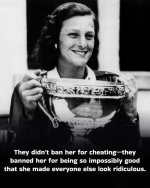
They didn't ban her for cheating—they banned her for being so impossibly good that she made everyone else look ridiculous.
Los Angeles, 1932. The Olympics. Twenty-one-year-old Mildred "Babe" Didrikson showed up to compete in track and field. Women were limited to just three events, so Babe chose strategically: javelin, 80-meter hurdles, and high jump.
She didn't just win. She obliterated the competition.
Gold in javelin. Threw 143 feet, 4 inches. World record.
Gold in the 80-meter hurdles. Ran it in 11.7 seconds. World record—breaking her own time from earlier that same day.
In the high jump, she cleared a height no woman had ever reached. Another world record.
Then officials disqualified her for diving over the bar headfirst instead of feet-first—a technique now standard but considered "improper" for ladies in 1932.
They gave her silver instead.
Babe looked at them and said: "I'd have gone higher if you'd let me."
But here's what made Babe Didrikson legendary: she wasn't just the best female athlete of her time. She became the only athlete ever—male or female—to win individual Olympic medals in separate running, throwing, and jumping events.
Think about that. Not just the best woman. The only human. Ever.
Born in 1911 in Port Arthur, Texas to Norwegian immigrant parents, Babe grew up poor. Her mother had been a ....
CONTINUED with comments
They didn't ban her for cheating—they banned her for being so impossibly good that she made everyone else look ridiculous.
Los Angeles, 1932. The Olympics. Twenty-one-year-old Mildred "Babe" Didrikson showed up to compete in track and field. Women were limited to just three events, so Babe chose strategically: javelin, 80-meter hurdles, and high jump.
She didn't just win. She obliterated the competition.
Gold in javelin. Threw 143 feet, 4 inches. World record.
Gold in the 80-meter hurdles. Ran it in 11.7 seconds. World record—breaking her own time from earlier that same day.
In the high jump, she cleared a height no woman had ever reached. Another world record.
Then officials disqualified her for diving over the bar headfirst instead of feet-first—a technique now standard but considered "improper" for ladies in 1932.
They gave her silver instead.
Babe looked at them and said: "I'd have gone higher if you'd let me."
But here's what made Babe Didrikson legendary: she wasn't just the best female athlete of her time. She became the only athlete ever—male or female—to win individual Olympic medals in separate running, throwing, and jumping events.
Think about that. Not just the best woman. The only human. Ever.
Born in 1911 in Port Arthur, Texas to Norwegian immigrant parents, Babe grew up poor. Her mother had been a ....
CONTINUED with comments
Shiftless2
Well-known member
This doesn't really fit anyplace else

"'I'll get it next year.' She was 15, had just won bronze at her first world championships, and instead of celebrating, she made a promise. One year later, she kept it. Five years later, at 20, she became the youngest American wrestler—male or female—to ever win Olympic gold, undefeated the entire time, outscoring opponents 375‑19. The Olympics told her she was one day too young. She spent the next five years proving that age was never the real limit."
Amit Elor was born on January 1, 2004. By the time the Tokyo Olympics rolled around in 2021, she was 17—but the age cutoff for wrestling was December 31. One single day separated her from a shot at the Games. Most athletes would be crushed. Amit simply went straight to work. She had started wrestling at four, tagging along to her older brother's practice in Walnut Creek, California, and begging to step on the mat. She beat the boys, and coaches told her to take it easy on them. She internalized their critiques, believing for years she wasn't good at wrestling—even as she kept winning.
In 2019, at 15, she won bronze at the Under‑17 World Championships. Instead of basking in the medal, she told reporters, "I'll get it next year." She wasn't making excuses; she was making a promise. The next year she won gold without giving up a single point. She hasn't lost since. Over the next three years, she piled up eight world championships across every division—junior, under‑23, senior, even beach wrestling. At 18, she became the youngest American wrestler to win a senior world title. All while grappling with personal loss: her brother Oshry was murdered in 2018; her father died in 2022. "I've had a lot of traumatic experiences," she said. "But I've learned to compartmentalize, to focus on the present." The mat became her sanctuary, her place of control.
Heading into the 2024 Paris Olympics, she faced one last obstacle: dropping nearly nine pounds to compete at 68kg, a weight class added to the Olympic program instead of her usual 72kg. Most wrestlers would struggle. Amit made it look easy. In Paris, she bulldozed through the bracket: the 2023 world champion, 10‑2; the Polish contender, 8‑0; a North Korean opponent dispatched in 1 minute and 44 seconds, 10‑0. In the gold medal match, she faced a two‑time Olympic medalist from Kyrgyzstan and controlled every second, winning 3‑0.
When the final whistle blew, Amit Elor became the youngest American wrestler—male or female—to ever win Olympic gold. She draped the American flag over her shoulders and skipped around the mat, a child's joy on an Olympic champion's face. "I'm still in disbelief," she said. "I think I have a little bit of impostor syndrome. I still feel like that little kid who just started wrestling, but I just became an Olympic champion." That little kid who coaches doubted. That teenager who promised she'd get it next year. That young woman who missed the Olympics by one day. She didn't just get it. She got everything.
"'I still feel like that little kid who just started wrestling, but I just became an Olympic champion.' She was told she was one day too young. So she spent five years making sure no one could ever count her out again. Age isn't the limit. The limit is the one you refuse to accept."
"'I'll get it next year.' She was 15, had just won bronze at her first world championships, and instead of celebrating, she made a promise. One year later, she kept it. Five years later, at 20, she became the youngest American wrestler—male or female—to ever win Olympic gold, undefeated the entire time, outscoring opponents 375‑19. The Olympics told her she was one day too young. She spent the next five years proving that age was never the real limit."
Amit Elor was born on January 1, 2004. By the time the Tokyo Olympics rolled around in 2021, she was 17—but the age cutoff for wrestling was December 31. One single day separated her from a shot at the Games. Most athletes would be crushed. Amit simply went straight to work. She had started wrestling at four, tagging along to her older brother's practice in Walnut Creek, California, and begging to step on the mat. She beat the boys, and coaches told her to take it easy on them. She internalized their critiques, believing for years she wasn't good at wrestling—even as she kept winning.
In 2019, at 15, she won bronze at the Under‑17 World Championships. Instead of basking in the medal, she told reporters, "I'll get it next year." She wasn't making excuses; she was making a promise. The next year she won gold without giving up a single point. She hasn't lost since. Over the next three years, she piled up eight world championships across every division—junior, under‑23, senior, even beach wrestling. At 18, she became the youngest American wrestler to win a senior world title. All while grappling with personal loss: her brother Oshry was murdered in 2018; her father died in 2022. "I've had a lot of traumatic experiences," she said. "But I've learned to compartmentalize, to focus on the present." The mat became her sanctuary, her place of control.
Heading into the 2024 Paris Olympics, she faced one last obstacle: dropping nearly nine pounds to compete at 68kg, a weight class added to the Olympic program instead of her usual 72kg. Most wrestlers would struggle. Amit made it look easy. In Paris, she bulldozed through the bracket: the 2023 world champion, 10‑2; the Polish contender, 8‑0; a North Korean opponent dispatched in 1 minute and 44 seconds, 10‑0. In the gold medal match, she faced a two‑time Olympic medalist from Kyrgyzstan and controlled every second, winning 3‑0.
When the final whistle blew, Amit Elor became the youngest American wrestler—male or female—to ever win Olympic gold. She draped the American flag over her shoulders and skipped around the mat, a child's joy on an Olympic champion's face. "I'm still in disbelief," she said. "I think I have a little bit of impostor syndrome. I still feel like that little kid who just started wrestling, but I just became an Olympic champion." That little kid who coaches doubted. That teenager who promised she'd get it next year. That young woman who missed the Olympics by one day. She didn't just get it. She got everything.
"'I still feel like that little kid who just started wrestling, but I just became an Olympic champion.' She was told she was one day too young. So she spent five years making sure no one could ever count her out again. Age isn't the limit. The limit is the one you refuse to accept."
"You're never beaten unless you quit." CNN founder Ted Turner"The limit is the one you refuse to accept." #264 - no link
Shiftless2
Well-known member
Re #264
Have to admit I haven't seen anyone trying to claim that she's trans because of her muscles.
Have to admit I haven't seen anyone trying to claim that she's trans because of her muscles.
Laymen may tend to misapprehend overlapping bell-curves.Re #264
"Have to admit I haven't seen anyone trying to claim that she's trans because of her muscles." S2 #266
Generally men may have upper body strength superior to women, the central tendency. BUT !
The strongest woman is surely stronger than the weakest man, opposite six sigma fringes. AND !
It's not like she vanquished Hulk Hogan. She's beating up "girls".
Shiftless2
Well-known member

Shiftless2
Well-known member
Indiana Lieutenant Governor Micah Beckwith is facing backlash after criticizing a Westfield High School percussion performance, calling it “demonic” and urging families to leave public schools.
The show, based on classical music including Carmen and Boléro, has been widely defended by the community, with educators and arts organizations praising the students’ work.

 www.facebook.com
The show, based on classical music including Carmen and Boléro, has been widely defended by the community, with educators and arts organizations praising the students’ work.
Indiana Lieutenant Governor Micah Beckwith is facing backlash after criticizing a Westfield High School percussion performance, calling it “demonic” and urging families to leave public schools. The show, based on classical music including Carmen an
Indiana Lieutenant Governor Micah Beckwith is facing backlash after criticizing a Westfield High School percussion performance, calling it “demonic” and urging families to leave public schools. The...
www.facebook.com
Shiftless2
Well-known member

Shiftless2
Well-known member

... back in the good ol' days, when we were a nation of immigrants ..."... so we can't chance it." #271
xe·no·pho·bi·a (zē′nə-fōbēə, zĕn′ə-)
n.
Fear of, hatred of, mistrust of, or contempt for that which is foreign, especially strangers or people from different countries or cultures.
Usage Note:
Xenophobia has long had two acceptable pronunciations: the traditional pronunciation with a short e in the first syllable, and a variant with a long e. In our 2015 survey, the Usage Panel overwhelmingly found both forms to be acceptable. Slightly more Panelists (55 percent as compared to 45 percent) use the long-e pronunciation in their own speech.
The American Heritage® Dictionary of the English Language, Fifth Edition copyright ©2022 by HarperCollins Publishers. All rights reserved.
Mother charged with involuntary manslaughter over teen son's alleged e-motorcycle crash
By Meredith DelisoMay 1, 2026, 7:46 PM
Mother charged after teen son allegedly hits veteran, 81, while riding e-motorcycle A mother has been arrested and charged with child endangerment
&
involuntary manslaughter after her 14-year-old child allegedly hit an 81-year-old veteran while doing wheelies on an e-motorcycle and the man later died, officials said Friday.
The victim, an 81-year-old veteran, died two weeks after the crash.

Mother charged with involuntary manslaughter over teen son's alleged e-motorcycle crash
Ed Ashman, 81, was struck by an e-motorcycle while walking home from his substitute teaching job in Lake Forest, according to prosecutors.
 abcnews.com
Not to advocate for parental irresponsibility, but an inquiry.
Where should the line be drawn?
If the scenario was nearly identical, but the cycle was a bicycle, and not an e-motorcycle?
If a 14 year old child is not old enough to obtain a driver's license for a gasoline fueled motorcycle, is there a reason it was legal for this 14 year old to operate this e-motorcycle in public?
Shiftless2
Well-known member

Shiftless2
Well-known member

He was not supposed to be there.
February 4, 2014. The Creation Museum in Petersburg, Kentucky, was packed wall-to-wall with people who had come to watch a man they considered a fraud be publicly dismantled.
Bill Nye—the bow-tied engineer who had taught a generation of children that science was magic wrapped in evidence—stepped onto a stage designed to prove him wrong. Around him, dinosaurs stood in dioramas next to humans, displays proclaimed Earth was six thousand years old, and exhibits argued that science without scripture was just arrogance dressed in lab coats.
For over two hours, he would face Ken Ham, the museum's founder, in a debate watched by millions worldwide. But this was never really about the age of rocks or the evolution of species.
This was about whether we still believe that evidence matters more than the volume at which someone shouts their opinion.
And it was about whether one person, standing calmly in a room full of skeptics, could remind us that defending truth is not optional—it is the only thing standing between civilization and chaos.
BEFORE THE BOW TIE
Long before the television cameras and the Emmy Awards, Bill Nye was ....
CONTINUED with comments
Shiftless2
Well-known member
You don't get rich writing science fiction. If you want to get rich, you start a religion. ~ L. Ron Hubbard

How an 18-Year-Old TikToker’s Scientology “Run” Inspired a Trend — and Why He Says It’s Gone Too Far
The creator, who calls himself Swhileyy, wants the copycats to stop: “I just did it because I thought it was funny … They should not have done that shit.”

How an 18-Year-Old TikToker’s Scientology “Run” Inspired a Trend — and Why He Says It’s Gone Too Far
The creator, who calls himself Swhileyy, wants the copycats to stop: “I just did it because I thought it was funny … They should not have done that shit.”www.hollywoodreporter.com
Gen Z turns on classic snacks, forcing major grocery shake-up: 'They don't trust them'
About 35% of parents buying snacks for Gen Alpha kids say they prioritize natural ingredients
By Deirdre Bardolf Fox News / Published May 4, 2026 8:00am EDTAmerica's snack habits are getting a makeover — with Gen Z and Gen Alpha leading the charge.
The snack aisle at the grocery store may be looking a little different as younger consumers reshape demand, favoring snacks with simpler ingredients, more nutritional benefits and lower upfront costs, according to NielsenIQ data.
Thirty-five percent of parents who are buying snacks for their households with Gen Alpha kids born after 2010 say they prioritize natural ingredients, while 34% are actively seeking high-protein options, according to NielsenIQ data reported by the National Association of Convenience Stores (NACS).
"The baseline for Gen Alpha is a better product," said Chris Costagli, vice president of thought leadership at NielsenIQ, according to the NACS.
"It's a cleaner product. It's a more transparent product."

Gen Z turns on classic snacks, forcing major grocery shake-up: 'They don't trust them'
Younger consumers are driving snack trends toward simpler ingredients, transparency and smaller pack sizes amid inflation concerns and a hunger for "functional" snacks.
 www.foxnews.com
Dr. Carlton Fredericks offered such insights as: if you can't pronounce it you shouldn't eat it, and
if bacteria are smart enough to not eat it, you should be too.
If the expiration date on your food extends beyond the life expectancy of your pet, you may wish to reevaluate your larder.
BOOMERS LOVED IT, GEN Z WON'T TOUCH IT: WHY CEREAL IS NO LONGER A BREAKFAST STAPLE
Shiftless2
Well-known member
Good idea .....

Shiftless2
Well-known member

Shiftless2
Well-known member
It's okay Grandpa .... it's time to go back to the home
 www.facebook.com
1M views · 24K reactions | 3 times Donald Trump was asked a simple question about his demands for compensation from the DOJ and he still couldn’t comprehend it! #truth #Corruption #accountability #MentalHealth #america #politics #UnitedStates #usa #
3 times Donald Trump was asked a simple question about his demands for compensation from the DOJ and he still couldn’t comprehend it! #truth #Corruption #accountability #MentalHealth #america...
www.facebook.com