You are using an out of date browser. It may not display this or other websites correctly.
You should upgrade or use an alternative browser.
You should upgrade or use an alternative browser.
The Second Term of Donald J. Trump as President of the United States of America
- Thread starter sear
- Start date
Shiftless2
Well-known member
Trump-o-nomics at work ....

Shiftless2
Well-known member
It's been a weird week

 www.facebook.com
97K views · 6.2K reactions | The Oscars were Prescient #marchmadness #war #oscars #sinners #iran #StraitOfHormuz #eidmubarak #ramadan #eid #onebattleafteranother #ncaa #dhs #ice #gas #oil #groceries #president #politics #funny #jokes #reels #cleanc
The Oscars were Prescient #marchmadness #war #oscars #sinners #iran #StraitOfHormuz #eidmubarak #ramadan #eid #onebattleafteranother #ncaa #dhs #ice #gas #oil #groceries #president #politics #funny...
www.facebook.com

"It's been a weird week" S2 #2,943
“Toto, I have a feeling we’re not in Kansas anymore.” Dorothy the witch slayer
ya think ?!
I do not understand why economic sanctions on civilian goods are allowed?
They clearly are war crimes, in violation of the Geneva Conventions.
It's true that starvation is a common tactic in war, like we did to Germany in WWI and Japan in WWII, but without a war, there seems to be no excuse?
And technically starvation strategy is illegal even in war.
They clearly are war crimes, in violation of the Geneva Conventions.
It's true that starvation is a common tactic in war, like we did to Germany in WWI and Japan in WWII, but without a war, there seems to be no excuse?
And technically starvation strategy is illegal even in war.
You get an "A" in humanitarianism."I do not understand why economic sanctions on civilian goods are allowed?" R5 #2,945
Blame Niccolò Machiavelli.
"They clearly are war crimes, in violation of the Geneva Conventions." R5 #2,945
I haven't reviewed the wording.
But I suspect a confluence of factors.
For example, starving a populace is bad.
Is dropping bombs on them an improvement?
Some nations that might otherwise object / protest may resist the temptation to do so, for the purpose of reserving for themselves that very option, should it seem to work to their advantage in the unforeseen future.
Shiftless2
Well-known member
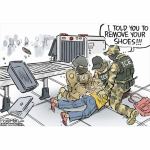
Trump administration scrambles to deploy ICE agents at airports as lines mount
Story by Erin Mulvaney, Michelle Hackman, Siobhan Hughes, Allison PohleImmigration and Customs Enforcement officers will begin trying to ease bottlenecks at airports on Monday, as the Trump administration scrambles to develop a plan to end hourslong security lines amid a partial government shutdown.
President Trump said in several social-media posts over the weekend that ICE agents would help at airports if a deal wasn’t reached by Congress to fund the Department of Homeland Security. His first post Saturday came as a surprise to officials inside ICE and at DHS, who have spent the weekend trying to figure out how it could work, according to three people familiar with the matter.
White House border czar Tom Homan said in an interview with CNN on Sunday that ICE officials could monitor exit lanes to make sure people don’t enter through them, or check identification before passengers enter the screening area to free up officers to move customers through the lines with body scans and X-rays.
“We’re trying to release TSA resources to get to positions that they really need expertise in, like ....
Immigration and Customs Enforcement officers will begin trying to ease bottlenecks at airports on Monday, as the Trump administration scrambles to develop a plan to end hourslong security lines amid a partial government shutdown.
President Trump said in several social-media posts over the weekend that ICE agents would help at airports if a deal wasn’t reached by Congress to fund the Department of Homeland Security. His first post Saturday came as a surprise to officials inside ICE and at DHS, who have spent the weekend trying to figure out how it could work, according to three people familiar with the matter.
White House border czar Tom Homan said in an interview with CNN on Sunday that ICE officials could monitor exit lanes to make sure people don’t enter through them, or check identification before passengers enter the screening area to free up officers to move customers through the lines with body scans and X-rays.
“We’re trying to release TSA resources to get to positions that they really need expertise in, like
================================================
As the article points out,
Before the Sept. 11, 2001, terrorist attacks, private-sector contractors handled most airport-security screenings. Those responsibilities were largely brought under federal oversight after the TSA was established in 2001.
ICE officers aren’t trained in aviation security and putting untrained officers at checkpoints creates a security gap rather than filling one, said Everett Kelley, national president of the American Federation of Government Employees in a statement issued Sunday. TSA officers “deserve to be paid, not replaced by untrained, armed agents who have shown how dangerous they can be,” Kelley said.
partial cross-post @ https://citizenvoice.us/threads/what-to-call-this-thread.253/page-73 #1,455
"In the fevered state of our country, no good can ever result from any attempt to set one of these fiery zealots to rights, either in factor principle.
They are determined as to the facts they will believe, and the opinions on which they will act.
Get by them, therefore, as you would by an angry bull; it is not for a man of sense to dispute the road with such an animal."
Thomas Jefferson (1743-1826), U.S. president. Letter, 24 Nov. 1808, to his grandson, Thomas Jefferson Randolph
Shiftless2
Well-known member
This may make matters worse."Trump administration scrambles to deploy ICE agents at airports as lines mount" S2 #2,947
TSA and ICE are two separate agencies, with two different missions.
Potentially, by slapping this metaphorical band-aid on Trump's second shutdown of his 2nd administration,
it may extend the shutdown, by making it less intolerable.
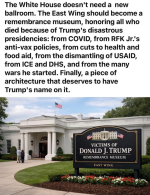
a) True."The White House doesn't need a new ballroom. ..." #2,949
b) Irrelevant. The white house East wing that served many presidential administrations well has been demolished, and along with it the history it embodied
The former white house East wing is rubble.
It's gone.
The tenuous Silver lining in this enormous dark and prevailing Trump storm-cloud is just how critically dependent the U.S. presidency is
upon superlative good character, intrinsic reflexive presidential commitment to constructive outcomes.
For a quarter millennium it may have seemed we didn't need duplicative safeguards, suspenders & a belt U.S. federal politics.
The administrations of President Donald J. Trump make it impossible for objective observers to deny,
additional safeguards to limit executive power, to restore co-equality to our three branch federal government are desperately needed.
Regardless of pro- vs con- rhetoric, President Trump has unmistakably proved the previously adequate "checks & balances" between our
3 branches of federal government have been breached.
Being aware of this stunning, potentially cataclysmic deficiency is not an implemented solution,
though recognition of a problem is generally an essential component of permanent solution.
We have a lot of very difficult and delicate political re-engineering to do.
It is difficult to imagine how it can be satisfactorily accomplished without bipartisan cooperation.
This glaring, vivid red flailing MAGA warning flag is potentially high on the list of President Trump's most constructive contributions.
"Opportunity knocks" BUT !!
"You have to open the door!"
inspired by the expression: "Every grey cloud has a silver lining."
Shiftless2
Well-known member
Shiftless2
Well-known member

Shiftless2
Well-known member
Shiftless2
Well-known member
Kash Patel Under Fire: White House Defends Trump as Scrutiny Over Classified Files Heats Up |
The Whitehouse has launched a sharp public rebuke of Kash Patel amid ongoing controversy over the handling of classified documents and U.S. strategy in the Iran war. Critics have connected Patel’s leadership at the Federal Bureau of Investigation with a series of high‑profile personnel decisions involving agents tied to investigations into President Donald Trump’s retention of classified materials at his Mar‑a‑Lago estate—moves that occurred just days before major military action in Iran and drew alarm from national security experts.Lawmakers and commentariats have raised concerns about Patel’s firings of FBI personnel involved in such probes, labeling them politically motivated and potentially undermining critical counterintelligence capabilities. These personnel, some experienced in tracking Iranian threats, were dismissed after being accused of improper conduct in their handling of Trump’s classified documents case—an investigation connected to federal scrutiny of mishandled government records.
The mounting backlash highlights broader tensions between the administration’s approach to classified information oversight and national security priorities during an active conflict. As debates continue over both Trump’s document retention and Patel’s leadership decisions, Whitehouse critics argue these controversies are undermining public trust in federal law enforcement and strategic clarity amid the Iran war.
Observers say the “Kash” controversy added fuel to an already tense hearing, sparking debates over accountability, professionalism, and the balance of power in government oversight.
Shiftless2
Well-known member

Shiftless2
Well-known member
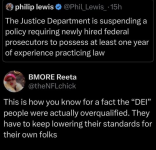
DOJ suspends minimum experience requirements for hiring attorneys after staff purges
Lawyers fresh out of law school can begin working for the DOJ so long as they are a U.S. citizen and have passed the bar exam
 www.the-independent.com
Shiftless2
Well-known member


Shiftless2
Well-known member
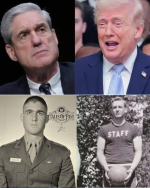
"Two men, born two years apart, raised in privilege, educated in private schools. One dodged the draft five times and built an empire on debt and branding. The other volunteered for Vietnam, graduated from Ranger School, was wounded in combat, and carried a fellow soldier to safety under enemy fire. When that soldier later investigated the first man, the man couldn't stop talking about the soldier's 'conflicts of interest.' The truth was simpler: he couldn't stand being measured against a man who had already measured himself."
Donald Trump and Robert Mueller were born into wealthy families, attended elite private schools, and came of age during the Vietnam War. When the war called, Mueller enlisted in the Marine Corps, graduated from Officer Candidate School, then volunteered for Ranger School. In Vietnam, he led a rifle platoon, was wounded in action, and received a Bronze Star with Valor for pulling a wounded Marine to safety under heavy enemy fire. Trump, by contrast, received five student and medical deferments—including one for bone spurs—and never served.
Decades later, when Mueller was appointed Special Counsel to investigate Russian interference in the 2016 election, the contrast between the two men became a prism for the national divide. Trump repeatedly attacked Mueller's credibility, called the investigation a "witch hunt," and questioned the integrity of a man who had spent a lifetime in service to his country. The subtext was always there: Trump resented a man whose life embodied the discipline, sacrifice, and duty that Trump had avoided.
Mueller's investigation did not find criminal conspiracy between the Trump campaign and Russia, but it detailed extensive obstruction of justice and left the question of accountability to Congress. Trump was impeached twice, but never convicted. Mueller returned to private life, rarely speaking publicly. The contrast between the two men remains a quiet commentary on the nature of leadership, service, and what America asks of its sons.
"One man served his country in war, was wounded, and carried a brother to safety. The other used family connections to stay home. When history measured them, it wasn't the medals that mattered—it was the moment each man chose, and what that choice said about everything that came after."
SOURCE with comments